Os voy a contar algo que me hace mucha ilusión. 💜
Hoy @elespanolcom ha contado mi historia. Pero más allá de la historia, hay algo que he construido yo misma y que de verdad quiero enseñaros.
Soy ingeniera y tengo un cáncer de mama muy raro. En vez de quedarme quieta, hice lo único que sé hacer: ponerme a construir. Con IA he creado una herramienta que dibuja en 3D mis metástasis y ayuda a decidir dónde biopsiar, qué lesión da el mejor material para acertar con el tratamiento que me puede dar más vida.
Y lo más fuerte: no es una idea guardada en un cajón. El equipo de oncólogos de Zúrich que lleva mi caso ya la está usando para tomar esa decisión.
Para mí esto es lo que debería ser la IA en medicina: no quitarle el sitio al médico, sino darle mejores ojos para decidir. Y si me sirve a mí, ojalá sirva a más personas con tumores raros a las que nadie da respuesta.
🔬 La herramienta: https://t.co/oLL6Nipxoc
🗞️ Mi historia en El Español: https://t.co/EmautZrHee
Si os toca algo, compartidlo. Cada persona que lo ve ayuda de verdad. Gracias por estar siempre ahí. 💜
En el hilo turras de hoy, y continuando con el arco sobre educación, hoy le toca el turno a un proyecto completamente acorde con nuestra naturaleza de académicos / doers / CPSers : Nuestra propia respuesta a los problemas en la escuela del hilo anterior. Al turrón.
Estuve en Suiza y había un debate político en mi cantón:
¿Debe el servicio municipal subir la tasa y recoger las basuras a diario, o es mejor congelar la tasa y seguir recogiendo los residuos en días alternos?
Había un debate —un cruce de argumentos—, una reflexión y una opinión en cada casa.
Me gustaría que el debate político en mi país fuese así. Una reflexión serena sobre nuestros retos colectivos. Pero, ¿qué ocupa los diarios y las conversaciones?
Que una exministra ha sido condenada por insultar a un juez. Que un ministro llevaba prostitutas a sus viajes oficiales. Que un expresidente ocultaba una fortuna en joyas de dudoso origen. Que un ministro está siendo juzgado por utilizar a la Policía para obstruir investigaciones judiciales. Que un diputado amañaba contratos públicos. Que la familia del primer ministro está sentada en el banquillo. Que asesores, comisionistas y tipos carcelarios campan e influyen en los poderes del Estado. Que los diputados —que habrían de ser para todos ejemplo de rectitud— utilizan nuestras lenguas, nuestra historia y nuestra diversidad no para celebrarlas sino para enfrentarnos a los unos contra los otros.
En este cenagal, cada cual toma su patético bando. «Los míos». «Los tuyos». «A favor». «En contra». Y los medios —inclusive los públicos— azuzan esta reyerta que, como un cáncer, está concomiendo mi país.
¿Cómo soportar este nauseabundo hedor en que se ha convertido el debate público? ¿Cómo podría alguien honesto querer implicarse en algo así?
Puedo aceptar que nos gobiernen mediocres, si son rectos. Pero cada caso es una herida. Cada noticia lacera el espejismo menguante de la ilusión que me gustaría sentir por mi país.
Quisiera tener líderes con grandes valores, aunque no sean exactamente los míos. Instituciones que, al frente, tienen hombres y mujeres respetables y elevados de espíritu. Quisiera no leer los insultos y las zafiedades que a menudo encuentro por aquí en la boca de las más altas magistraturas del Estado y la soberanía nacional. Quisiera ver la ética por encima de las ideologías.
Pero siento tristeza.
« L’islam a 700 ans de moins que le christianisme et vit sa période inquisitoire. Est-ce que l’inquisition chrétienne est défendable ? Non. Eh bien l’islam inquisitoire ne l’est pas non plus. J’ai entendu que moi et mon Persepolis étions aussi islamophobes. Alors que j’ai vécu sous la dictature religieuse. Qu’ils ont exécuté une bonne partie de ma famille. Sans compter ceux qui étaient “juste” torturés. Quelle phobie ? Je n’aime pas l’islam politique comme n’importe quelle personne saine d’esprit. »
Marjane Satrapi, mars 2026
@le_Parisien
Cambiar de vida a los 60 años: ¿locura o valentía? Descubre la reflexión sobre la crisis, el optimismo y la literatura de este autor. Un análisis imperdible. #Libros#Reflexion#CambioDeVida Action:click the link https://t.co/feSt6S2c15 below
En el hilo turras de hoy, y continuando con el arco sobre educación, hoy le toca el turno a dos cosas: Como encaja infantil/primaria/secundaria en toda esta fiesta y por qué es la etapa más importante. Al turrón.
A Chicago philosopher wrote one book in 1940 proving that 95% of the books you have read in your life, you didn't actually read, and Charlie Munger has been telling people to read it for 50 years.
His name was Mortimer Adler.
He spent 40 years at the University of Chicago, ran the editorial board of the Encyclopædia Britannica, and built his entire career on one uncomfortable observation about the people around him.
Most adults who called themselves well-read had not actually read a book in the real sense even once. They had run their eyes over the pages, registered the words, formed a vague impression, and put it back on the shelf.
The book had passed through them without ever entering them.
In 1940 he wrote How to Read a Book. It has stayed in print for 86 years.
Charlie Munger recommends it. Naval Ravikant recommends it. Fareed Zakaria recommends it.
Every serious thinker who builds a career on absorbing information eventually finds their way to this book, and the reason is that Adler had isolated something nobody else was naming clearly.
There are four levels of reading. Almost everyone is stuck on the second one. The fourth level is so different from what most people call reading that you have probably never done it in your entire life.
Level one is elementary.
You learn it as a child. You decode the letters into words and the words into sentences. You finish the sentence and understand roughly what it said. This is reading the way a 7-year-old reads, and almost every adult on earth has stopped developing past this point in some quiet way.
Level two is inspectional.
This is skimming. You move through a book quickly to figure out what it is broadly about. You read the back cover, scan the table of contents, glance at a few paragraphs, and form an opinion. Most adults who claim to have read 50 books a year are actually doing this. They are inspecting books, not reading them. They walk away with a vague sense of the argument and almost none of the evidence that supports it.
Level three is analytical.
This is the level Adler said most people have never properly experienced. You take one book and you wrestle with it for as long as it takes. You identify the question the author is trying to answer. You map their argument from front to back. You write your disagreements in the margins. You force yourself to articulate, in your own words, what the author is claiming and why. The point is not to finish the book. The point is to argue with it as if the author were sitting across the table from you. Most people never do this once in their life, because it is exhausting and slow and feels nothing like the reading they were taught as children.
Level four is the one almost nobody knows exists. Adler called it syntopical reading. The word means "across topics," and the technique is something closer to running a small private research lab in your own head.
You pick a single question that actually matters to you. How does power corrupt people. Why do civilizations collapse. What makes a marriage last. How does a person change their own mind. Then you assemble five or ten or twenty books from different authors, different centuries, different traditions, all of them taking a swing at the same question.
You do not read any of them cover to cover. You move between them. You find the chapter in book three that addresses the same question as the chapter in book seven. You force those two authors to argue with each other inside your own head.
The book stops being the unit of reading. The question becomes the unit. And the authors become voices in a conversation you are now hosting.
This is the level where reading stops being consumption and starts being construction.
You are no longer absorbing what someone else thinks. You are building a position of your own out of the friction between people who disagreed.
Adler argued that this is the only level of reading where you stop being a passive receiver of other people's ideas and start being someone who can produce ideas of their own.
The reason Charlie Munger has been recommending this book for 50 years is that this is exactly how Munger has always thought. He calls it building a latticework of mental models. The technique he is describing is just syntopical reading applied for a lifetime.
You take the strongest insight from psychology, the strongest insight from biology, the strongest insight from economics, and you stack them against the same problem until something new falls out the bottom.
The reason most people never reach level four is not that it is intellectually difficult. It is that it is logistically uncomfortable. It requires you to keep multiple books open at once.
It requires you to take notes that nobody is going to grade. It requires you to abandon the goal of finishing books and replace it with the goal of answering questions.
This is also why AI just changed everything Adler was teaching.
NotebookLM, Claude, and tools like them let you do syntopical reading at a speed that would have looked like magic to a Chicago philosopher in 1940.
You upload 10 books on the same question. You ask the AI to surface every place those authors agree and every place they contradict each other.
The technique Adler said almost nobody on earth had reached can now be run on a Sunday afternoon by anyone with a laptop and one good question.
The technique was always the unlock. The bottleneck used to be time. The bottleneck is now curiosity.
Most people will keep reading the way they always have. A book at a time. Eyes over the pages. No question driving it. No other authors in the room. Adler called that level two for a reason.
You are not behind on your reading list.
You are behind on the level you are reading at.
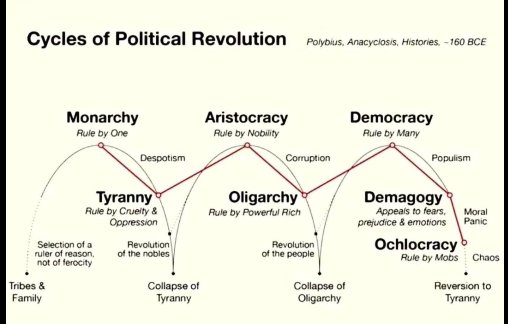
LA CONDICIÓN POLÍTICA
Polibio.
Sobre cómo evoluciona el gobierno y organización de sistemas humanos complejos.
En mi opinión y experiencia, aplica tanto para política privada como para política pública.
Formulado hace 2200 años 👇
In Auschwitz, my mother taught me three rules.
Not stories. Not prayers. Rules. The kind that kept you alive.
Rule one: Never make eye contact with a guard.
Rule two: Never show that you are sick.
Rule three: Never, ever, lose your bowl.
I was five years old. I memorized them the way other children memorize nursery rhymes.
The bowl was a small tin thing. Dented. Scratched. It held whatever thin soup they gave us once a day. If you lost your bowl, you had no bowl. If you had no bowl, you had no ration. If you had no ration, you understand.
I guarded that bowl with everything I had. I slept with it. I held it against my chest during roll call. I knew where it was every second of every day.
Then one morning, I fell into the latrine.
There is no delicate way to say this. The latrines in Auschwitz were wooden boards with holes cut into them over a pit. The holes were large. I was very small. I was in a hurry. I slipped.
I went in up to my neck.
The smell. The cold. The rats. I do not need to describe it. Your mind already knows.
My mother tried to pull me out. She could not. I was slippery and she had no strength. None of us had strength. We had not eaten properly in months. She called out. Other women came. Together they pulled me free. Someone found a hose. They sprayed me down in the cold air while I stood there shaking.
I did not cry. Rule number one in Auschwitz was the same rule everywhere, do not attract attention.
But I got sick. Very sick. The kind of sick that comes from rats and filth and cold water and a body that has nothing left to fight with.
And I remembered Rule Two, never show that you are sick.
I hid it from everyone. From the guards. From the other children. Even from my mother, because I knew if she knew, she would do something. And doing something in Auschwitz got you killed.
But someone saw. I do not know who. I do not know why they helped me instead of reporting me. I never knew.
They took me to a room, a makeshift hospital. I lay in a bed, a real bed, not a wooden bunk, for the first time since we had arrived.
I do not remember much of what happened next. The fever blurred everything. Days passed like smoke.
When I came out, I still had my bowl.
I had held it even in the latrine. Even in the fever. Even in the dark when I did not know where I was or what day it was.
My mother looked at me when I came back. She looked at the bowl. She did not say anything. She just nodded, the way she nodded when something had gone the way it needed to go.
People ask me what survival looks like.
I tell them, sometimes it looks like a five year old girl climbing out of a latrine in a death camp, covered in filth, shaking with cold, still holding her tin bowl.
Because she knew that the bowl was the difference between eating and not eating. Between living and not.
Because her mother had told her. And she had listened.
I am Tova Friedman. I fell into a latrine in Auschwitz at five years old.
I came out still holding my bowl.
Tova.
#NeverForget #Survival #DaughterOfAuschwitz #ShesStillHere #TheirNamesLiveOn
Falacias de la justicia social
Thomas Sowell
★★★★☆ (4/5)
Hay libros que intentan tranquilizar al lector confirmándole todo aquello que ya sospechaba. Y hay otros que funcionan como una corriente de aire frío entrando por una ventana mal cerrada. "Falacias de la justicia social", de Thomas Sowell, pertenece claramente a esta segunda categoría. No porque tenga razón en todo (no la tiene), sino porque obliga a revisar muchas intuiciones políticas y morales que suelen darse por sentadas sin demasiada inspección intelectual.
Sowell escribe como alguien que desconfía profundamente de las abstracciones morales cuando estas se desligan de los incentivos, de la economía real y del comportamiento humano. Su tesis de fondo podría resumirse así: muchas políticas concebidas para ayudar a los más desfavorecidos terminan perjudicándolos precisamente porque ignoran cómo reaccionan las personas a las restricciones y recompensas del entorno. No analiza la sociedad como una fotografía inmóvil, sino como un ecosistema de agentes adaptativos que cambian de conducta cuando cambian las reglas.
Uno de los aspectos más interesantes del libro es precisamente esa mirada sistémica. Sowell insiste en que las buenas intenciones no bastan para producir buenos resultados. Y pone ejemplos incómodos. Por ejemplo, recuerda que en 1948 apenas existían diferencias significativas en las tasas de desempleo juvenil entre negros y blancos en Estados Unidos, a pesar de que el racismo social era mucho más explícito que décadas después. Según su interpretación, las posteriores subidas del salario mínimo habrían expulsado del mercado laboral a muchos jóvenes con menor formación o experiencia, generando diferencias raciales de desempleo mucho más pronunciadas. Es decir, una política concebida como protección habría terminado funcionando, para algunos colectivos, como una barrera de entrada.
El argumento puede incomodar a muchos porque desplaza el foco desde las intenciones morales hacia los mecanismos. Sowell viene a decir algo parecido a esto: la realidad no negocia con nuestros deseos. Y ese es probablemente el núcleo filosófico del libro.
También resulta provocador su análisis sobre la discriminación. En lugar de presentar el mercado como una maquinaria inherentemente racista, sostiene algo más paradójico: discriminar suele resultar más costoso en mercados competitivos que en estructuras protegidas o financiadas con dinero ajeno. Una empresa privada que rechaza talento por prejuicio paga un precio económico directo. En cambio, un organismo público o una institución blindada frente a la competencia puede permitirse discriminaciones más prolongadas porque el coste se socializa entre contribuyentes o usuarios cautivos. Sowell recuerda, por ejemplo, que antes de la Segunda Guerra Mundial apenas había profesores negros en universidades blancas sin ánimo de lucro, mientras cientos de químicos negros trabajaban ya en industrias privadas competitivas.
Es una idea intelectualmente estimulante porque invierte parte del relato habitual. Y aunque uno no comparta todas sus conclusiones, el libro obliga a hacerse preguntas que rara vez aparecen en ciertos discursos políticos contemporáneos: ¿qué ocurre cuando una política altera incentivos básicos?, ¿puede una medida moralmente atractiva generar efectos secundarios destructivos?, ¿hasta qué punto confundimos desigualdad con injusticia?, ¿y cuánto de nuestra visión política nace de analizar sistemas complejos como si fueran mecanismos simples y lineales?
El problema del libro es también una consecuencia de su propia fuerza. Sowell tiene tendencia a escribir como un fiscal brillante más que como un juez equilibrado. Sus ejemplos están muy bien escogidos para reforzar su tesis, pero a veces da la sensación de que otras variables desaparecen demasiado deprisa del encuadre. Hay momentos en los que el argumento parece avanzar con la contundencia de una locomotora intelectual que rara vez se detiene a explorar zonas grises, matices culturales o dimensiones psicológicas menos economicistas.
Aun así, el libro posee una virtud cada vez más escasa, que es trata al lector como a un adulto capaz de tolerar ideas incómodas. No ofrece sedantes ideológicos. Tampoco frases motivacionales disfrazadas de pensamiento político. Lo que propone es algo más exigente, que es observar la sociedad como un sistema complejo donde las consecuencias indirectas importan tanto o más que las intenciones declaradas.
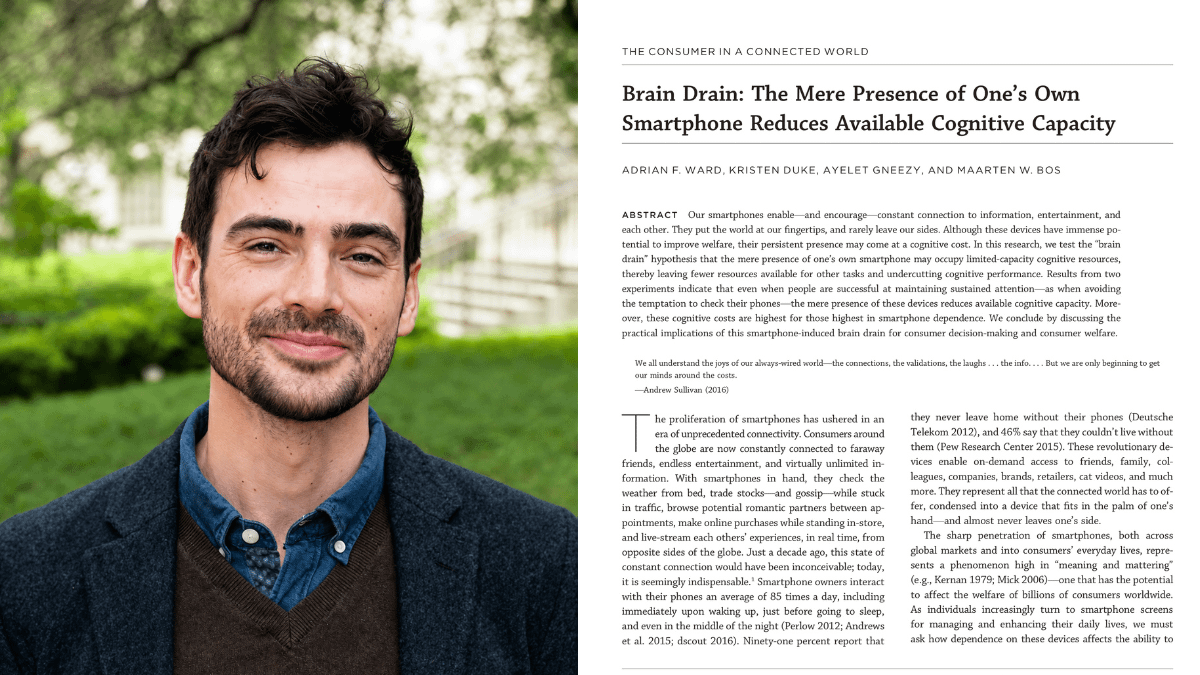
A marketing professor at the University of Texas ran an experiment that found the phone on your desk was quietly pulling down your performance on hard cognitive tasks even when it was face-down, silent, and completely powered off. Most of the people in his own study refused to believe him.
His name is Adrian Ward.
He teaches marketing at the McCombs School of Business at the University of Texas at Austin. He studies the cognitive cost of a device most of us never put down.
The paper that opened the conversation came out in 2017, in the Journal of the Association for Consumer Research. The title is "Brain Drain: The Mere Presence of One's Own Smartphone Reduces Available Cognitive Capacity." He wrote it with Kristen Duke, Ayelet Gneezy, and Maarten Bos.
The setup was almost unfair in how simple it was.
They brought in 548 undergraduates, sat each one at a computer, and split them into three groups.
One group left their phone in another room.
One kept it in a pocket or bag.
One placed it face-down on the desk.
Every phone, in every group, was on silent. Ring off. Vibrate off. No notifications. Just the device.
Then everyone took two of the harder cognitive tests psychologists use. The Operation Span task, which measures working memory, the mental scratchpad you use to hold and shuffle information in real time. And a 10-item subset of Raven's Progressive Matrices, which measures fluid intelligence, the raw horsepower behind solving a problem you have never seen before.
The results did not wobble.
The students who left their phones in another room beat the students whose phones were on the desk. The pocket group sat in between. Desk to pocket-or-bag to other-room. A clean linear slope. F(2, 513) = 6.07, p = .002.
Then Ward did the part that should be on a billboard.
In a second experiment, with 296 new participants, he added a power condition. Half left their phones on. Half were told to turn them completely off. Not silent. Not airplane mode. Off. Black screen. Dead device.
It did not matter.
The drain was identical. The main effect of phone power came back at F(1, 263) = .05, p = .83. A powered-off phone on your desk hurt working memory exactly as much as a powered-on one. The brick of glass did not need to do anything. It just needed to be there. The other-room group still beat the desk group on working memory by a mean difference of 4.67 points, p = .008.
Here is the line that should haunt you.
When the researchers asked participants afterward whether the phone's location had affected their performance, 75.9 percent said not at all. They were sure of it. They felt fine. They felt focused.
The numbers said otherwise.
And the heavier users took the cleaner hit. The interaction between self-reported smartphone dependence and phone location came in at F(2, 247) = 3.25, p = .04. The more you feel you need your phone, the more its mere presence costs you when it is near you. The dependence is not a side effect. The dependence is the mechanism.
Ward's explanation is the part that lives in your body once you read it.
Your brain has a finite pool of attention. When something in your environment is meaningful, conditioned, personal, your brain spends energy not looking at it. Not picking it up. Not checking it. That inhibition is not free. It is paid for in the same currency you need for whatever is in front of you.
In his words: "resources recruited to inhibit automatic attention to one's phone are made unavailable for other tasks, and performance on these tasks will suffer."
You are not multitasking. You are paying rent.
The follow-up evidence has only gotten heavier. A 2023 meta-analysis in Behavioral Sciences pooled the literature and confirmed a significant overall negative effect of smartphone presence on cognition, strongest for memory. And in 2025, Ward and his co-authors published a preregistered randomized controlled trial in PNAS Nexus. They had 467 adults install an app that blocked all mobile internet on their phones for two weeks. Mental health improved. Subjective well-being improved. Objectively measured sustained attention improved. 90.7 percent of participants got better on at least one of the three. The attention gain alone was equivalent to reversing roughly ten years of age-related decline.
So here is the part where it stops being about Adrian Ward and starts being about you.
You have been blaming yourself for the wrong thing.
You think you cannot focus because you have no discipline. Because you are weak. Because the algorithm broke your brain. Some of that may be true. The experiment says something quieter and more brutal.
You cannot focus because the device is still in the room with you.
Face-down does not work. Silent does not work. Powered-off does not work. Willpower is not the variable. Distance is the variable.
The students who walked their phones into another room did not have more discipline than the students who left them on the desk. They had more meters.
That is the whole study, in one sentence.
Put it in another room.
Not in your pocket. Not in your drawer. Not face-down behind your monitor. In another room, behind a closed door, far enough that getting it is a decision instead of a reflex.
You will not feel smarter. The participants did not either.
You will just be smarter.
En el hilo turras de hoy, siguiendo con el arco sobre educación, vamos a hablar de las tensiones a las se encuentra sometido el sistema educativo y su relación con el tejido empresarial a raíz de la aparición de la IA.
je me demande sincèrement si vous mesurez l'ampleur du massacre cognitif silencieux qu'on est en train d'assister collectivement
une génération entière déjà fragile cognitivement transfère ce qui restait de sa pensée à chatgpt pour 20 euros par mois et appelle ça une révolution, le pire c'est que ces gens publient des threads dont ils ne maîtrisent ni le contenu ni les sources, incapables de distinguer le réel de l'hallucination dans ce que le modèle leur sort et ils inondent le débat public avec des fake news bien tournées qui circulent uniquement parce que la forme est léchée
c'est exactement ça l'illusion du savoir au 21e siècle, des phrases parfaitement structurées sur la forme et complètement vides sur le fond, des gens qui croient avoir une opinion alors qu'ils ont juste impressionné une audience pendant 10 secondes avec du langage cosmétique généré par une machine qu'ils utilisent sans rien comprendre et le drame c'est qu'eux-mêmes finissent par croire qu'ils pensent réellement parce que le texte sort en français correct alors que leur cerveau a juste sous-traité l'opération cognitive la plus précieuse de l'humanité qui est de structurer une pensée
perso j’ai envie de dire ce qu’ils croient gagner en clarté ils le perdent en profondeur mais ce qu'ils ne réalisent pas c'est que la capacité à structurer sa propre pensée EST JUSTEMENT l'accès au savoir, c'est ce qui permet d'articuler ses idées, de déconstruire les dogmes de remonter aux premiers principes et de démonter les arguments des autres avec précision, sous traiter cette compétence à un LLM c'est exactement comme sous traiter sa propre digestion à une machine, vous ne nourrissez plus votre cerveau vous nourrissez juste l'illusion d'avoir mangé
la question terrifiante que personne pose c'est quelle sera la valeur économique d'un humain en 2035 dont le cortex a passé 10 ans à attendre que la machine finisse sa pensée et pour moi le calcul est implacable, quand 4 milliards de personnes ont accès à la même intelligence pour 20 euros par mois la seule prime de valeur portera sur les humains qui ont gardé un cortex capable de produire du signal original
et sachez que ce type de cortex se construit avec 15 ans de lecture profonde, d'écriture lente, de doute méthodique et de pensée silencieuse (ce que je ne cesse de pousser/recommander ici à travers mes différents threads) et c’est exactement le contraire de ce qu'enseigne l’IA générative à la population générale aujourd'hui
Dijo una vez Paul Auster: “Se vive solo. Los demás están cerca, pero la vida se vive en soledad. A veces logramos asomarnos al misterio del otro, rozar su verdad, pero eso ocurre rara vez. Es el amor, casi siempre, lo único que permite esos breves encuentros, esas grietas luminosas en la pared de nuestra soledad. Y aun así, volvemos a estar solos. Siempre.”
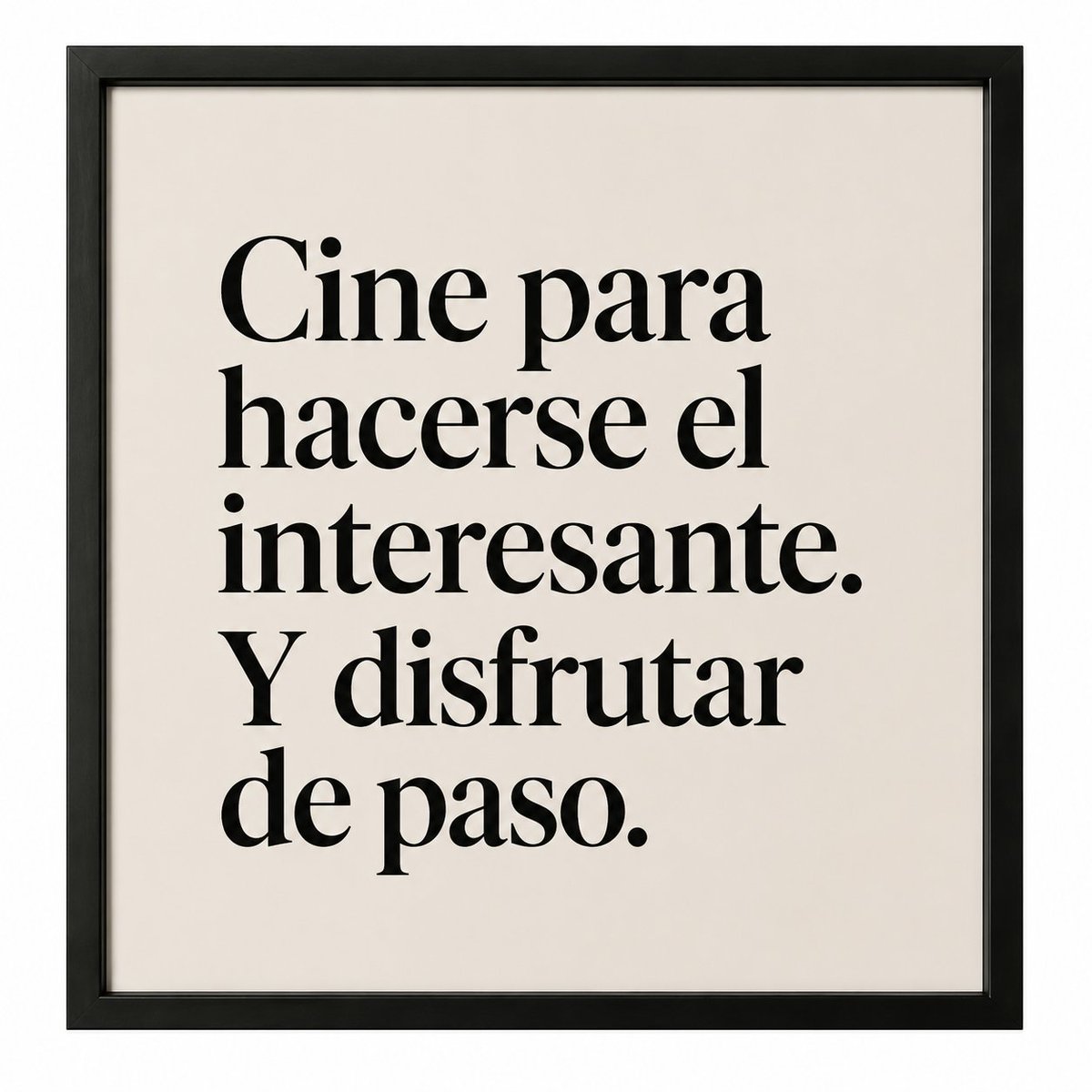
¿No te va el cine clásico? ¿En la próxima quedada con amigos quieres ser especial hablando de una película que seguro sólo habrás visto tú? ¿Te gustaría arquear la ceja cuando alguien comente F1?
La lista que necesitas. Aquí.
Diez. Si gusta pongo más.
Lo de Asimov hablando de su hijo es demencial:
"David nació el 20 de agosto de 1951.
Fue un parto difícil y pesó menos de dos kilos y medio. (Creo que es un hecho probado que los hijos de madres fumadoras, sobre todo si fuman durante el embarazo, cosa que Gertrude hizo, tienden a nacer con poco peso).
Pronto fue evidente que David no podría jugar con otros niños en una relación de igualdad ni sería capaz de hacer amigos.
A medida que crecía, descubrimos que la escuela constituía una fuente de infelicidad para él porque era utilizado como cabeza de turco. Más tarde, resultó que no podía conservar un empleo porque no se llevaba bien con sus compañeros de trabajo.
Acepté todo esto con cierta resignación, porque reconocía la situación. Yo había sido exactamente igual que él. De hecho, incluso cuando David era un niño y yo enseñaba en la Facultad de Medicina, no me llevaba bien con la gente, así que mi trabajo estaba constantemente en peligro.
Pero lo que David no tenía era mi inteligencia. Quiero decir que su capacidad mental era completamente normal, no era retrasado en ningún aspecto. (No nos arriesgamos. Le hicimos pruebas neurológicas y consultamos a psiquiatras).
Pero la normalidad no es suficiente cuando uno es un inepto social.
Yo me salvé de mi ineptitud solo gracias a mi demostración de brillantez y, a pesar de ello, lo logré a duras penas.
Pero, no crea, David es una persona buena y cariñosa, por lo general amable y comprensiva.
Tiene tendencia a volverse testarudo cuando le llevan la contraria (también yo) y en esas ocasiones no muestra muy buen criterio.
Cuando mi hijo todavía era un adolescente, me pareció que no iba a ser capaz de mantenerse cuando fuera adulto, así que tomé medidas para crear un fondo en fideicomiso de manera que esté libre de preocupaciones financieras.
La mayor afición de David es grabar los programas de televisión que le gustan y crear un enorme archivo con ellos. Me parece una vida bastante solitaria, pero, como a mí, le gusta estar solo y que le dejen en paz. No fuma, ni bebe, ni se droga y tampoco me crea ningún otro problema que el de mantenerle, lo cual no es ningún problema y (aunque no sea exactamente un placer) es mi obligación.
La gente a veces supone que como tengo un hijo y soy tan notable, mi hijo también debe serlo. Me preguntan lo que hace, esperando que les responda que es físico nuclear como mínimo. Mi contestación invariable es que es un «caballero que vive de rentas».
Si insisten, les digo francamente que le mantengo y que lleva una vida tranquila e intachable.
Si actúan como si pensaran que yo debería estar molesto, les digo (a veces ocultando algo de irritación) que mi hijo vive su vida y que no tiene que trabajar para proyectar su gloria sobre mí. Puedo crear mi propia gloria. Mi único deseo para mi hijo es que sea feliz y yo trabajo para que esto sea posible. Cuando hablo con él por teléfono siempre parece sentirse dichoso, y prefiero tener por hijo a un caballero feliz que vive de rentas en vez de a un físico nuclear desgraciado."
A Stanford computer science professor has been teaching the same software design class for more than a decade, and every quarter the seats fill faster than almost any other course in the department.
Students from Google, Meta, and Apple sneak back onto campus to audit it. Most of them have been writing code professionally for years.
I read the book that came out of the class in a week and walked away seeing every codebase I had ever worked on through completely different eyes.
His name is John Ousterhout. The book is called A Philosophy of Software Design.
Almost everyone in tech eventually hits the same wall. You learn to code. You get good at it. You ship features. 6 months in, you cannot find anything in your own codebase. 12 months in, you are afraid to change things. 2 years in, you start wondering if the problem is you, because everyone around you seems to be drowning at exactly the same depth and nobody is willing to admit it.
Ousterhout's argument is that the problem is not you. The problem is that nobody ever taught you what software was supposed to look like.
Here is the story almost nobody tells you.
Ousterhout was already a legend before he became a teacher. He invented the Tcl programming language, which has been used inside everything from Cisco routers to NASA spacecraft. He built systems companies. He served as a senior fellow at Electric Cloud and as VP of research at Sun Microsystems. By any normal measure he had earned the right to coast.
He went back to Stanford instead.
The reason he gave in interviews is the part that should make every senior engineer pay attention. He said almost every brilliant engineer he had hired in 30 years of running teams had the same gap. They could implement anything. They could solve any algorithmic problem. They could ship code that compiled, ran, and passed tests. And then 6 months later their own code would start to suffocate them, and they had no idea why.
Nobody had ever taught them what good software was supposed to feel like to maintain. Universities taught data structures and algorithms. Bootcamps taught syntax and frameworks. Companies taught company processes.
But the actual craft of designing software so that you would not hate yourself in two years was being passed down by accident, in code reviews, by the few senior engineers who had figured it out the hard way.
Ousterhout decided to teach it on purpose.
He built a class called CS 190 at Stanford, A Philosophy of Software Design.
The structure of the class was unusual. Students did not just write code. They wrote code, threw it away, and rewrote it from scratch after detailed feedback. Sometimes 3 rewrites per assignment. The point was not to ship a project. The point was to feel, in your own hands, the difference between a system designed well and a system designed badly. Most students had never felt the difference before. After the class, they could not stop seeing it.
He turned the lectures into a small book. It is around 190 pages. The first edition came out in 2018. It costs less than a textbook. It has quietly become one of the most-shared engineering books inside senior teams at Google, Meta, Stripe, OpenAI, and Anthropic. Senior engineers buy copies for their juniors. Tech leads send specific chapters to their teams during code reviews.
The argument inside the book is brutally simple.
Complexity is the enemy. Not bugs. Not slow performance. Not missed deadlines. Complexity.
A system too complex to hold in your head is a system you will break by accident. You will not know which line broke it. You will fix the symptom and miss the cause. Over time, complexity compounds. The codebase becomes a place engineers fear to touch. New features take longer. Old features break for unrelated reasons. Eventually the team starts whispering about a rewrite. The rewrite usually fails for the same reasons the original did.
Ousterhout argues that complexity comes from two sources. Dependencies, which are pieces of the system that affect each other across boundaries. And obscurity, which is information about the system that you cannot see from where you are reading. Reduce one, you almost always reduce the other.
The deepest insight in the book is about what good modules actually look like.
Most engineers are taught to build small, simple modules with lots of small, simple methods. Ousterhout calls these shallow modules and he says they are the disease, not the cure. A shallow module has a small interface and an even smaller body. The interface barely hides anything. To use the module, you have to understand almost everything inside it. Building software out of shallow modules creates the illusion of organization while the actual complexity stays exposed.
Good modules are deep. A deep module has a small interface that hides a large amount of functionality inside. You use the module without understanding how it works internally. The interface gives you exactly what you need and nothing else. The complexity is contained. Files have file names, sizes, modification dates. You read and write them. You do not need to know about disk sectors, file allocation tables, or buffering strategies. The Unix file system is a deep module. Most modern abstractions are not.
This is the part of the book that makes engineers stop reading and look at their own code with horror.
Most production codebases are full of shallow modules disguised as good engineering. Tiny classes. Tiny functions. Long parameter lists. Wrapper layers that wrap other wrapper layers. Every layer leaks information about the layer below it. Every interface forces the caller to understand internals. Engineers wrote it that way because they thought small was good. Ousterhout argues that small is not good. Hidden complexity is good. The module should be doing a lot. The interface should be revealing very little.
The second insight that landed hardest for me was about comments.
Most engineers are taught that good code does not need comments. The code should be self-documenting. Variable names should be descriptive. Functions should be small enough to read top to bottom. Comments are a sign of failure.
Ousterhout argues this is wrong, and that the people who say it have never actually maintained a large system over many years.
Comments are not a failure of the code. Comments are how you write down the things the code cannot say. Why a particular approach was chosen. Why a tempting alternative was rejected. What invariants the function depends on. What the caller is supposed to know. None of these things can be expressed in code itself. If a future reader has to read every line of your function to understand what it is doing, you have not finished writing it. The job is not done when the tests pass. The job is done when the next engineer can pick up the file and understand it without asking you a question.
The third insight is the one that hit me hardest, because it is the one almost no engineer is taught to think about until it is too late.
Strategic versus tactical programming.
Most engineers are taught to be tactical. You get a task. You finish the task. You move on. You take the shortest path between the current state of the codebase and the new feature. Each individual decision is reasonable. The combined effect, over years, is a codebase that has been hacked into shape by hundreds of small reasonable decisions, none of which made the system better as a whole.
Strategic programming is the discipline of asking, every time you make a change, whether the change is leaving the system better than you found it. Sometimes the smallest task should pay for a refactor that makes the next ten tasks easier. Sometimes the right move is to pause for an hour and redesign the abstraction before you add the feature. Tactical programmers always feel like they are moving fast. Strategic programmers actually move fast. The difference becomes obvious around the two-year mark.
Ousterhout's rule is the one I think about almost every day now. The best engineers do not write code faster than bad engineers. They delete code faster. Every line you add to a system is a permanent tax on every future reader. Most of the job of being a senior engineer is deciding what not to write.
The book is short. Around 190 pages. You can finish it in a weekend.
Reading it once will not make you a better engineer. Reading it twice, then watching yourself catch your own bad habits in real time, then forcing yourself to redesign one module per week using its principles, will measurably change how you write software in less than a year.
Almost every engineering team I admire has at least one person who has read this book carefully and has been quietly nudging the rest of the team toward what it teaches. Most teams that do not have someone like this end up rewriting the same system every two years and never understanding why.
Ousterhout is still teaching the class at Stanford. The course site is public. The book is around twenty dollars.
The single most useful book about how to actually design software is sitting one click away from you. Most engineers will spend a decade learning the hard way what 190 pages would have taught them in a weekend.