@themarklstone Here we have used exclusively Automatic Differentation (with a custom adjoint as hard to parallelize). Finite-difference parallelize well on GPUs, but we preferred to stick to AD for exactness! It could be worthwhile to compare with Knitro/FiniteDiff indeed.
@matbesancon @giomdal I have a remarkable 2 and would recommend it. The reason why? It runs on linux and I can just use ssh to transfer PDF to the tablet, without relying on a cloud
@MadVictorZ @CMU_ChemE@IBEROMX @AIChECAST10 @aicheeddiv Thanks for sharing! I am always impressed by the impact chemical engineers have had on nonlinear optimization 🙂
@MadVictorZ @JuliaLanguage@UWMadCBE @JuliaComputing @HighsOpt @JuMPjl@IEEEorg@TheSIAMNews Congratulations! I discovered Plasmo in 2017 at the first jump-dev, and it has been very influential for the end of my PhD. Looking forward to see what comes next!
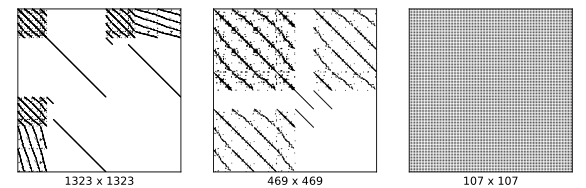
At #iccopt2022, the talk focused on a parallel algorithm to condense and solve large-scale KKT systems on GPU. The method is now implemented inside the MadNLP solver!
https://t.co/vcMIRLFmZS
@IlyaOrson Yes, code is available on github: https://t.co/Snjc4sLuNw
We are planning to do an official release once the package is properly documented 🙂
How easy is it to solve large-scale nonlinear optimization problem solely on the GPU? Not trivial, but doable if you exploit the problem's structure to condense the KKT system to a dense matrix
The implementation uses @JuliaLanguage, together with the nonlinear solver MadNLP and the AD library ForwardDiff.jl. Not forgetting the excellent KernelAbstraction.jl as a portability layer.
I am glad to announce that I arrived last week in the US to start officially my postdoc at Argonne. After 18 months of remote work from (Old) Orléans, I can finally say "À nous deux, Chicago!"