My new book "Dealers de mots" is out (Actes Sud)
"Parfois les mots vous manquent, parfois un texte vous semble trop long à lire par vous-même, vous souhaitez qu’on vous en propose un résumé. Vous ne regrettez pas d’utiliser des outils informatiques pour vous aider : la qualité des textes qu’ils produisent est extraordinaire.
Mais vous savez aussi que ces mots sont ceux des autres, volés sur des millions de pages jadis écrites.
Tous ces discours collectés, analysés, modélisés sont le capital accumulé par des entreprises qui désormais vous le revendent sous forme de services.
Comment en sommes-nous arrivés là ? Des premières enchères sur les mots aux modèles de langage géants : ce livre raconte comment le capitalisme linguistique s’est construit en vingt ans."
https://t.co/3fAX5tAEzw
Fable 5.1: "Create the Catalog of Ships from the Iliad with a map, etc. i should be able to explore each accurate ship in 3D. there should be real images & archeological data i can draw on. test it with agents to make it accurate & beautiful, then revise" https://t.co/SpFapJlMo9
Understanding synthetic populations has been an active area of research for more than thirty years, but it has now become more important than ever. We can now build large populations of artificial individuals whose distributions, interactions, and dynamics reproduce those of real societies, question them, and test public-health policies, energy interventions, or other societal scenarios on them. The scientific challenge is to turn a plausible simulation into a trustworthy scientific instrument, which is where calibration, validation, fairness, and privacy become essential.
With François Pachet and Mirko Degli Esposti, I am editing a Research Topic on Synthetic Populations for Frontiers in Artificial Intelligence. If you are working in this area, from theoretical foundations to practical applications, we would be delighted to receive your submission.
Direct link : https://t.co/lvSacnkhyN
Longer post : https://t.co/PmpkJcSCaa
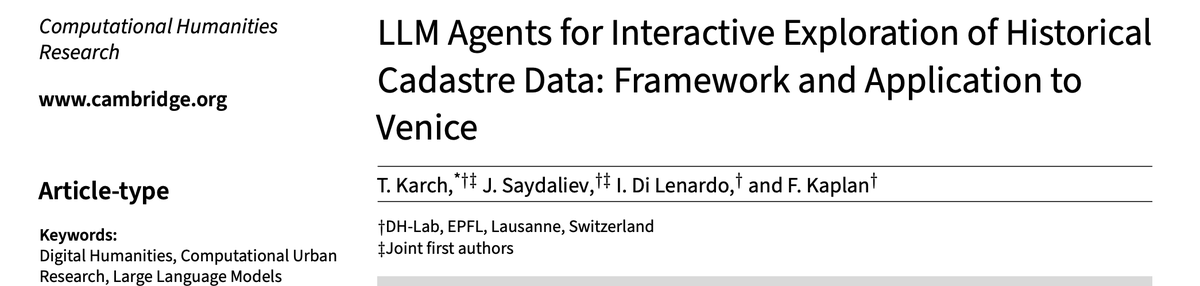
New paper accepted in Computational Humanities Research (Cambridge University Press)!
We show how Large Language Models can help historians query and analyze centuries-old cadastral data — starting with Venice (1740–1808).
Join us for Venice Data Week 2025 at EPFL (June 25-27) — a three-day workshop dedicated to exploring, interpreting, and enriching historical datasets on the city of Venice.
👉 Details & registration: https://t.co/slRCrC7HMI
#DigitalHumanities#VeniceTimeMachine#EPFL
Sven Najem-Meyer's research exemplifies the exciting intersection of AI and classical studies. It focuses on advancing document processing for commentaries on Ancient Greek texts. His PhD Thesis, which I co-supervised with Matteo Romanello, addresses the unique challenges of working with low-resource, domain-specific environments and its impacts go beyond this specific domain of application. https://t.co/9Ou5LDmaPL
The creation of 3D assets for cultural heritage is accelerating, bringing us closer each day to a European Time Machine—an open 4D mirror world that enables the exploration of places across space and time. This week marks the launch of two decisive projects, with joint kick-off meetings in Trento, Italy, at the Fondazione Bruno Kessler (FBK): 3DBigDataSpace, coordinated by the Time Machine Organisation, and 3D-4CH, in which the Time Machine Organisation actively participates.
These initiatives bring together a strong network of European partners who have been at the forefront of 3D cultural heritage for decades, now forming a solid ecosystem, implementing standards and pipelines to process massive 3D datasets. This effort comes at a crucial moment, as the production of 3D models is accelerating—exemplified by datasets such as Objectverse XL, featuring 10 million 3D models, or the Scan the World initiative.
Beyond standardization, curation, and interoperability—ensuring that these datasets can be accessed via browsers, mobile devices, and augmented reality platforms—these projects are laying the foundation for a new generation of AI-powered pipelines. These advancements will enable large-scale spatiotemporal alignment, the simulation of new objects and buildings based on analyzed patterns, and the creation of an accelerating positive feedback loop that may transform the 4D mirror world into reality.
Major challenges remain in curation, quality control, and standardization. Yet, thanks to a well-established network of academic and industrial partners, and the continuous support of the European Commission, there is strong reason to believe that Europe can lead this critical transformation of the Internet.
https://t.co/i6RMtymiPy
New Publication (in French) : Linguistic Prostheses: Typology, Authorship, and Proletarization. In Gefen Alexandre & Huneman Philippe (Eds), Philosophies of AI: thinking and writing with LLMs, Intellectica, 81, (pp.135-161)
https://t.co/wuEW1jRLBi
This article proposes a classification of linguistic prostheses, which are tools, devices, or technologies that transform the writing process. The concept of linguistic prosthesis brings together a wide variety of mediation devices under a single name. What they all have in common, however, is that they open up questions of authorship and the possible proletarianization of writing skills. Questions of authorship are central to many economic and legal processes involving the rights and responsibilities of authors. Questions of proletarianization touch on social issues of great importance linked to inequalities in writing skills, indirectly affecting questions as vast as the future of work or representativeness in democracy
One of the conclusions of the article is that the issue of extending or supporting linguistic capabilities with prostheses is essentially linked to the fact that the user generally doesn't own them, but at best, simply rents access to them. The behavior of the prosthesis may change depending on the subscription taken out, or just when the underlying language model is updated. In the long term, the user has no guarantee of either their accessibility or the quality of their performance. The coupled system is therefore fundamentally unstable. Given these intrinsic fragilities, it seems important that the user should be able to maintain autonomous control over his or her linguistic skills, regardless of their extension by the prostheses.
The article also stresses that the use of prostheses should be studied from the more specific angle of a loss of critical knowledge and the risk of new forms of control and influence made possible by their intermediation in linguistic flows. This more subtle form of proletarianization - a control of society through a control of linguistic devices - can be understood as the implementation by machines of linguistic politics of which there are examples in history. Given the nature of the entities that today control the most linguistic capital, forms of commercially motivated bias must also be considered. If these fears are well-founded, in this second perspective, the possibility of decoupling with the prosthesis is no longer a risk, but a possible escape from a control device.
—
Check also the other articles (some in French, some in English) of the issue curated by Alexandre Gefen & Philippe Huneman
Philosophy of AI: Thinking and Writing with LLMs by Alexandre Gefen and Philippe Huneman :
https://t.co/AhqPLGQGG2
On the Semantics of Large Language Models by Martin Schüle https://t.co/PQtYeLmArU
The Human and the Mechanical: logos, Veridicality Judgment, and GPT Models by Anastasia Giannakidou and Alda Mari
https://t.co/T8xEQ6Nr0E
About a Pseudo-Knowledge: Large Language Models and the Replika Hypothesis by Philippe Huneman
https://t.co/1WtxKVOmrz
Knowing with Large Language Models: a Paradigmatic Break by Stéphan-Eloïse Gras and Gaël Varoquaux
https://t.co/Obmqhe8LSX
Generative Grammars, Minimal Operations and LLMs: True and False Problems by Pierre-Yves Modicom
https://t.co/wtUGdi9ZyQ
The artificial image: Portrait of Edmond de Belamy by Alexandre Gefen
https://t.co/PaNurpQWos
Artificial Agency and Large Language Models
by Maud van Lier and Gorka Muñoz-Gil
https://t.co/t4uJod4cyN
Playing with à Chat(GPT)? the Ludic Side of Appropriating AI Technologies by Lionel Obadia
https://t.co/y1b3JGeMAS
To Understand AI Sentience, First Understand it in Animals by Jonathan Birch and Kristin Andrews
https://t.co/fidt2Wb5IQ
Generation of LOD4 models for buildings towards the automated 3D modeling of BIMs and digital twins. New article by Bryan German Pantoja-Rosero, Alexander Rusnak, Katrin Beyer and myself. One step closer to the Mirror World. https://t.co/Ie1C9y8r77
Kazuo Sejima architect of the Rolex Learning Center receives a Dr Honoris Causa from EPFL and explains that SANAA’s intention was to create for students « a new type of learning experience not only by books and teachers but also by each others » @EPFL_en