Get your ENS domain in 2022.
New prices for:
voos.eth (flights in pt-br)
mulher.eth (woman in pt-br)
empregos.eth (jobs in pt-br)
wagmi💪.eth
gabrielmedina.eth
leticiabufoni.eth
🤴🤴🤴🤴.eth
🚀🤩🚀.eth
#ens#ensdomains#domains $ens #ethmoji#ensmoji
https://t.co/CzCHrxInA0
She's 22. Her AI runs inside the Fortune 100. a16z just led her $21M raise.
"Put up the most minimal fake version you probably can of something and then go sell it."
In 17 minutes, MIT grad Jessica Wu reveals the YC playbook that got her here in 24 months.
From youngest hedge fund quant to founder + the trick her batchmates missed + the Christmas Day deployment + the 10-year founder test
Worth more than a year of YC advice on your timeline
I met a 19 year old who makes $200,000+ building apps with AI and he can't even code.
1 year ago he was literally working at TJ Maxx.
He made a deck called "How to scale your app to $10k/month (easy mode)" and gave away the entire playbook on the pod:
1. Pick an idea you're actually passionate about. He proved this the hard way. The app he hated got 1.8M views and made $35. The app he loved made $17,000. Same month.
2. Build one "gotcha feature" anyone gets in 5 seconds. Take a picture of food, get calories. That's the whole pitch. 90% of distribution is nailing this. Gotcha features that include AI are working a lot right now.
3. Onboarding is where the money is. Educate, add social proof, personalize to create sunk cost, then hit them with FOMO right before the paywall.
4. Your IG is both a sales funnel for users and your credibility when pitching influencers. Three demos, clean bio, collab posts.
5. Distribution is a numbers game. Tailor your feed to your ideal customer, scroll and DM all day, hire a VA, get creators on the phone fast.
His name @GeorgeLampro20. It was fun hearing him share what is working in real-time from his POV.
Might get your creative juices flowing if building mobile apps with AI is exciting to you.
I love how simple his deck he showed is.
Full episode on @startupideaspod
Watch
Today I'm publishing a new essay, Policy on the AI Exponential. AI is progressing extremely fast—much faster than the policy process was built to handle. The essay lays out where I think the technology is now, and the action needed to close the gap: https://t.co/Lh6PWae178
Citadel fired their best quant. He rebuilt their entire algo with Claude Fable 5 in 48 hours - and he's up $430,000 trading it against them.
He didn't take a single file. He didn't need to - ten years of that logic lived in his head, and you can't raid a memory.
Wallet proof: https://t.co/JSA6VkmGuX
Here's the engine MiroFish runs - and it's rigged in his favor. Picture a Galton board: a ball dropping through eight rows of pegs, bouncing left or right at random.
One ball is chaos. Thousands of balls always fall into the same bell curve. That's the law he weaponized.
Every ball is one trade. Each row is a volatility gate - news, liquidations, order-book flow, things nobody controls.
On a fair board every gate is a 50/50 coin flip. His model tilts each one to 0.54 - four cents of edge that only shows up when fair value splits from the book.
Four cents sounds like nothing.
Compound it through eight gates, thirty-two thousand times, and the whole bell shifts right of breakeven: 71% of trades land green.
$93 of edge per trade. $430k across the distance.
Watch the win rate converge in real time - it swings between 50 and 85% for the first few dozen trades, then locks on 0.71 and never leaves.
He doesn't predict a single trade. One trade is a coin flip. Eighteen thousand is mathematics.
They thought firing him protected the edge. They just handed it a grudge.
Copy the wallet quietly out-trading a $60B fund before they connect the dots: https://t.co/vbDZyVcfT3
Andrej Karpathy spent 2h showing how he actually uses AI day to day
he's a co-founder of OpenAI and led AI at Tesla, so when he shows how he works, it’s worth watching
and the whole session is just him telling the machine what he wants in simple terms, like he's briefing a coworker
watch what's actually happening the entire time:
> he describes the task in normal words
> it goes off and does the work
> he glances at the result and nudges it with one more sentence
that's the whole skill, and you've had it since you learned to talk
the only gap between that and a worker that runs on its own is handing that sentence a schedule and the tools to act
check his work, then build the version that keeps working when you stop
A Google Cloud engineer just showed how to build a full app with Claude from scratch
he spent 26 minutes showing exactly what one person with Claude can do, completely free
worth more than any $500 vibe-coding course
here's what he covers:
> raw idea to deployed app in a single session
> using Claude as the entire engineering team
> the exact workflow they use at Google
> no big team, no prior experience needed
the people who figure out what Claude can actually do are building things everyone else thinks requires a team
that's exactly why I put together a guide on Claude features most people have no idea exist
the guide is in the article below
Andrej Karpathy spent 4 minutes in an interview explaining a single idea
about how most people haven’t even started learning how to use AI
and everyone paying $20/month for a subscription.. that's not really using Claude at all
his point is that the real skill gap is the ability to build with AI
he identified 4 behaviors that break Claude Code and put them all into one file
a developer expanded it into 21 rules and published it - 82,000 stars and #1 on GitHub Trending
coding accuracy jumped from 65% to 94%
here's what these 21 rules actually are and why most developers using Claude every day have never configured them
the full breakdown is covered in the article below 👇
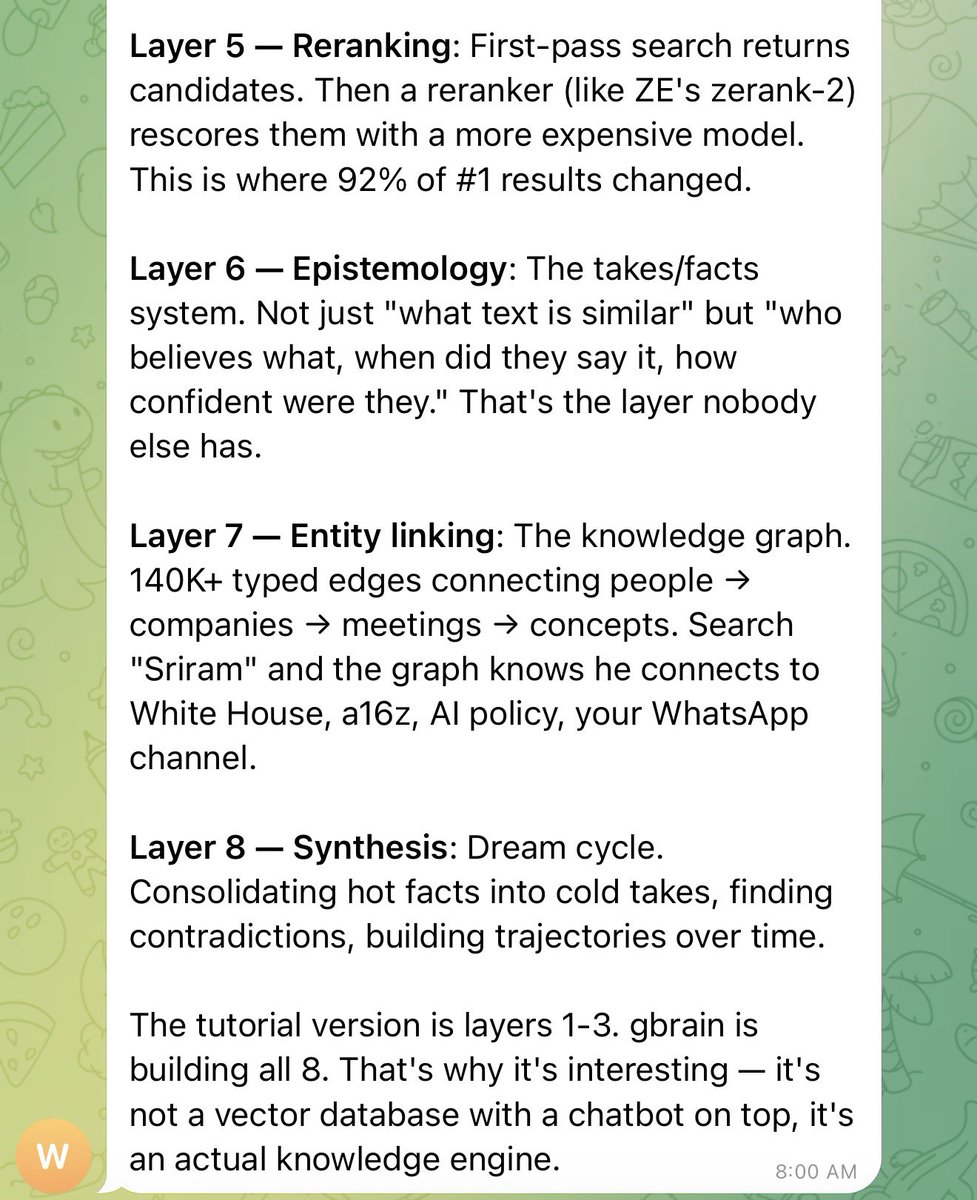
What is GBrain? My open source project is a knowledge system, not RAG in a box.
It gives agents 8 layers that work together to improve memory in a way that makes your already smart OpenClaw or Hermes Agent feel clairvoyant about who you are.
Personal AI becomes possible.
The biggest alpha leak of 2026 is that you can tokenmax $10k/mo with OpenClaw/Hermes + GBrain and get the AI that everyone will have in 2028 for $100/mo, but you can get it now, and that is the biggest single unlock you can have vs your competition
Demis Hassabis: "In the near future, one person who knows AI will outperform an entire startup team"
I've watched hundreds of AI talks, this 60-minute Cambridge lecture is the one I wish I had seen a year ago
this is the Nobel Prize winner in Chemistry, CEO of Google DeepMind and the guy who made AI solve biology
here's the part I can't stop thinking about:
> the AI you're using today is the dumbest it will ever be
> in 5 years the gap between people using AI and people who aren't will be impossible to hide
> companies will run on 10 people doing what 200 used to do
> the ones who get there first won't be the smartest, they'll be the ones who started right now
right now the average person opens Claude, types something, gets an answer, closes the tab
they think they're using AI, but they're using maybe 10% of it
I turned his lecture into 18 steps to actually use Claude the way it was designed, copy-paste prompts included
full guide in the post below.
god i’ve watched this entire thing twice now.
krishna is a force at anthropic & he’s masterfully given them a winning hand.
the amount of alpha in this episode:
> the #1 place anthropic spends compute isn’t model training or customers… it’s the research team. he explains:
- research team uses compute to build a better model
- better model uses LESS tokens so the same amt of compute can serve MORE people in the future.
“we could’ve earned billions more in revenue but then we would’ve lost the model race”
> anthropic’s the only lab to train AND inference their models across 3 different chip architectures.
krishna: “one morning we will run an inference block on trainium and by the afternoon it’s used to train claude”
the unique advantage = they don’t rely on a single supplier.
> krishna says people don’t fully comprehend how advanced each model version gets. agents, long-horizon tasks, cost effectiveness improve ALL AT ONCE
“we went from $9B to 30B in months” - that wasn’t just because the chatbot got better.
bonus:
krishna uses claude to generate the companies monthly financial report. it does it in 30 mins and is 95% accurate.
the highest token-consumer on his team is the tax guy.
there’s so much more i want to share but honestly just watch the interview
@patrick_oshag you killed it