Examples of the sort of design decisions I'm talking about:
What information would be useful to show here?
Should we make this a dialog or put it on its own page?
Should this button save the user's changes instantly, or should we have a confirm step?
For batch edits, what would be a good way to mark the things that have changed and are unsaved?
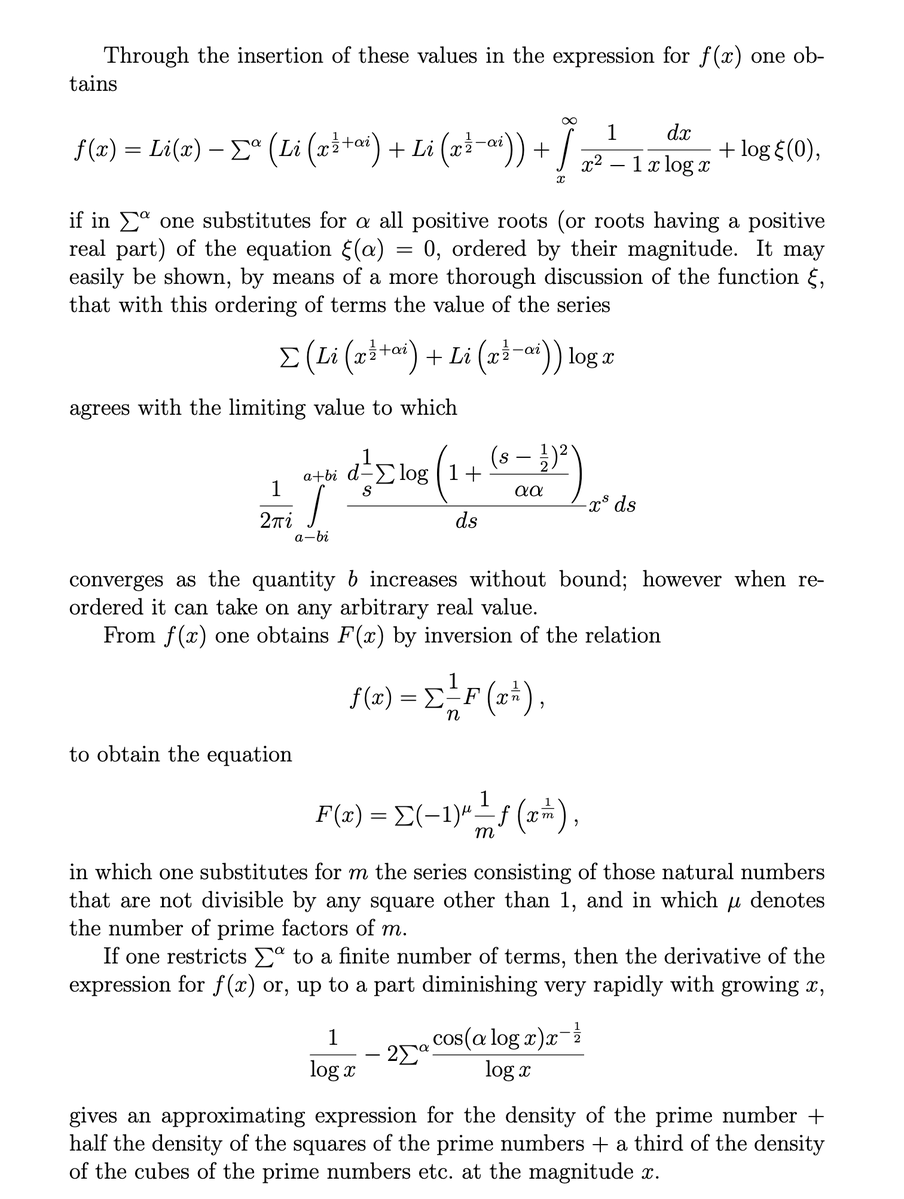
It's hard to say what's more surprising and impressive: proving the Riemann hypothesis in 2026 using superintelligent AI models, or Herr Doktor Riemann getting as far as he did in his paper from 1859 using his own 20 Watt computer (i.e., his brain). See:
https://t.co/SfEHwQtyey
@anderssandberg Indeed: LLM are architecturally, incapable of abductive reasoning; this is why symbolic layers on top of them are so important (but even now, I have not seen any such harnesses designed to do such theory building).
The proof feels like a brute force thing that’s only possible with a lot of computer. As noted down thread I also wonder if “looking for implied concepts that compress them strongly” will become a focus. Surely such compression is still useful?
In my understanding, the Alpöge/Claude proof of the Riemann Hypothesis seems to be winding its way through a vast set of known methods and tricks. In a sense it is an "elementary" proof in that it does not use any new fancy concepts to succeed. https://t.co/N7z0e5C0iV
"The question is not whether there will be iron, but what kind of Irontown we build with it. I want our conversation about AI to make room for nuance and genuine understanding, for us to look at it and each other with eyes unclouded by hate. We should take advantage of its real benefits, but also recognize the damage it can do, and the choices we still have about what we build and what we’re willing to sacrifice for it."
so good @mitsuhiko
https://t.co/m4HbczmPD8
Guys, this is very serious and you have to read this right now. The Riemann Hypothesis may have just been solved, and if the claim holds, it's an insane achievement.
In mathematics there is a famous problem called the Riemann Hypothesis, and it's about prime numbers. Primes are numbers like 2, 3, 5 and 7 that can only be divided by 1 and themselves. Every other number is built by multiplying them together, so they're the building blocks of all numbers. You can never tell exactly where the next prime will show up, but if you step back, there's a pattern.
Around 1,000, about 1 in 7 numbers is prime. Around a million, about 1 in 14. Around a billion, about 1 in 21. Primes get rarer at a steady, predictable pace.
Because of that pattern, mathematicians can estimate how many primes there are below any number. But the estimate is never exactly right. It's always a little off, and the big question is how far off it can get. Think of flipping a coin 1,000 times. You expect 500 heads, but you'll get something like 480 or 520. It's a little off, but never wildly, and you can predict how far off it will be.
In 1859 a mathematician named Bernhard Riemann found that the prime estimate's error isn't random. It's controlled by a hidden set of special numbers. Where those numbers sit decides how big the error gets. Riemann guessed that every single one of them sits on one straight line. If he's right, the error always stays small, just like the coin, and primes are as orderly as they could possibly be. If even one of those numbers is off the line, the error can grow much bigger, and primes are far messier than we think.
So far computers have found trillions of these special numbers, and every single one is on the line. But there are infinitely many, so checking will never be enough. You need a proof that covers all of them at once. For 167 years nobody has found one. It's one of the seven hardest unsolved problems in mathematics, with a million dollar prize attached.
Now a mathematician has posted a note saying that, working with Claude, he believes he has that proof. He says a computer has already checked every step, and that Claude raced ahead of him near the end. Experts still need to confirm it, but this isn't a random internet claim.
If it holds, it doesn't mean we can predict every prime. It means we finally know the pattern can never go wildly wrong. Thousands of math papers that begin "assuming the Riemann Hypothesis is true" become proven fact overnight. We'd also get firm limits on how far apart primes can be, and a guarantee that a fast method for testing whether a huge number is prime always works. And no, your bank account isn't in danger. Online security depends on how hard it is to break a huge number into its prime factors, and this proof doesn't make that any easier. If anything, it gives the math behind encryption a stronger foundation.
If it holds, this is bigger than one math problem. A question that beat the greatest minds in history for 167 years would have been cracked by a human and an AI in a matter of weeks. If AI can find answers and computers can check them, the limit on science is no longer how smart we are. It's how many good questions we can ask.
Well that's what I thought watching in real time, that they were just filibustering, but Mullin eventually did provide a relatively coherent explanation ~15 minutes in, and Duffy was clearly fuming about it because it was a) off-message and b) blamed Duffy!
@fredine I think news editors were wary to universalize their own office hell to every working person in the country suffering alone and disconnected, whereas at an airport that universality is visible and manifest and can be photographed
Story time: How I set out to build a parser and ended up implementing a full-blown scheduler.
When I started Hardwood, a Parquet reader (and writer) for Java, I expected the hard part to be decoding: types, encodings, nesting, SIMD. All this is real work, but for remote files (S3), the hardest part is deciding what to do next. Depending on region and distance, every request can cost tens of milliseconds before the first byte arrives. A reader that fetches a column chunk, decodes it, then fetches the next one spends most of its time waiting. To hide that latency you need many requests in flight. Then you need to decide when to issue which ones, how many, and what to do with the CPU while they're outstanding.
For Hardwood, the goal is that a read should either run at the speed of its slowest resource (network, cores, memory) or of the code consuming the rows, but never slower due to scheduling. That means hiding fetch latency as much as possible, and no core idle while there are pages ready to decode. It also means not reading ahead without limit, because memory is finite and one read must never starve another.
Parquet makes this harder than it sounds. The metadata sits at the end of the file. A page can't be decoded until its bytes have arrived, its column chunk's dictionary has been decoded, and its position in the output batch is known. Some files have no page index, so you only find the pages by scanning headers as the bytes come in. Every one of those steps finishes in its own order, on its own thread.
So Hardwood now has a complete work and IO scheduler. All the work, from fetching a byte range to parsing a footer, planning a row group or decoding a page, is a job. Each job is keyed by the first row it serves, and the lowest key runs first. IO jobs (fetching bytes) run on Java 21 virtual threads, while CPU jobs (decoding) run on a worker pool with a configurable size. Optionally, CPU jobs can run on the caller's thread instead, should you want no extra threads competing for the CPU (e.g. in a single-core K8s pod).
Separate bounds govern how far fetching and decoding may run ahead of the consumer. The two are bounded apart because their costs differ: request latency calls for many bytes in flight, while decoded values are several times larger than compressed ones and need only a few batches of head start. To guarantee progress, whatever the consumer needs next always runs, no matter what the bounds say. Pages are decoded straight from the fetched buffers into output batches, so the engine also tracks who still reads each buffer and frees it once the last page is done.
None of this is specific to Parquet. Any format read over a high-latency link, with dependencies between its parts, ends up here. I'm planning to write up the details of Hardwood's scheduling engine in a longer post at some point. For now, the short version: if you're building a remote reader, you're building a scheduler. If only someone had told me that upfront ;)
I urge all to read "No Silver Bullet - Essence and Accident in Software Engineering" by Brooks.
TLDR: shrinking all the "accidental" complexities in software engineering (semantics, boilerplate, dep management, awkward syntax, composition of code and packages, etc.) does NOT reduce the "essence" of complexity. And often, out of accidental complexities emerge new essential complexities.
Shrinking down all the accidental bits to zero does not inherently and instantly result in the core complexities disappearing: if so, with the convention of ergonomic languages like Python and Lua and TypeScript, or better tools like IaC, we would have seen leaps and bounds in software capabilities and productivity.
But, what emerges and transforms, like a werewolf, is increasing essential complexities that are, at the heart of it all, bound to the domain of the software and abstractions of the real world. What happens when abstractions and ergonomics and new ways of working arrive is that the inherent complexity transforms and re-appears:
> "The complexity of software is an essential property, not an accidental one. Hence descriptions of a software entity that abstract away its complexity often abstract away its essence."
AI and agents have changed software development. But the hard essential bits in software remain (if not are 10x) - today, instead of focusing on syntax, focus on how to build stable, complex, interlocking systems where the complexity is well managed.