I recently put on my *anti-fraud tech* hat (the vocation that pays my bills) to review Traffitech, the new automated traffic ticket/fine system in Ghana. Here is what I found.
1. You would notice that the base Traffitech fine of GHS 240 is more than 11x the minimum wage in Ghana.
2. So, minimum-wage earners must work for 11 days to pay each fine.
3. The median income in Ghana is ~GHS 2130 a month. Among informal workers, it is GHS 1200. And in Greater Accra, it is GHS 3000.
4. It is true that drivers who own their own cars tend to earn higher than the median wage. But a very large number of drivers on the road are commercial drivers who earn around the 3000 - 4000 a month mark.
5. One of the attached charts show you how the fines escalate against the disposable income of such drivers.
6. All of this to say that we should pay attention to COMPLIANCE as a function of AFFORDABILITY. If people simply can't pay, they will not pay. As the fines pile up, the ability to pay worsen.
7. It is not surprising that before the Kenyan scheme was suspended, compliance rate (people actually paying the fine) was a mere 16% and that in Cote D'Ivoire the authorities had to introduce an option to pay in installments.
8. Compare that with compliance rates of 75% in Berlin, 67% in Chicago, and 70% in New South Wales (Australia).
9. Apart from income, I would argue that a major factor for higher compliance rates in the above places compared to what we have seen in Africa is the SENSE OF FAIRNESS.
10. If drivers begin to feel that the whole scheme is arbitrary and it is hard to modify your behavior to avoid fines because the speed limits are hard to scope and determine, compliance will fall and arrears will pile up.
11. Something else will then happen: FRAUD.
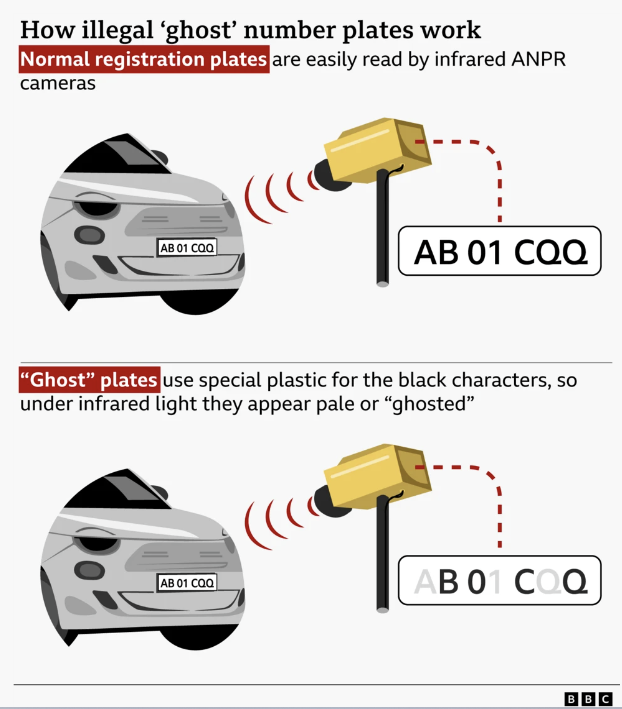
12. Last year, the UK authorities launched operation phantom, an exercise to detect car number plates deliberately tampered with to avoid automated tickets and fines.
13. Special cameras called "Sentio Ghost" were acquired from a company called Redspeed for the effort. Within 2 weeks, 4,335 ghost plates were recorded. Another provider, MAV, detected 1000 such plates at the Dartford Crossing. (Sensys Gatso, Ghana's provider, doesn't seem to have developed such tech.)
14. Researchers at UT Austin (Texas) recently showed how with $100 anyone can create a simple rim unobvious to the naked eye that reduces the performance of even the most advanced cameras by 60%. And now there are simple sprays that do similar things.
15. The situation is made worse by the poor street lighting in Ghana that makes using other spectra beside infra-red much harder.
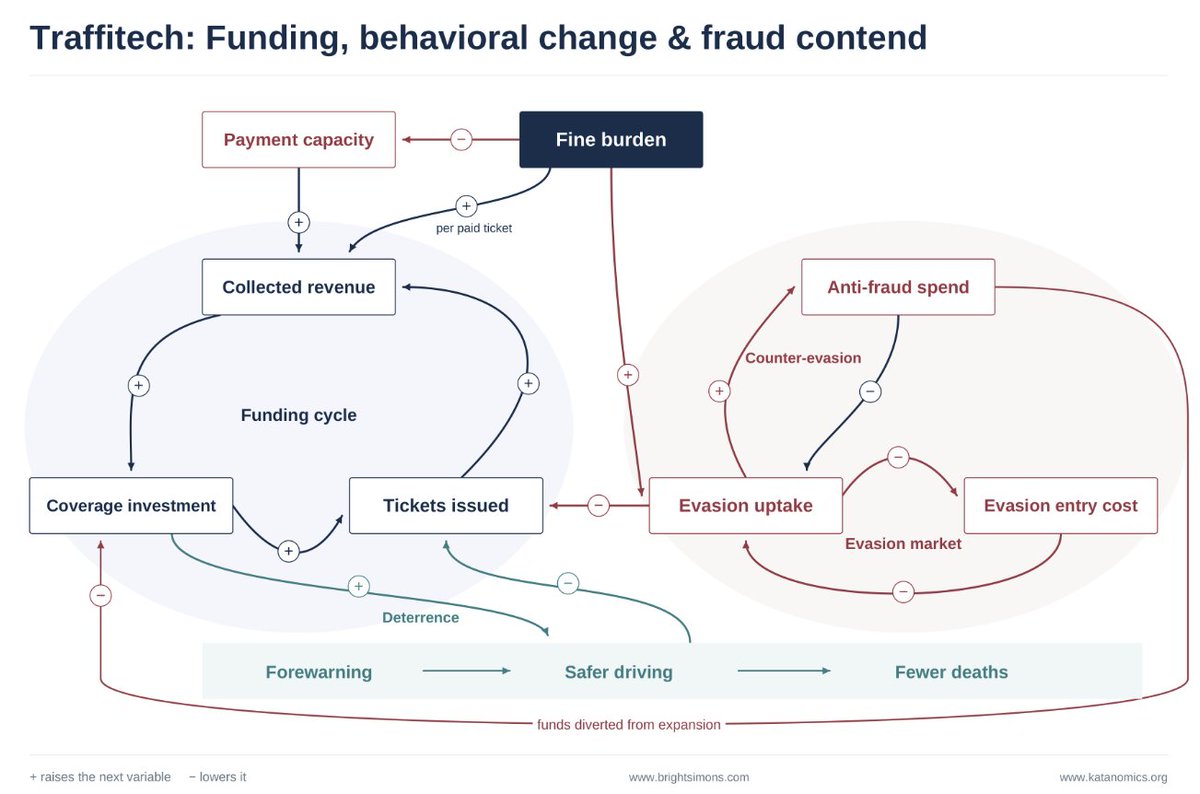
16. Capitalism means that if the number of evaders grow, the supply of "ghosting" tools will increase and costs will fall. Meanwhile, Mr. Frank Osei and Sensys Gatso will counter by pushing for more higher-tier cameras, which will drop revenue. But less revenue would also limit the ability to spread the system. See chart.
17. At any rate, research shows that in this fraud "arms race", the cost advantage is on the side of the criminals.
18. As the chart shows, there aren't easy answers about how to address these complex feedback loops. But, for sure, the idea that fines have to be kept high to serve as a deterrence is not all that smart.
I genuinely didn't see this coming! 😳
As someone who advocates for technology and public policies that improve lives, this Traffitech-GH revelation has changed how I look at the initiative.
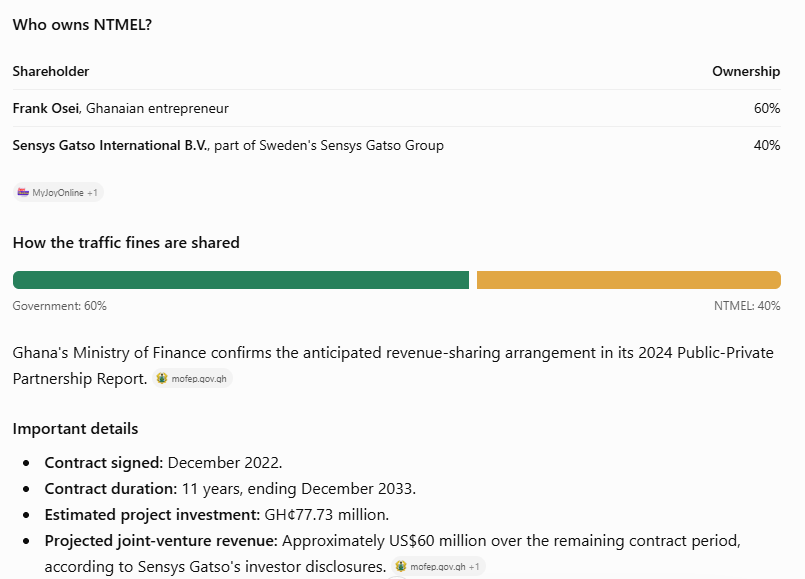
Ghana's Ministry of Finance reports that 40% of traffic fine revenue is earmarked for a private company, Nationwide Traffic Management and Enforcement Ltd (NTMEL), while the government receives 60%.
And who owns NTMEL?
• Frank Osei, Ghanaian entrepreneur: 60%
• Sensys Gatso, Swedish traffic technology company: 40%. The contract runs for 11 years, from December 2022 to December 2033, with an estimated project investment of GH¢77.73 million.
I've always supported technology that makes our roads safer. But this raises serious questions for me.
If a private operator earns more when motorists commit more offences, how do we ensure road safety remains the priority, not revenue generation?
What happens to poorly marked roads, missing speed-limit signs and unclear school zones?
I'm not against Traffitech. I'm questioning the incentives behind its implementation.
Are we building a safer road network or a revenue-generating enforcement system?
Ghanaians deserve transparency on this arrangement.
https://t.co/pZKuSxhAPZ
https://t.co/cKgyjpW2Ud
🤯🇷🇺 Meanwhile in Russia, the score is 1-1 in the 87th minute and one team gets a free-kick in the perfect position..
You'll never guess what happens when the goalkeeper steps up to take it. 🤣⚽️
God of war storm Kumasi PZ 😂😆
Chez & Happiness.. Satisfy your cravings and experience with our special Acheke 🍱🤩🤩 call us now to order ☎️ 0243952339 / 0502432037