CORPORATE GRAVEYARDS SERIES
Ep 3 — East African Cables PLC
Ep 3 in the Corporate Graveyards series is the odd one out: a company that was actually getting healthier operationally right up to the point it collapsed.
East African Cables has manufactured cables in Kenya since 1966, adding a Tanzania plant in 1977 — nearly 60 years supplying the region's power grid. It became TransCentury's flagship subsidiary, 68.37% owned through Cable Holdings Kenya Ltd. And its own board chairmen — first Zephaniah Mbugua, then Michael Waweru — were both TransCentury founders. Its audit committee included TransCentury's own group CEO. The people meant to oversee EAC independently were, structurally, running the company that controlled it.
The financial story is unusual. KPMG flagged going-concern doubt as early as 2017, when losses hit Sh662.8 million. Years later, a second, fully independent auditor — RSM Eastern Africa — flagged the same thing again. Two firms, years apart, same conclusion. And yet by 2023, EAC's gross profit was actually rising 24% even as losses grew — the company's own
2024 results blamed rising finance costs, not weak trading, for the
widening loss.
Then the parent's crisis caught up with it: TransCentury's failed 2023 cash call triggered Equity Bank's receivership over both companies together. EAC followed its parent into administration in 2025, shares suspended at just Sh1.71. The good news: a genuine industry buyer, Cable Experts Limited, signed a rescue deal in 2026 — its first job, paying off
the bank debt.
The lesson here isn't about a failing business. It's that a healthy subsidiary can still be killed by who controls it, and by a board that can't independently say no to its own parent.
Swipe through for the full corporate autopsy, fully sourced.
------------------------------------------------
HASHTAGS:
#CorporateGovernance #CorporateGraveyards #KenyanBusiness #EastAfricanCables
#GoingConcern #BoardGovernance #BusinessLessons #FinancialLiteracy
CORPORATE GRAVEYARDS SERIES
Ep 5 — Deacons (East Africa) PLC
Ep 5 in the Corporate Graveyards series is the fastest collapse yet: from a real profit to full liquidation in under three years. Deacons started trading in Kenya in 1958, first as the East African franchise holder for Marks & Spencer. From 1994 it reinvented itself, building a portfolio of international apparel franchises — Woolworths, Truworths, Mr Price, Adidas — plus its own brands, 4U2 and Angelo. By the 2010s, the Mr Price franchise alone generated half the company's revenue. Then the franchises started leaving. In 2016, Deacons sold its remaining Woolworths stake back to the South African parent. In February 2018, it sold back Mr Price too — taking half its revenue with it. Losses, already worsening, jumped 204% that year to Sh841.4 million. Full-year FY2018 results were never published. Nine months after losing Mr Price, the board called in administrators.
The ownership story is genuinely unusual for this series: Swedfund International, a Swedish state development fund, was the largest shareholder at listing. Former President Mwai Kibaki, whose family co-founded the modern business, was the second-largest — his daughter sat on the board. Together, Deacons' top shareholders lost a combined Sh1.2 billion. By September 2020, after a year-long failed search for a buyer, the company was liquidated — 60-plus years of trading, gone. The lesson isn't about overexpansion or debt-fuelled growth. It's that a franchise agreement is a rented relationship, not owned business value — and if one contract can generate half your revenue, its loss can end
your company. Swipe through for the full corporate autopsy, fully sourced.
------------------------------------------------
HASHTAGS:
#CorporateGovernance #CorporateGraveyards #KenyanBusiness #Deacons
#RetailKenya #FranchiseRisk #BusinessLessons #FinancialLiterac
CORPORATE GRAVEYARDS SERIES
Ep 6 — Uchumi Supermarkets PLC
Ep 6 in the Corporate Graveyards series is different from the rest: this company collapsed twice, a decade apart — and it's still fighting today.
Uchumi was born in 1975 as a government-backed venture, pioneered the hypermarket format in Kenya through the 1990s, and listed on the NSE in 1992. Then, in 2006, poorly funded expansion left it with a Sh1.2 billion loss and it collapsed into receivership — revived within six weeks under a government-brokered framework, back to profit by 2008, re-listed by 2011.
Then it did it again. Fresh capital funded a regional expansion into Uganda and Tanzania, peaking at roughly 40 stores and record profit in 2014. The regional stores never turned a profit. Uchumi exited both countries in 2015, laying off 900 people. A KPMG audit found goods recorded in the books as delivered that had never arrived. Supplier debt
doubled to Sh3.6 billion. By 2019, just two stores remained in Nairobi. The recovery plan today hinges on selling a Sh2.8 billion parcel of land in Kasarani — but in May 2025, the High Court awarded most of that land to the Kenya Defence Forces instead. Uchumi has appealed. As of today, the company has one store left, is under active regulatory
investigation, and its 2025 auditors couldn't even confirm it can continue as a going concern.
The lesson isn't just about debt-funded expansion — it's that surviving one collapse doesn't inoculate you against a second, if the underlying pattern never actually changes.
Swipe through for the full corporate autopsy, fully sourced.
------------------------------------------------
HASHTAGS:
#CorporateGovernance #CorporateGraveyards #KenyanBusiness #Uchumi
#RetailKenya #GoingConcern #BusinessLessons #FinancialLiteracy
CORPORATE GRAVEYARDS SERIES
Ep 8 — Dubai Bank Kenya Limited
8 in the Corporate Graveyards series is the smallest company we've covered yet — literally. Dubai Bank Kenya was ranked dead last, 43rd of 43 licensed commercial banks in Kenya by assets. It still managed a full collapse, and a fast one.
Licensed in 1982, Dubai Bank operated for over three decades without ever growing beyond being the smallest bank in the country. In 2012, its managing director was dismissed after raising concerns about the chairman's conduct and about irregular transactions endangering roughly Sh2 billion in deposits. She was right to worry: by the end of 2014,
those deposits had fallen to just Sh4 million.
By mid-2015, the bank was defaulting on basic obligations — Sh48 million owed to another bank, Sh197 million owed to a single depositor. Its own managing director left the country in May 2015, in the middle of a Central Bank investigation. On 14 August 2015, a new CBK governor just weeks into the job placed the bank under receivership. Ten days
later, the regulator's own review found the weaknesses too severe to fix — and ordered liquidation.
One investor, Jacob Juma, said he alone lost Sh247 million across two accounts, and that his own earlier warnings had gone unheeded. The one genuinely hopeful note: Kenya's deposit insurance framework worked. By 2022, depositors had recovered 92% of what they were owed, with a further payment round beginning in 2026.
The lesson isn't about size. It's that being small can just mean fewer people are watching — until, all at once, someone finally does.
Swipe through for the full corporate autopsy, fully sourced.
------------------------------------------------
HASHTAGS:
#CorporateGovernance #CorporateGraveyards #KenyanBusiness #DubaiBank
#BankingRisk #InsiderLending #BusinessLessons #FinancialLiteracy
Me after filing my taxes: “Surely that’s everything.”
KRA: “We have just one small question…” 👀
That “small question” has 47 attachments, 3 reconciliations and a deadline of yesterday. 😂💀
The Tax Plug ☕🇰🇪
#KenyaTax#KRA#TaxPlug#TaxHumour#KenyaBusiness
Day 2 — VAT
THE TAX PLUG 🧾
VAT is not your money.
You collected it on behalf of the government.
Spending it because “cash is cash” is how tomorrow's tax bill becomes today's headache. 😭
Collect VAT. Account for VAT. Remit VAT.
Simple.
#TheTaxPlug
THE TAX PLUG — SERIES
Bank deposits ≠ sales
Money entering your bank account ≠ automatically taxable sales.
But if you can't explain where it came from…
👀The Plug
Keep the receipts, agreements, records.Don't let your bank statement tell your tax story for you.
#TheTaxPlug 🇰🇪
KENYA'S JOURNEY TO INDEPENDENCE
What does freedom actually look like? For decades, Kenya lived under British colonial rule. Land was taken, laws were imposed, and political power belonged elsewhere. The journey continues.
TAX & DEBT SERIES Con'd
Domestic Borrowing:
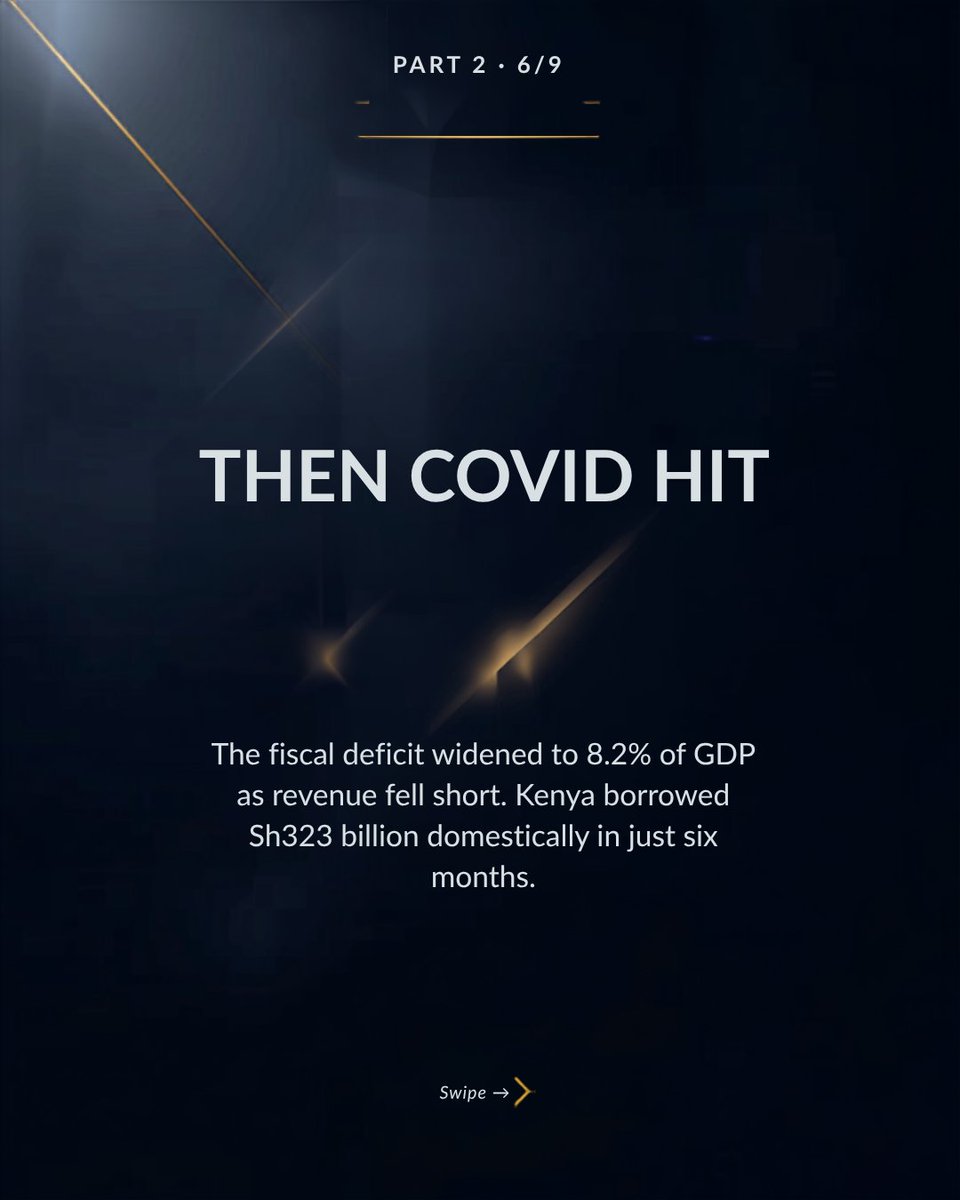
Part 2 — How Did We Move From Billions to Trillions?Kenya's domestic debt was once counted in billions. Today it's Sh6.78 trillion. Part 2 of the series traces exactly how that happened — a timeline, not just a headline number.
TAX & DEBT SERIES
Domestic Borrowing:
Part 2 — How Did We Move From Billions to Trillions?Kenya's domestic debt was once counted in billions. Today it's Sh6.78 trillion. Part 2 of the series traces exactly how that happened — a timeline, not just a headline number.
TAX & DEBT SERIES Cont'd
Domestic Borrowing:
Part 2 — How Did We Move From Billions to Trillions?Kenya's domestic debt was once counted in billions. Today it's Sh6.78 trillion. Part 2 of the series traces exactly how that happened — a timeline, not just a headline number.
TAX & DEBT SERIES - Cont'd
Domestic Borrowing:
Part 1 — How Did Domestic Borrowing Begin? Kenya's domestic debt hit Sh6.78 trillion in March 2026 — 55% of everything the country owes. Banks hold Sh2.32 trillion of it. Pension funds hold Sh1.80 trillion.
TAX & DEBT SERIES
Domestic Borrowing:
Part 1 — How Did Domestic Borrowing Begin? Kenya's domestic debt hit Sh6.78 trillion in March 2026 — 55% of everything the country owes. Banks hold Sh2.32 trillion of it. Pension funds hold Sh1.80 trillion. #KenyaDebt