9/9Never judge a loan just by its monthly payment.
Plug the loan amount and due date into this free calculator to see the exact final bill waiting at the end:
https://t.co/eY8o3y6H4S
If you borrow $200,000 and make every single monthly payment on time for 10 years straight, how much of that loan do you think you’ve paid off?
1/9 With a balloon loan, the answer is only 15%. After a full decade of paying, you still owe 85% of what you borrowed. Here is why: 🧵
8/9 If you ever look at a loan with a big final payout (for a car, business equipment, or property), check two things first:
1⃣Is there a fee if I pay extra each month?
2⃣What happens if I can't get a new loan when the final bill is due?
5/5 Before you buy or trade in a car, check how fast your loan balance actually drops compared to your down payment and loan length.
You can test your own numbers for free here:
https://t.co/yLfCtF1Pic
HOW TO AVOID OWING MORE ON YOUR CAR THAN IT IS WORTH
1/5 Many people trade in their old car for a new one and accidentally bring their old debt with them. Here is how that trap works and how to stay out of it. 👇
4/5 Three simple ways to protect yourself:
• Put at least 10% to 20% down when you buy.
• Pick the shortest loan term you can comfortably afford (4 or 5 years is much safer than 7).
• Keep driving your current car until you owe less than its trade-in value.
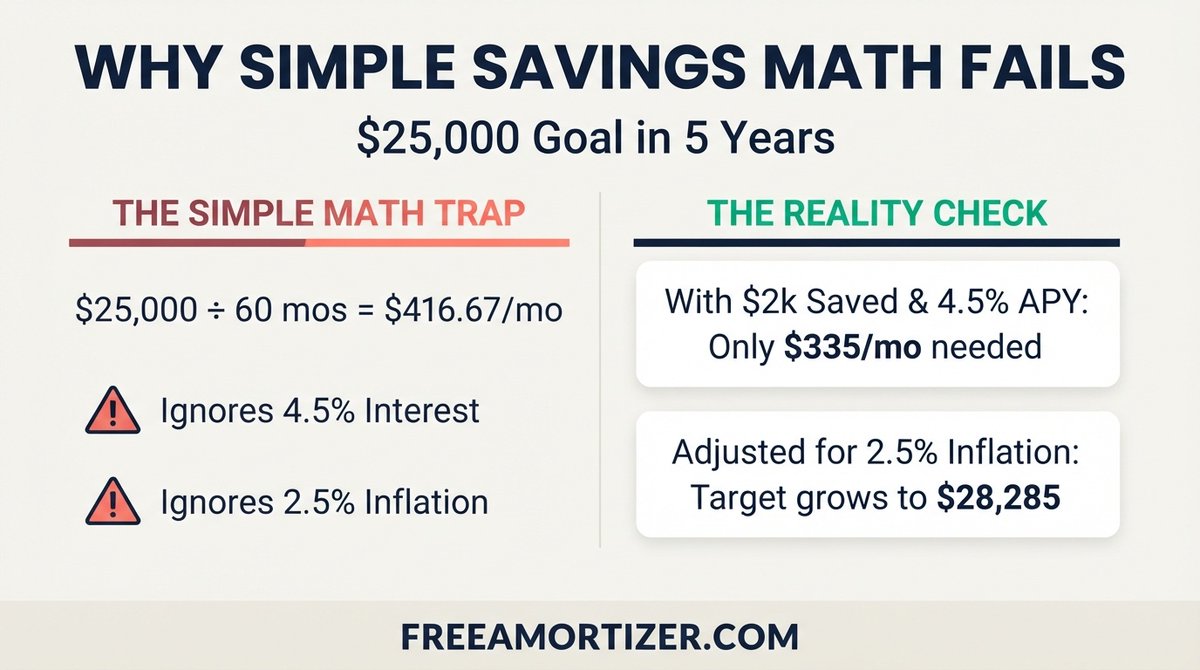
8/ If you want to skip the spreadsheet math and test different timelines or inflation rates in seconds, you can plug your numbers into this free savings goal calculator:
https://t.co/XNKzOhgiBZ
AVOID SIMPLE MATH WHILE SAVING
1/ When most people set a savings goal, they do simple division. Want $25,000 in 5 years? Divide $25,000 by 60 months = $416.67 a month.
Whereas it’s quick math and completely natural, it’s also usually wrong.
7/ Next time you set a target, don't just divide by the number of months.
Factor in what you already have, a realistic interest rate, and whether your goal needs to be adjusted for inflation.