"Customers will upload a part and everything downstream will be manufactured autonomously within the next 12 months."
Our founder & CEO Erik Palitsch in the @latimes. We're building the factory that lets hardware companies scale from one part to thousands. Don't sleep on @freeform_future.
https://t.co/nRLKfbNZyy
#DefenseTech #Manufacturing #Reindustrialization #PhysicalAI
Break every problem down to first principles. The old ways no longer serve what the future needs.
@MachinaLabs_ founder @EdwardMehr and @ErikPalitsch break down what @SpaceX taught them and how those lessons apply to the hard problems we’re solving today.
$57 of steel vs a $2,000 machined part.
Where did the other $1,943 go?
@freeform_future CEO @ErikPalitsch joins our CEO @EdwardMehr to unpack the first-principles thinking behind SpaceX and why being willing to blow up an engine was part of the learning process.
What does a factory look like when the boundaries between operations disappear?
Sensing and control span every step. Parts move as one continuous process. The factory is the machine.
@ErikPalitsch and @EdwardMehr dig into it at @MachinaLabs_.
Full discussion👇🏽
Everyone wants to be physical AI. Very few are generating the physical data that justifies the term.
Without it, you’re riding the bandwagon. The future belongs to software and hardware built together from day one. @ErikPalitsch@EdwardMehr
Full episode in the comments.
America doesn't need to rebuild the factories of the 1950s. It needs to invent the factories of the future.
@EdwardMehr and @freeform_future CEO @ErikPalitsch discuss reindustrialization, lessons from SpaceX, outmaneuvering China, and the future of physical AI.
Full discussion 👇
If your “physical AI” is only trained on simulation, it’s not physical AI. Sim doesn’t have porosity. Sim doesn’t have thermal drift. Sim doesn’t have a bad batch of material.
Real data comes from your own machines making real parts. Everyone else is grabbing the words, shipping hollow marketing, and diluting the term for the companies actually doing the work.
#advancedmanufacturing #physicalAI
For years, additive couldn’t make it past prototyping. The process wasn’t repeatable, the parts were hard to certify, and the economics never worked at volume.
The new generation of 3D printing fixes those problems at the root, with smarter process control, more efficient throughput, and consistent production-grade parts. That’s why this is the moment. The technology finally matches the demand, and the government needs manufacturing capacity it can’t get from legacy supply chains.
https://t.co/Vag6mGyZ0U?
38 lasers. Real-time scheduling. A three-day print that can’t survive a single crash.
Sam Secondo writes the software that decides which lasers fire, and where, on @freeform_future's printers. On the edge, the only layer between you and molten metal is your own software.
#EdgeComputing #AdvancedManufacturing #softwareengineering
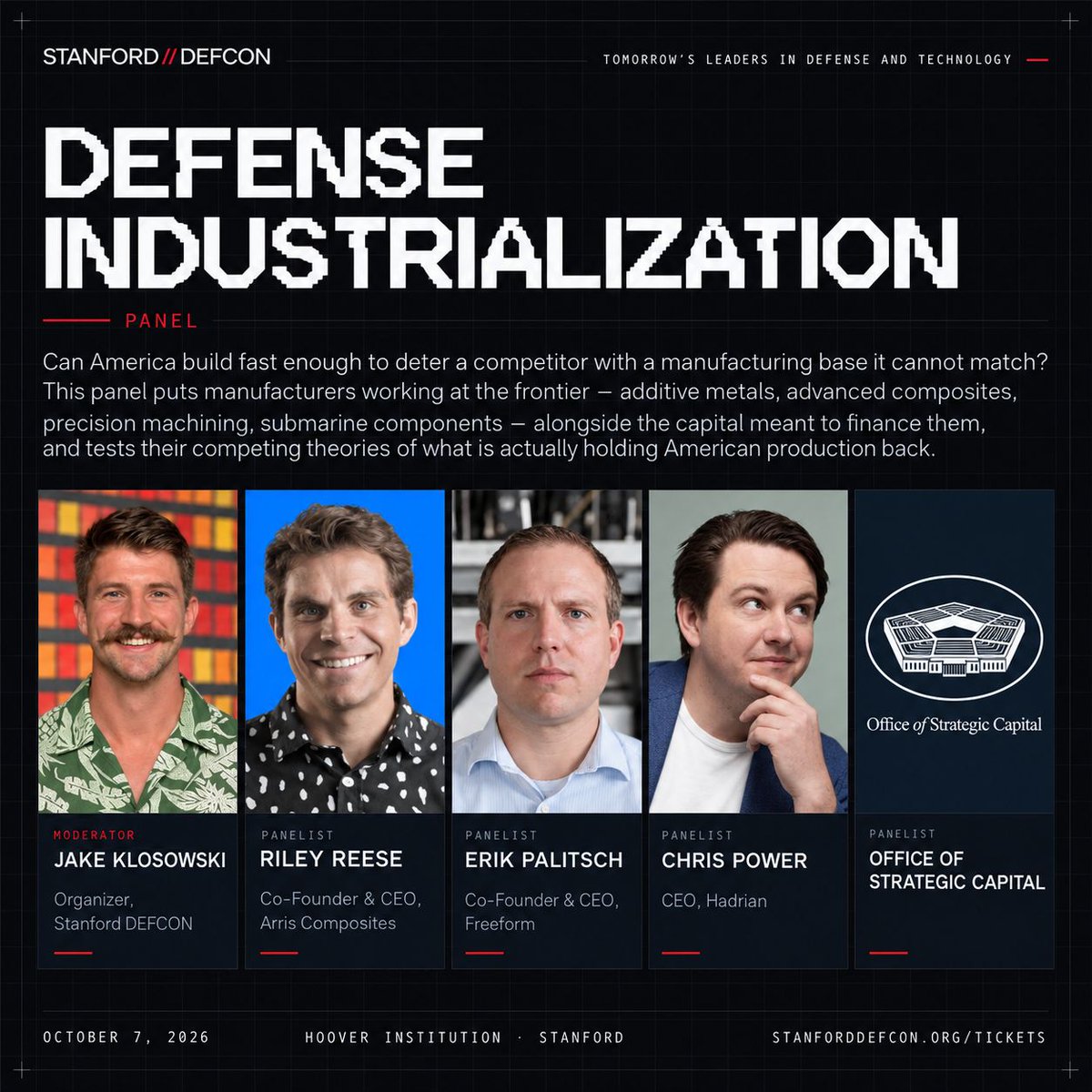
Great week at Stanford’s Defense Industrialization panel. Main takeaway is America won’t win the race the old way. We must:
- Innovate, don’t integrate. New factories should be automated by design.
- New technology requires new approaches to qualification.
- Build what comes next, not what already exists.
#AmericanManufacturing #DefenseTech
Nandana is the Mechanical Technical Director at @bruinracing and a rising senior in mechanical engineering at @UCLAengineering. This summer at @freeform_future, she owned the commissioning of our new depowdering system.
Parts come out of our printers buried in metal powder, and all of it has to come off before they move through post processing. The current system on our smaller printer can’t handle the volume that Skyfall produces, so Nandana commissioned the new one.
Manufacturing engineering is where theory meets the floor, problems get solved in real time, and those solutions end up as parts in the hands of our customers.
#MechanicalEngineering #AdditiveManufacturing #EngineeringInternship
We think its essential to completely rethink the way products are made on a fundamental level. Not just replace labor with humanoids. Sure automated factories are an important part of what our future industrial base looks like, but if the foundational technology looks the same as it used to, we're not actually getting anywhere.
The hardest problem in American defense manufacturing isn't scale. It's that we keep mistaking assembly for invention.
We're excited for our founder & CEO @ErikPalitsch to take the stage at the Defense Industrial Summit at Stanford this week. Rebuilding the defense industrial base won't come from retrofitting a supply chain built for another era.
Innovation is the only path to progress. That's the reason we exist.
#DefenseTech #AdvancedManufacturing #DefenseIndustrialBase #Reindustrialization