Today, we share a breakthrough on the planar unit distance problem, a famous open question first posed by Paul Erdős in 1946.
For nearly 80 years, mathematicians believed the best possible solutions looked roughly like square grids.
An OpenAI model has now disproved that belief, discovering an entirely new family of constructions that performs better.
This marks the first time AI has autonomously solved a prominent open problem central to a field of mathematics.
Elon Musk thinks the entire education system is built on a broken assumption.
That every student should learn the same thing. At the same speed. In the same order. At the same time.
Musk: “Everyone goes through from like 5th grade to 6th grade to 7th grade like it’s an assembly line. But people are not objects on an assembly line.”
The model was designed for a factory economy. Standardized inputs. Predictable outputs.
That economy is gone. The assembly line is gone.
But the education system still runs on its logic.
A student who masters algebra in two weeks sits through eight more weeks because the calendar says so. A student who struggles gets dragged forward because the schedule doesn’t wait.
Neither is being served. Both are being processed.
Musk: “Allow people to progress at the fastest pace that they can or are interested in, in each subject.”
AI doesn’t teach a classroom. It teaches a student.
One at a time. Every time.
It skips what a student already knows. It finds where they’re stuck and approaches it from a different angle.
It adjusts in real time. Not at the end of a semester when the damage is already done.
A student obsessed with basketball learns fractions through shooting percentages. A student who builds in Minecraft learns geometry through architecture.
The subject doesn’t change. The entry point does.
No teacher with thirty students can do this. Not because they lack skill.
Because the math doesn’t work.
AI doesn’t have that constraint.
Musk: “You do not need to tell your kid to play video games. They will play video games on autopilot all day. So if you can make it interactive and engaging, then you can make education far more compelling.”
The brain isn’t broken. The format is.
Kids learn complex systems and strategic thinking for hours voluntarily. Then walk into a classroom and can’t focus for twenty minutes.
That’s not a discipline problem. That’s a design problem.
Musk: “A university education is often unnecessary. You probably learn the vast majority of what you’re going to learn there in the first two years. And most of it is from your classmates.”
Four years. Six figures of debt.
And the real value comes from the people sitting next to you. Not the institution charging you.
The degree doesn’t certify knowledge. It certifies endurance.
Musk: “If the goal is to start a company, I would say no point in finishing college.”
The system was built to train employees. If you’re not trying to be one, it has nothing left to offer you.
Every lecture. Every textbook. Every curriculum. Now available instantly. Personalized to any learner. Adapted to any pace.
The question isn’t whether the old model survives.
It’s how long we keep forcing students through it while the replacement already exists.
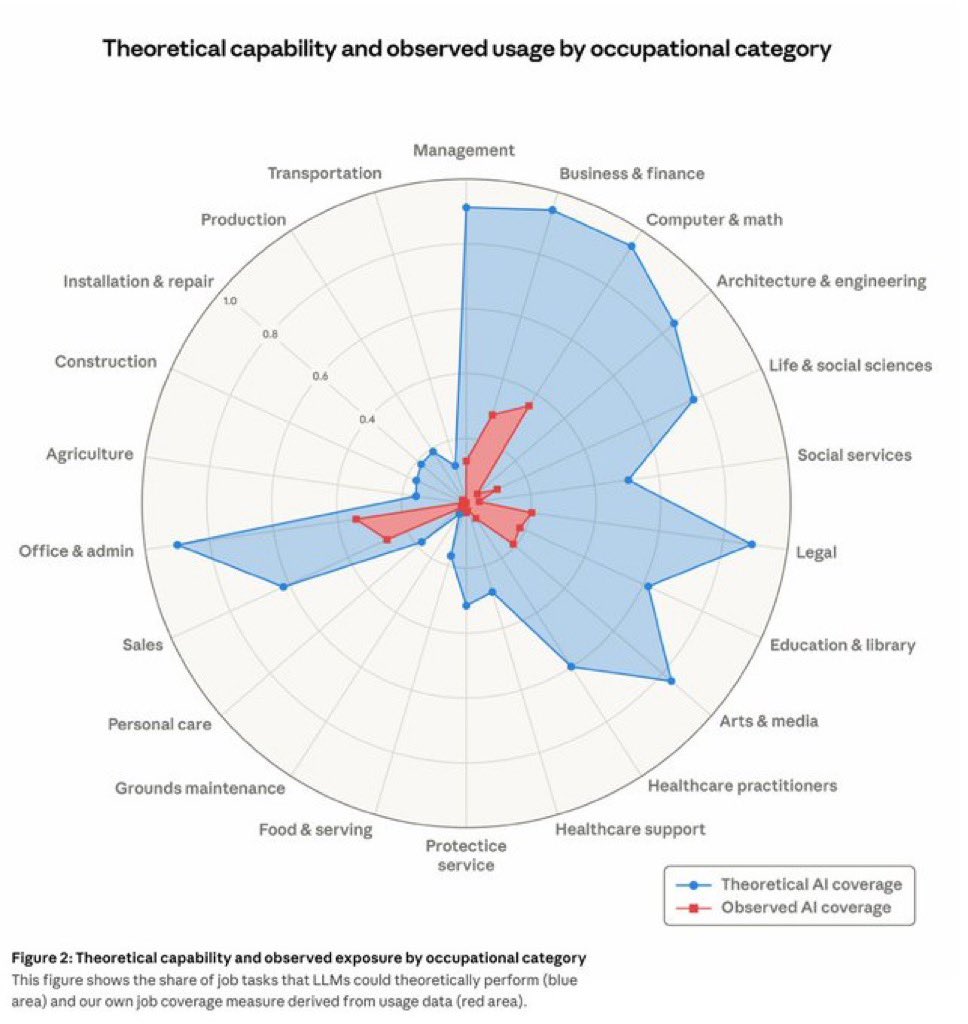
Anthropic just released the most IMPORTANT chart in the AI labor debate.
This comes from the company that builds Claude using data from 2 million real conversations.
Here’s what it shows.
The blue area is every task AI could theoretically do right now.
The red area is what people are actually using it for.
The gap between them is enormous and that gap is your career runway.
Computer programmers are already 75%
covered.
Customer service reps, data entry workers, financial analysts, they’re next.
But here’s what no one is talking about.
The mass layoffs haven’t really started.
Unemployment for exposed workers hasn’t budged.
So what’s actually happening?
Companies are closing the front door, hiring for workers aged 22 to 25 in AI exposed jobs has dropped 14%.
The most exposed workers aren’t factory workers, they’re college educated, higher earning.
49% of US jobs now have at least a quarter of their tasks inside AI’s reach.
That’s up from 36% just one year ago.
And the red area on that chart,
the real world usage is still a fraction of what’s possible.
Every month, it grows a bit.
Anthropic built the scoreboard and most people haven’t looked at it yet.
We’re scaling up robotics in Europe. 🤖
Our Robotics Accelerator is tailored for startups and designed to bridge the gap between technology and business, powering the next generation of physical agents.





![susumuota's tweet photo. [1/30] 40 Likes, 4 Comments, 5 Posts
https://t.co/o4yae8pyCF cs․AI | cs․CY, 23 Feb 2026
🆕Agents of Chaos
Natalie Shapira, Chris Wendler, Avery Yen, Gabriele Sarti, Koyena Pal, Olivia Floody, Adam Belfki, Alex Loftus, Aditya Ratan Jannali, Nikhil Prakash, Jasmine ... https://t.co/ACGizyjwTd](https://pbs.twimg.com/media/HChs_96bgAAnhGC.jpg)