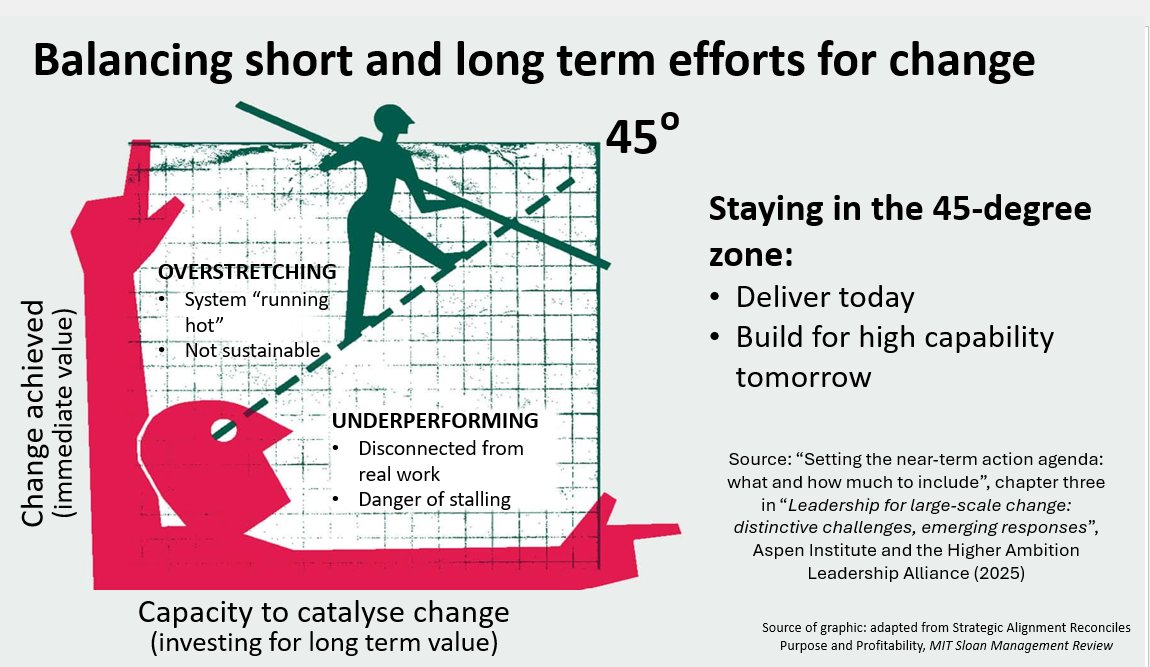
“The 45 degree zone” is an important principle for organisational & system change. It represents the balance point in large-scale change efforts between two vital types of progress: achieving tangible short-term results AND building long-term capacity for further change.
Remaining in the 45-degree zone means that, as leaders of change, we advance our initiatives in ways that both deliver impact now & strengthen the system for future impact. Too much emphasis on rapid short-term results can overextend people & processes, risking burnout or change failure. On the other hand, taking our eye off the ball of delivery & focusing excessively on building for the future can slow momentum & frustrate stakeholders expecting visible progress.
Leadership research supports the principles behind the 45 degree zone. Leaders who can flex between exploratory (the future: experimenting & learning) & exploitative (the current: driving focus & delivery) achieve stronger performance & engagement. That’s the case even after controlling for whether leaders have transformational or transactional leadership behaviours.
Five ways to stay in the 45-degree zone
1. Blend action with learning: Design initiatives that deliver outcomes while generating new knowledge. “Learning by doing” ensures each project both achieves impact & improves capability for the next cycle of change.
2. Develop leaders everywhere: Invest in building capacity to lead & engage people widely in change so results aren’t dependent on a few individuals. This widens future capability without halting present progress.
3. Balance the portfolio of change activities: Adopt hybrid strategies combining fast-progress, narrow-focus projects with broader, exploratory efforts, advancing both the pace & scope of change.
4. Engage decision makers/stakeholders on both fronts: Demonstrate the importance of supporting organisational infrastructure & capability, not just visible metrics of success, reframing investment in capacity as essential to outcomes.
5. Use reflective cycles, bottleneck analysis & other improvement tools: Regularly diagnose constraints that limit progress & performance (e.g., skills, relationships, resources) & address them strategically to relax tensions between achieving results & strengthening the system
The “45 degree zone” from the @AspenInstitute & Higher Ambition Leadership Alliance: https://t.co/CRpOkvA6CV
Research on balancing current & future focussed leadership by Hannes Zacher & colleagues: https://t.co/Fezt5jw2CB
We’re developing clinical governance standards that will provide assurance that healthcare is delivered in line with best practice, national policy and legislation.
The consultation on our draft standards closes on 2 Sept. We welcome your feedback.
Link is in the comments.
The building blocks to quality improvement that form the roots of most projects.
While the tools and techniques on top of them may vary depending on the context, these foundational elements are essential to successful and sustainable improvement:
The Scottish Approach to Change is now live on our corporate website! 😃 This valuable resource is designed to support teams and individuals to make meaningful improvements in healthcare. Head to our website to find out more. Link in comments.
Loved drawing this for NHS Highland - 7 factors for caring with compassion.
A great source to use to check in with teams and to reflect on ourselves
Find out more about what I offer here: https://t.co/0kONpqSnHB
What is the difference between cooperation, coordination & collaboration?
1) Cooperation - making sure our respective activities don't conflict; doesn't require high levels of trust, we just need to respect each other's space & activity.
2) Coordination - moving together towards a known shared outcome; requires greater trust as we rely on one another to do the work to achieve the common goal.
3) Collaboration - uniting people to create something new together that we couldn't accomplish alone; needs strong interpersonal trust.
We need all three in different contexts. When it comes to leading across systems, we get the best outcomes when we invest in the strong trusting relationships that enable us to collaborate: https://t.co/P8IGk3PiP3. By Ed Morrison @Strategic_Doing.
Deeper dive: https://t.co/i2Mv1w4hC0
We're keen to hear from midwives who deliver antenatal booking appointments.
Your feedback will inform our work to help improve antenatal care.
Share your insights in this 5-minute survey⤵️
Closes Sun 19 Jan: https://t.co/14b6eABubp
We may not be able to change the whole world, but our small acts of kindness still make a big difference 💕
You can help spread some joy by using and sharing the December Kindness calendar https://t.co/kD5nLQS9DK #DoGoodDecember
A great way to feel happier and build resilience is to try a new activity or take a different approach ✅
Join us for #NewWaysNovember to get daily ideas and find new ways forward https://t.co/VeJd1aAnzo
It's helpful to stay hopeful, especially in difficult times🌈 Join #OptimisticOctober and find ways to make things better and take positive steps forward https://t.co/Zwx28pfkXB
Are you a #HealthVisitor in Scotland? Have you been working as a HV since at least 2019? Opportunity to participate in research #Covid19 - more details ⬇️ Please share/repost with networks. Scan the QR code or access link in the thread to share your interest #SupportingFamilies