Ayer la vieja re puta que manejaba el Uber me quería cobrar adicional el peaje (que ya está incluido y en el desglose), casi me convierto en el protagonista de Magnetizado.
Personas que escuchaban Gente Sexy, ¿alguna recuerda y tiene por ahí esa foto en la que estamos elalesi, Calo y y yo un fin de año rotos y dormidos en la radio?
How fast is your 5K?
• 12–14 min = Olympic-level
• 14–18 min = Elite
• 18–22 min = Competitive
• 22–25 min = Average
• 25–30 min = Fit enough
• 30–40 min = Beginner
Over 40?
You’re out there trying. And honestly… that counts more than people admit.
Most people won’t even test themselves over 5K. They’ll stay comfortable and never find out.
You did. That already puts you in a different group.
Running progress can be weirdly quiet.
No huge breakthrough.
No obvious moment where everything changes.
Just the same routes, the same easy effort, the same normal days that do not feel important at the time.
Then one day a pace that used to feel like work starts showing up without much drama.
That is usually the kind of progress worth trusting.
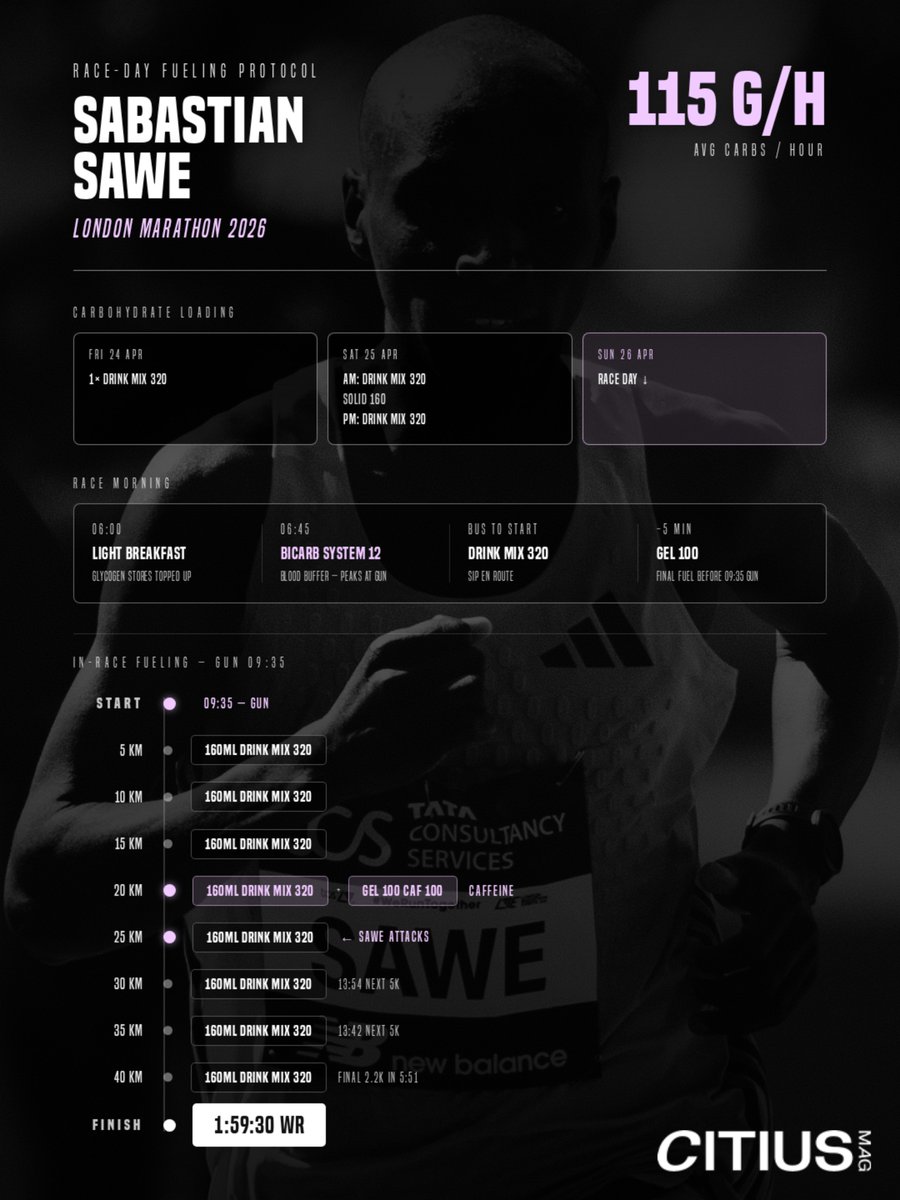
How did Sabastian Sawe fuel during his 1:59:30 marathon world record?
The Maurten team has shared his fueling plan.
The Maurten research team was embedded with Sawe’s team in Kenya for 32 days across six trips between last and this April. They were training his gut to absorb that load by mimicking race-day protocol in training. The hydrogel technology they have developed over the past 10 years now allows athletes to absorb 90–120 grams of carbs per hour without GI distress. In addition to that, sodium bicarbonate is also used, essentially a blood buffer since it neutralizes the lactic acid buildup that causes the burning sensation in muscles during high-intensity effort.
Sawe used both of Maurten’s products for it on race day. Taking the bicarb early is deliberate since it peaks in the bloodstream roughly 60–90 minutes after ingestion, so the timing of 2+ hours before the race would put peak buffering capacity right at the start.
Sawe told the media in the press conference that he had two pieces of bread and tea with honey as his breakfast before the race.
What in the world did we just see!
The 2 hour marathon barrier has been broken. Three guys went under the old world record...
Sabastian Sawe just ran 1:59:30 with crazy negative splits, closing the last half in 59:01....faster than the American Record in the half.
One of the most mind blowing performances we've seen. How did we get here?
Every breakthrough is a mixture of belief and progress.
It takes folks daring to see what's possible, surrounding themselves with a quality team and doing the work to give themselves a shot.
You've got to bet on yourself in a big way.
When asked whether he believed he could run a sub-2-hour marathon before the race, Sawe answered with one word:
"Yes."
Let's get the obvious out of the way. Performance enhancing drugs are the legitimate question mark to every breakthrough.
So Sawe did as much as he could about taking that off the table.
He and his team asked to be tested all the time. His sponsor put up 50K to the Athlete Integrity Unit. The tests are run independently, no advance notice. Over a 2 month stretch, he went through 25 drug tests.
There's always a doubt. There has to be given what we know. Hopefully there's transparency in the results. But hats off to Sawe for addressing it:
"I want to prove that I am clean when I set foot at the start line."
But how'd we actually get here where two guys went sub 2 in the same race?
1. Shoe tech
We've had a revolution in shoe technology that boosts running economy.
For years shoe companies said their shoe would make you faster and was mostly marketing. Until 2016, when it actually did.
Initial research showed a 3-4% saving in economy, while subsequent work has shown it's highly variable.
Now, it's a matching game. Find the perfect shoe for your form and you can get a big boost.
Normally, it takes years of lots of miles and strength training to boost economy.
But now we get that instant boost that not only helps boost performance but often leaves us feeling less beat up in the later stages of the marathon.
So we get a little bit less hitting of the wall...
2. The fuel
For a long time, fueling was limited by biology. You can only take in and process so much.
Then in the 2000s, researchers found if we mixed sugars, we can boost intake because they're processed differently.
Then recently, Maurten found if you use a hydrxogel, you boost utilization without GI distress anymore.
We've gone from pushing 60g/hr to 120g/hr in a few decades.
Again...less bonking.
3. Depth
A few decades ago, you spent your career racing on the track and then once your speed started to fade a bit you went to the marathon.
Now, many skip right to the marathon. That's where the money is.
And with the economy boost from the shoes, you can make that jump quickly.
More depth of talent means more competitors in their prime pushing barriers.
4. Belief
Even with the shoes and tech, a few years ago sub 2 hours seemed a long way off, until Kipchoge pushed that barrier in a series of time trials.
Yes, they weren't official races and had contrived pacing. But it absolutely shifted everyone's thinking on what is possible.
A generation of runners saw Kipchoge go for it.
Our prediction of what is possible changed.
It's mind blowing how far we've come in such a short time.
What once seemed decades away, just got smashed twice in the same race.
Hats off to Sawe, especially for addressing the scourge of doping and showing folks what is possible with a lot of hard work, some crazy belief, and some fortuitous advances.
April 26, 2026.
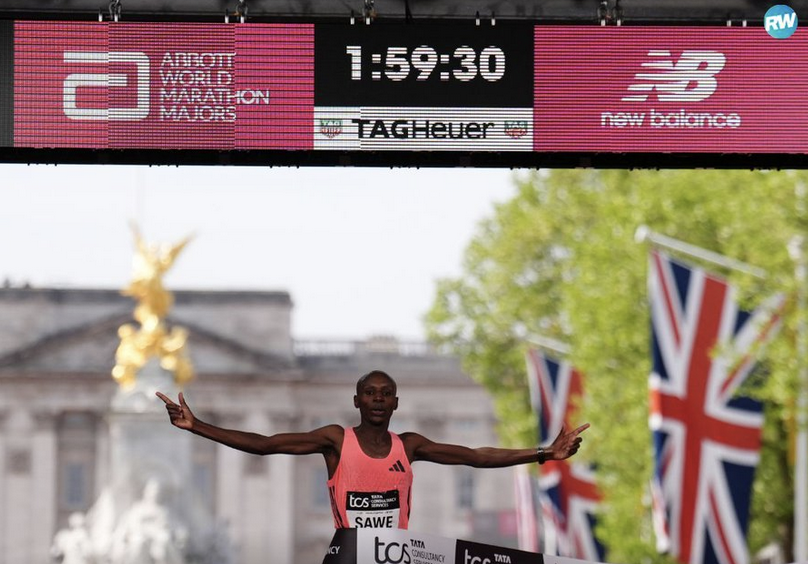
Sabastian Sawe does it.
The first man to break 2 hours in a record-eligible marathon.
1:59:30 to win the most incredible London Marathon in history.
Yomif Kejelcha runs 1:59:41 IN HIS DEBUT and finishes 2nd!
https://t.co/hmS5ykXyu4