You cannot ruminate on a promise you do not trust. And you cannot trust a promise without intimately knowing the person behind it.
Scripture doesn’t just invite us to hold God’s promises; it commands us to dwell on them, to let our imaginations run wild with them, presenting this deep meditation as an antidote to our pain. Yet, most of us find this impossible. Why? Because we try to claim the promise without studying the Promiser.
A promise is only ever as strong as two things: the promiser's capacity, and the promiser's heart toward you.
I learned this as a kid. A wealthy woman in our church told me she was going to buy me a gift after hearing about my good grades. Because I knew she was rich, I let my mind race. A new bicycle? A brand-new football?
When the gift finally arrived, it was a pack of honey-coated peanuts that cost less than a dollar. I was crushed. It wasn’t that she was a bad person; it was simply that she didn’t care about me all that much. She had the immense capacity, but I didn't have as much of her affection as I thought I did.
Capacity without a relational investment still delivers disappointment.
This is exactly what 1 Corinthians 2:9 is challenging us to understand: “Eye has not seen, nor ear heard... the things which God has prepared for those who love Him.”
To truly receive a sentence like that, your imagination needs somewhere to go. But your imagination will only go as far as your knowledge of God allows.
If a wealthy stranger promises you an extraordinary gift, your mind immediately calculates a rational ceiling based on how little you mean to them.
Resource has limits, and so does casual interest. But if that same promise comes from someone of staggering, unimaginable wealth who is fiercely, extravagantly devoted to you, then the ceiling completely vanishes. You stop calculating, and you start imagining.
God’s capacity is entirely without boundary. And His heart toward you is generosity at the root; it is the very substance of His nature.
The Apostle Paul settles the relationship question before we even have the chance to ask it. He writes, “He who did not spare His own Son, but delivered Him up for us all, how shall He not with Him also freely give us all things?”
The Son was the costliest gift in existence. If the cross is the floor of God's generosity, then there is no ceiling. You are not petitioning a wealthy stranger who is sitting back, casually deciding whether you have earned a fraction of their abundance. The depth of His investment in you was answered forever at Calvary.
Scripture goes further still: no human has ever tasted even a fraction of the pure bliss and satisfaction that God Himself permanently inhabits. He is the most replete, overflowing being in existence. When He promises beyond what your mind can reach, He is drawing from a treasury that has never known shortage, and a nature that has never known withholding.
Most people spend their lives holding the covenant with a grain of salt because they are trying to receive the promise without ever studying the One who made it.
At the farmers market with my so called girlfriend. She hands me her cell phone, says it’s my dad. Mannn this aint my dad, this is a cell phone. I threw it on the ground
@Dorag0nX@PhrogPollen Not only is this not biblical, it's also a broad generalization.
All people are bad people. That's why we need grace in the first place.
When the standard is God's perfect holiness, we all fall dramatically short.
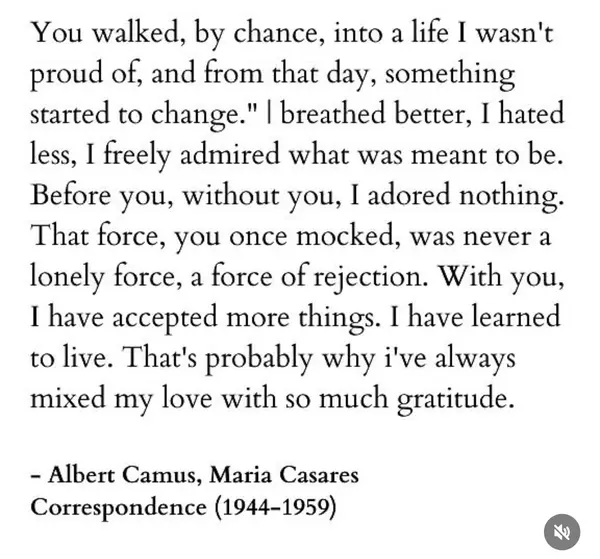
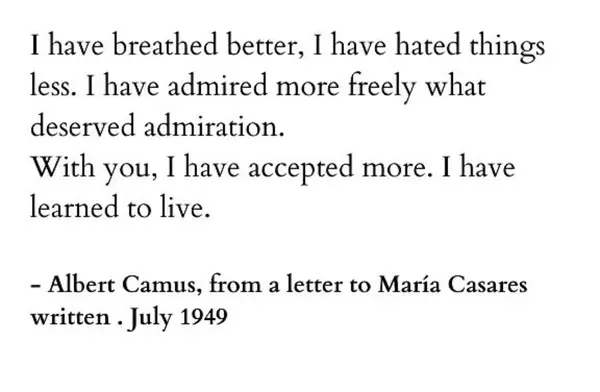
'with you, i have accepted more. i have learned to live..without you, i adored nothing'
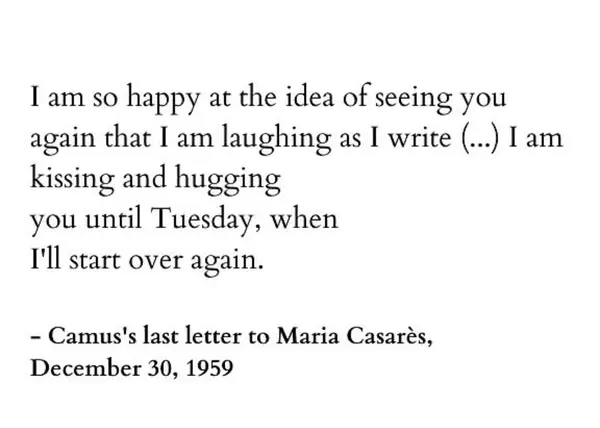
what love does through some of my favourite letters by Albert Camus to Maria Casares