The dazzling Tarantula Nebula, with its sprawling 1,000 light-year reach in the Large Magellanic Cloud, captivates with its tarantula-like brilliance and is a central hub for massive star formation research.
(Credit: TRAPPIST/E. Jehin/ESO)
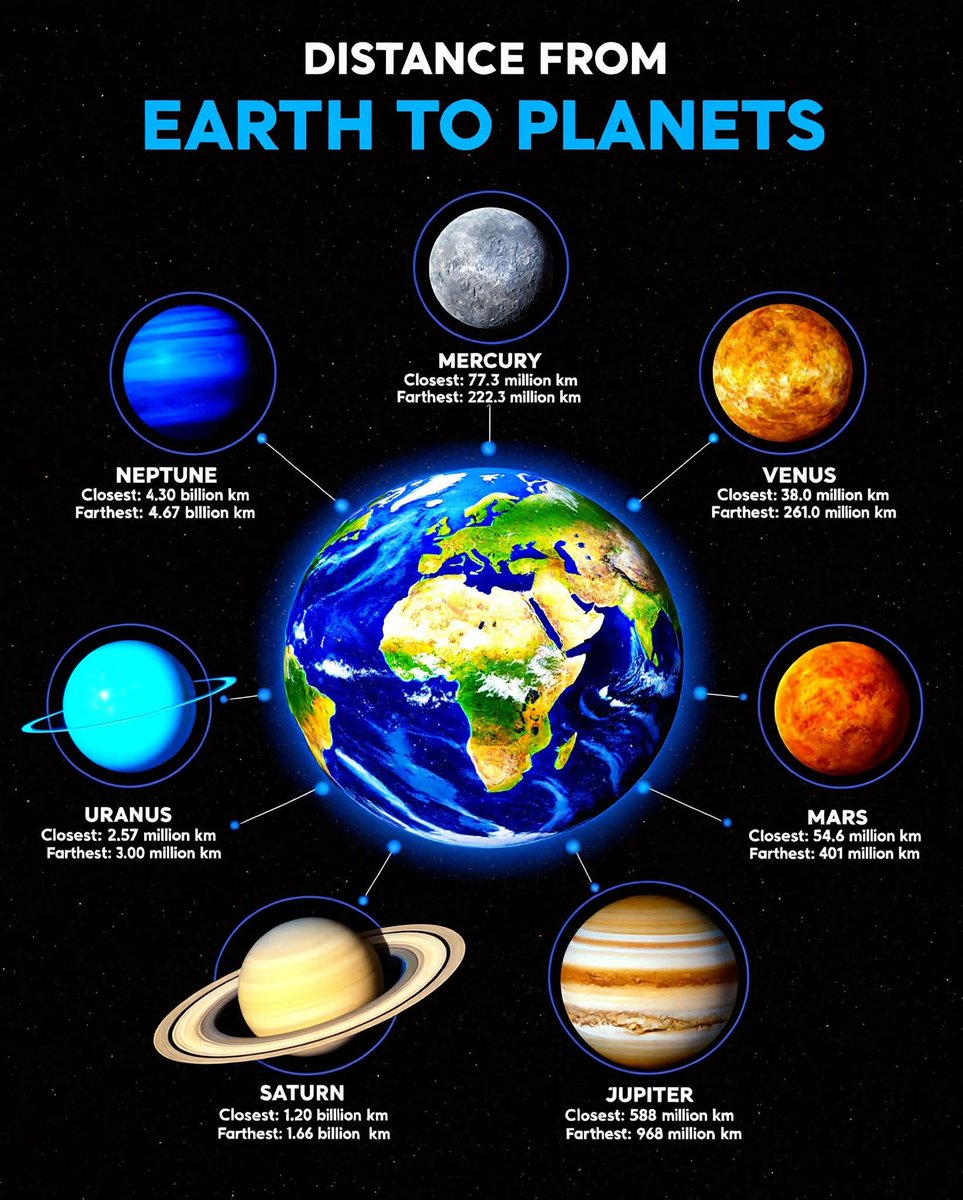
The planets of our Solar System may look like neighbors in textbooks and diagrams… but in reality, they’re separated by mind-boggling distances. Imagine shrinking the entire Solar System to the size of a football field. The Sun would be a grapefruit at one end, Earth a grain of sand 15 meters away… and Neptune would sit at the opposite goal line, nearly 100 meters distant. Real distances are even more humbling:Venus, our closest neighbor, swings as near as 38 million km — yet a spacecraft still needs several months to reach it.
Mars can be 55–100 million km away depending on orbital positions.
Jump to the outer planets and the gaps become enormous: Jupiter lies over 600 million km from Earth, Saturn more than a billion, while Uranus and Neptune float in the cold darkness 2–4.5 billion kilometers away.
These vast empty stretches are exactly why even our fastest probes take months to years to arrive. New Horizons needed nearly 10 years to reach Pluto. A crewed mission to Mars is still a multi-year round trip.The immense scale doesn’t just show how challenging interplanetary travel is — it makes every successful mission an astonishing triumph of human ingenuity. Every probe we’ve sent, every rover that’s landed, and every picture we receive from another world is a hard-won victory across cosmic oceans of emptiness.Our Solar System is far grander — and far emptier — than most illustrations ever let on.
Everyone's out here waiting for aliens to arrive.
WE are the aliens.
A camera we built is orbiting mars right now, staring into a crater no living thing has ever seen. crossed the void, showed up unannounced, peeked inside.
In this story we're the visitors from another world.
and honestly? kinda iconic of us 🪐