@OldNewYork1664 I've never been able to find New York reference apart from a couple of newspaper articles on this case. It left me wondering about black and native syncretic beliefs during the period.
In 1870, Thurlow Weed claimed that Lansing had been murdered at the behest of multiple influential men, that he had intended to identify them after they died, and that on further consideration, he had elected not to, in order to spare their surviving families the anguish.
I find it fascinating that our local NY accent is really Dutch accented English and spoken originally by the inhabitants of what was called Breuckelen. The syntax and phonetics are eerily familiar to me as a native speaker, let’s look at some examples given by Jonathan Kruk.
“Or else de imp will give him a peg leg”
“Dondah-Boig, Youse must tip yer hat ta da heer O’da Dondeh-Boig.”
The first sentence contains “de” which is the common local replacement from a “th” sound.
The second sentence contains even more evidence, “Boig” is an example of pronunciation that has carried over to the present day in the form of the Dutch “Berg” to the use of “Youse” to denote an individual or 3rd group. Take the use of “da” sound standing in for “the.” Just ask any New Yorker to pronounce “The Bronx” and you’ll find this alive and well. “O’da” is a common local shortened example “of the.” Finally “ta” is a common local replacement for “to.”
Dewulf writes at the moment the Dutch language was dying out in New York, there would have been more than 150 years of interaction between the low variety and English. There was a strong accent mentioned in the sources, yet we have no idea what it sounded like.
Our best available evidence comes from mid 19th century newspaper articles that are peppered with a clear “d” replacing a “th.” Examples like “dots all,” “if dey,” or “my mudder,” shows clear Dutch influence on the local New York dialect. Phrases are jumbled like “how does you do now-a-tays mit yourself,” creating a creole like “Englutch” throughout the Hudson Valley.
So where is that unique NY dialect brewing, it’s going to be the Afro-Dutch mixing with the new waves of immigrants like the Irish or in urban areas from NYC to Albany. Segregated by ethnicity or origin, but mixing where the populations bordered each other, the dialect and accent grew, as the state’s population blossomed by the start of the 20th century.
An 1835 Nativist perspective:
From the New York Evening Star, June 22, 1835
Riots.--There was fighting yesterday (Sunday) in the neighborhood of the Five Points, which commenced in the afternoon and did not terminate until 9 o'clock in the evening. Fighting is no novelty in that neighborhood, but the present affray was of a more serious character, requiring the presence of the Mayor and police, and had its origin in the too free use of liquor and then outbreakings--disputes, quarrels, and finally riots, in which Americans and Irish freely commingled. It is unnecessary to enter into details--Such fights will always continue until Centre, Orange, Augustus and Anthony streets are opened, the property improved, and the liquor shops removed. Until these measures are adopted, it will be the head quarters of mobs.
The Times of this morning has thrown off the cloak, and comes out in favour of the Irish and against the Americans. Knowing as we do the influence which George D. Strong and his colleagues exercise over the columns of that paper, we have been for some time expecting it to take sides and it has done so. It commences as follows:
The American Party.--We predicted the other day when a meeting of unheard-of people, at some unknown place on the east side of the town, resolved to set up an American party, that no long period would intervene before they were joined by the leaders and managers of the late whig party, and by the prominent journals of that interest. It appears to be settled now that the disbanded whigs shall be rallied, and that they are to fight the next campaign under the name of the American Party.
The American people are here stigmatised by the name of an “unheard of people,” meeting at an “unknown place.” We fear that this is too true--we are strangers in our own land, and the sneers of the Times ought at least to awaken us to a sense of our own wrongs, and it is time that we Americans should be “known,” and known as the rightful rulers and proprietors of this country.
Of the cause and origin of the riots last night, the Times speaks as follows:
It commenced; we understand, by two men fighting in Centre street, near Roosevelt, and by some means an opportunity was afforded to follow out the recommendation of the Charter and Star, and get up a difficulty between a body of our native-born citizens, and those too- much persecuted people, both at home and abroad--the Irish.
“At home and abroad,” and in what instance has the Irish been treated with injustice in our country? They arrive here and find instant employment, good wages and comfortable homes. They enjoy the equal protection of our laws; but scarcely do they land, when renegade Americans manufacture them into citizens; give them rights which natives do not possess; incite them to riots at the polls, and to maltreat native citizens, and then sell their influence. They insist upon being represented, and are represented in Congress, in the Legislature, and in the Common Council: they insist upon a large share of the offices, and actually obtain them: foreigners turn out Revolutionary soldiers from office; and, finally, they aim at possessing the entire government, and are countenanced by the intrigues of our own countrymen. Is this the “abuse and persecution,” which the Times declare the Irish meet at our hands? We are the oppressed and persecuted, and not the Irish. We Americans are the sufferers.
We never have, and never will countenance any opposition towards the Irish, or any class of adopted citizens. Our advice to them has always been useful and friendly; it has been to remain quiet and industrious; to take no active part in politics, and, above all, to shun intriguing and selfish Americans, who set themselves up as leaders of Irishmen, and then dispose of their votes to the dominant party for the highest price; get these poor creatures into trouble, into disrepute, and into danger.
The Times will find that the American party, which they sneer at, is composed of the honest part of the republicans of Tammany Hall, who are determined to draw the line, and discard this foreign influence; and every patriotic American will join them, under whatever party name the Times may please to class them. In Ireland, the people rise against cruelty and oppression. There they have cause; but what cause can they possibly have in this country for riots and disorders, when they enjoy every blessing—every right—nay, more rights and privileges than native citizens?
New York Journal of Commerce, July 26, 1839
Out of 15 cases of "Murder of Violent Death" the city prosecuted three murder cases and one manslaughter case.
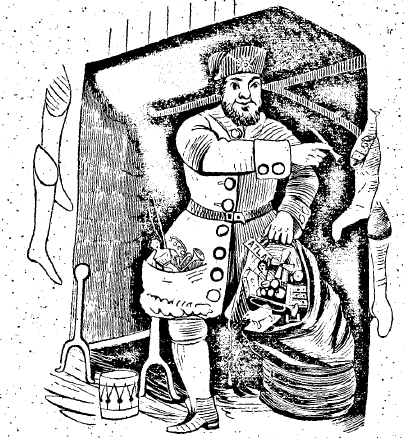
Sancta Claus goede Heiligh man,
Treckt uwen beste klederen aan,
En reys daer mee na Amsterdam,
Van Amsterdam na Hispanie
Waer appelen van oranjen
En appelen van granaten,
Die rollen door de straten;
Sancta Claus, myn goede vriend,
Ick hab it altyt, wel gedient
Alz gymy nu wat wil geaven,
Ick sal eu dienen al myn leveen.
HYMN OF THE DUTCH CHILDREN TO SANTA CLAUS
Santa Claus, good, holy man,
Put on the best clothes that you can;
Go clad therewith to Amsterdam,
From Amsterdam to sunny Spain,
Where oranges and apples reign;
And likewise those granate surnamed;
Roll through the streets all unclaimed.
Santa Claus, my dear, good friend,
To serve you ever was my end;
If you now something will give;
Serve you I will, long as I live.
@Alex_Hortis I was delighted to come on that passage last night. I'm about halfway through and am enjoying your able research and deft narrative choices.
During the 1845 murder trial of Polly Bodine, attorney Clinton DeWitt attempted to discredit a witness by exploring her history of seeing Staten Island apparitions.
Grateful for the New York Times' review of my new book The Witch of New York: The Trials of Polly Bodine and the Cursed Birth of Tabloid Justice. On sale now for release this Tuesday, March 5! https://t.co/TKmcQK9YIK
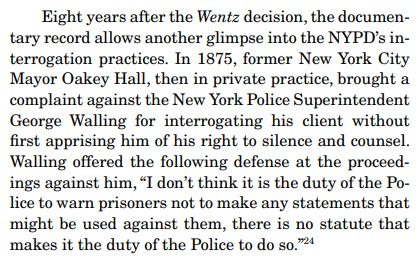
There's a rare Oakey Hall appearance in the robust and interesting historians' amicus brief in Vega v. Tekoh, seemingly contributed by Wesley Oliver of Duquesne.
https://t.co/flidzYW222