Today is the Nineteenth Sunday in Ordinary Time.
Go to Mass, it’s a holiday of obligation. God deserves our worship. Pray the rosary. The tiny whispering sound for Elijah; and Jesus’ stepping aside on the mountain by himself to prayer, reinforces the place of silence in the Catholic liturgy and spirituality. Here, the Holy Hour comes to mind.
Congratulations to @KeikoFujimori on becoming President of Peru.
She swore her oath beside a crucifix, a fitting symbol for someone whose Catholic faith runs through everything she does.
May God bless her and guide her service to the Peruvian people.
Today, we celebrate the
Memorial of Saint Dominic, Priest.
SAINT DOMINIC Gúzman was born in Spain in 1170. As a student, he sold his books to feed the poor in a famine, and offered himself in ransom for a slave. At the age of twenty-five he became superior of the Canons Regular of Osma, and accompanied his Bishop to France. There his heart was well-nigh broken by the ravages of the Albigenian heresy, and his life was henceforth devoted to the conversion of heretics and the defence of the Faith. For this end he established his threefold religious Order. The convent for nuns was founded first, to rescue young girls from heresy and crime. Then a company of apostolic men gathered around him, and became the Order of Friar Preachers. Lastly came the Tertiaries, persons of both sexes living in the world. God blessed the new Order, and France, Italy, Spain, and England welcomed the Preaching Friars. Our Lady took them under her special protection, and whispered to Saint Dominic as he preached. It was in 1208, while he knelt in the little chapel of Notre Dame de la Prouille, and implored the great Mother of God to save the Church, that Our Lady appeared to him, gave him the Rosary, and bade him go forth and preach. Beads in hand, he revived the courage of the Catholic troops, led them to victory against overwhelming numbers, and finally crushed the heresy. His nights were spent in prayer; and, though pure as a virgin, thrice before morning broke he scourged himself to blood. His words rescued countless souls, and three times raised the dead to life. At length, on August 6, 1221, at the age of fifty-one, he gave up his soul to God.
Today, we celebrate the Feast of the Transfiguration of the Lord.
All three Synoptic Gospels tell the story of the Transfiguration (Matthew 17:1-8; Mark 9:2-9; Luke 9:28-36). With remarkable agreement, all three place the event shortly after Peter’s confession of faith that Jesus is the Messiah and Jesus’ first prediction of his passion and death. Peter’s eagerness to erect tents or booths on the spot suggests it occurred during the week-long Jewish Feast of Booths in the fall.
According to Scripture scholars, in spite of the texts’ agreement it is difficult to reconstruct the disciples’ experience, because the Gospels draw heavily on Old Testament descriptions of the Sinai encounter with God, and prophetic visions of the Son of Man. Certainly Peter, James, and John had a glimpse of Jesus’ divinity strong enough to strike fear into their hearts. Such an experience defies description, so they drew on familiar religious language to describe it. And certainly Jesus warned them that his glory and his suffering were to be inextricably connected—a theme John highlights throughout his Gospel.
Tradition names Mount Tabor as the site of the revelation. A church first raised there in the fourth century was dedicated on August 6. A feast in honor of the Transfiguration was celebrated in the Eastern Church from about that time. Western observance began in some localities about the eighth century.
On July 22, 1456, Crusaders defeated the Turks at Belgrade. News of the victory reached Rome on August 6, and Pope Callistus III placed the feast on the Roman calendar the following year.
Copyright: https://t.co/Cn1rBTrNHX
Today, we celebrate the optional memorial of Saint Mary Major Basilica.
After the Council of Ephesus in 431, in which the mother of Jesus was acclaimed as Mother of God, Pope Sixtus III erected at Rome on the Esquiline Hill a basilica dedicated to the honor of the holy Mother of God. It was afterward called Saint Mary Major and it is the oldest church in the West dedicated to the honor of the Blessed Virgin Mary.
Today, we celebrate the Memorial of Saint John Vianney, Priest.
SAINT JOHN VIANNEY, patron of priests, known as the “Curé of Ars”. Saint John Mary Vianney, born during the days of the French Revolution, was ordained a priest in 1815. Three years later he was made parish priest of Ars, a remote French hamlet, where his reputation as a confessor and director of souls made him known throughout the Christian world. His life was one of extreme mortification.
Accustomed to the most severe austerities, beleaguered by swarms of penitents, and besieged by the devil, this great mystic manifested a imperturbable patience. He was a wonderworker loved by the crowds, but he retained a childlike simplicity, and he remains to this day the living image of the priest after the heart of Christ.
He heard confessions of people from all over the world for the sixteen hours each day. His life was filled with works of charity and love. It is recorded that even the staunchest of sinners were converted at his mere word. He died August 4, 1859, and was canonized May 31, 1925.
Today is the Eighteenth Sunday In Ordinary Time of the Year. Go to the Holy Mass; it’s an obligation we owe to God through his son, Jesus Christ. Pray the rosary for ourselves and for souls in the purgatory. Amen.
Today, we celebrate the Memorial of Saint Alphonsus Liguori, Bishop and Doctor of the Church.
ALPHONSUS was born of noble parents, near Naples, in 1696. His spiritual training was entrusted to the Fathers of the Oratory in that city, and from his boyhood Alphonsus was known as a most devout Brother of the Little Oratory. At the early age of sixteen he was made doctor in law, and he threw himself into this career with ardor and success. A mistake, by which he lost an important cause, showed him the vanity of human fame, and determined him to labor only for the glory of God. He entered the priesthood, devoting himself to the most neglected souls; and to carry on this work he founded later the missionary Congregation of the Most Holy Redeemer. At the age of sixty-six he became Bishop of St. Agatha, and undertook the reform of his diocese with the zeal of a saint. He made a vow never to lose time, and, though his life was spent in prayer and work, he composed a vast number of books, filled with such science, unction, and wisdom that he has been declared one of the Doctors of the Church. Saint Alphonsus wrote his first book at the age of forty-nine, and in his eighty-third year had published about sixty volumes, when his director forbade him to write more. Very many of these books were written in the half-hours snatched from his labors as missionary, religious superior, and Bishop, or in the midst of continual bodily and mental sufferings. With his left hand he would hold a piece of marble against his aching head while his right hand wrote. Yet he counted no time wasted which was spent in charity. He did not refuse to hold a long correspondence with a simple soldier who asked his advice, or to play the harpsichord while he taught his novices to sing spiritual canticles. He lived in evil times, and met with many persecutions and disappointments. For his last seven years he was prevented by constant sickness from offering the Adorable Sacrifice; but he received Holy Communion daily, and his love for Jesus Christ and his trust in Mary’s prayers sustained him to the end. He died in 1787, in his ninety-first year.
Today, we celebrate the Memorial of Saint Ignatius of Loyola, Priest.
SAINT IGNATIUS was born at Loyola in Spain, in the year 1491. He served his king as a courtier and a soldier till his thirtieth year. At that age, being laid low by a wound, he received the call of divine grace to leave the world. He embraced poverty and humiliation, that he might become more like to Christ, and won others to join him in the service of God. Prompted by their love for Jesus Christ, Ignatius and his companions made a vow to go to the Holy Land, but war broke out, and prevented the execution of their project. Then they turned to the Vicar of Jesus Christ, and placed themselves under his obedience. This was the beginning of the Society of Jesus. Our Lord promised Saint Ignatius that the precious heritage of His Passion should never fail his Society, a heritage of contradictions and persecutions. Saint Ignatius was cast into prison at Salamanca, on a suspicion of heresy. To a friend who expressed sympathy with him on account of his imprisonment, he replied, “It is a sign that you have but little love of Christ in your heart, or you would not deem it so hard a fate to be in chains for His sake. I declare to you that all Salamanca does not contain as many fetters, manacles, and chains as I long to wear for the love of Jesus Christ.” Saint Ignatius died on the 31st July, 1556.
Today we celebrate the optional memorial of Saint Peter Chrysologus. - Bishop and Doctor of the Church.
SAINT PETER was born about the year 380 at Imola in Emilia, and there entered the priesthood. He was elected bishop of Ravenna in 424 and instructed ahis flock by his learned semons and writings. He died around the year 450.
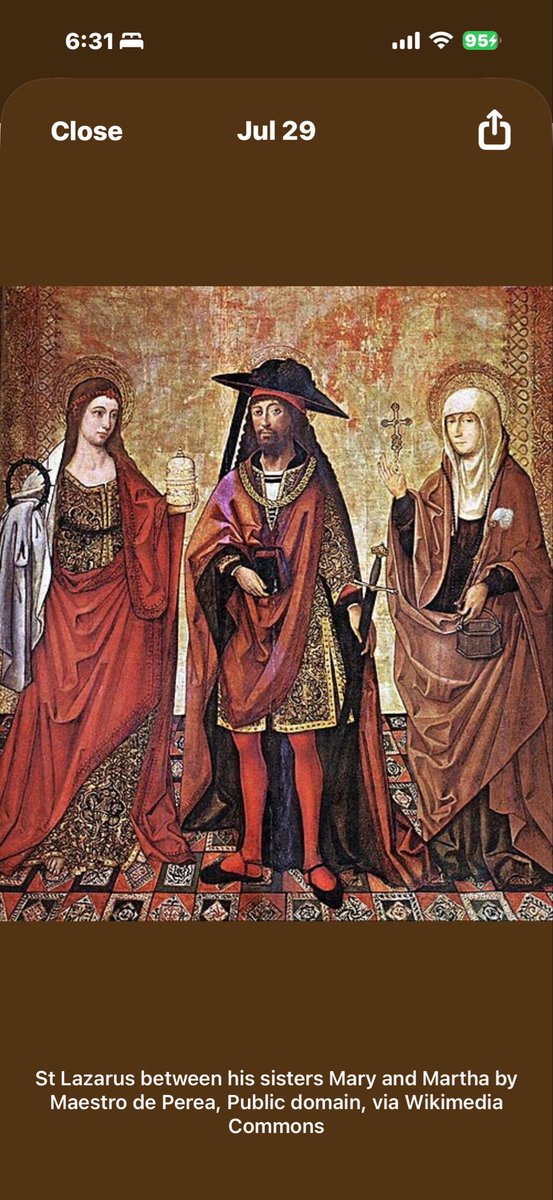
Today we celebrate the Memorial of Saints Martha, Mary, and Lazarus.
SAINTS MARTHA, Mary and their brother Lazarus were evidently close friends of Jesus. He came to their home simply as a welcomed guest, rather than as one celebrating the conversion of a sinner like Zacchaeus or one unceremoniously received by a suspicious Pharisee. The sisters feel free to call on Jesus at their brother’s death, even though a return to Judea at that time seems almost certain death. No doubt Martha was an active sort of person. On one occasion (see Luke 10:38-42) she prepares the meal for Jesus and possibly his fellow guests and forthrightly states the obvious: All hands should pitch in to help with the dinner.
SAINT MARY OF BETHANY was Martha’s sister, whose attitude in listening to Jesus was praised by him at their visit to her home (Luke 10:39-42). She is not to be confused with Mary Magdalen. At his final dinner at their house during Holy Week, she anointed Jesus’ feet in preparation for his death and burial.
SAINT LAZARUS, the brother of the sisters is mentioned in the Gospel of John. He was raised from the dead by Jesus (John 11) and later sought out by the enemies of Jesus.
Originally celebrated as the Memorial of Saint Martha, this Memorial was expanded in 2020 by Pope Francis to include the entire household at Bethany.
Because today is the Day of Our Lord, Sunday. Therefore, no other celebrations shares it with Him. But for catechetical purposes, we need to remember the grandparents of Jesus, whose feast falls today, July 26.
SAINTS JOACHIM and ANNE are the parents of Mary, the Mother of our Savior, Jesus Christ. They were privileged to be the grandparents of Jesus Christ. So, as the Church remembers Saints Joaschim and Anne today, they also remember Mary.
What we know about Mary’s parents, Joachim and Anne, come from Protoevangelium Jacobi (The Gospel of James). It is not part of the Bible, but the document, which was written c. 170 AD may give insight into the life of Mary and her parents. Joachim was a prominent and respected man, however, he had no children, and he viewed this as a punishment from God. In an answer to his prayers, he and Anne, his wife, were given the daughter Mary, who was conceived without sin. She remained sinless, ever-virgin, and was the Mother of God. Their prayers were answered greater than they could have ever imagined.
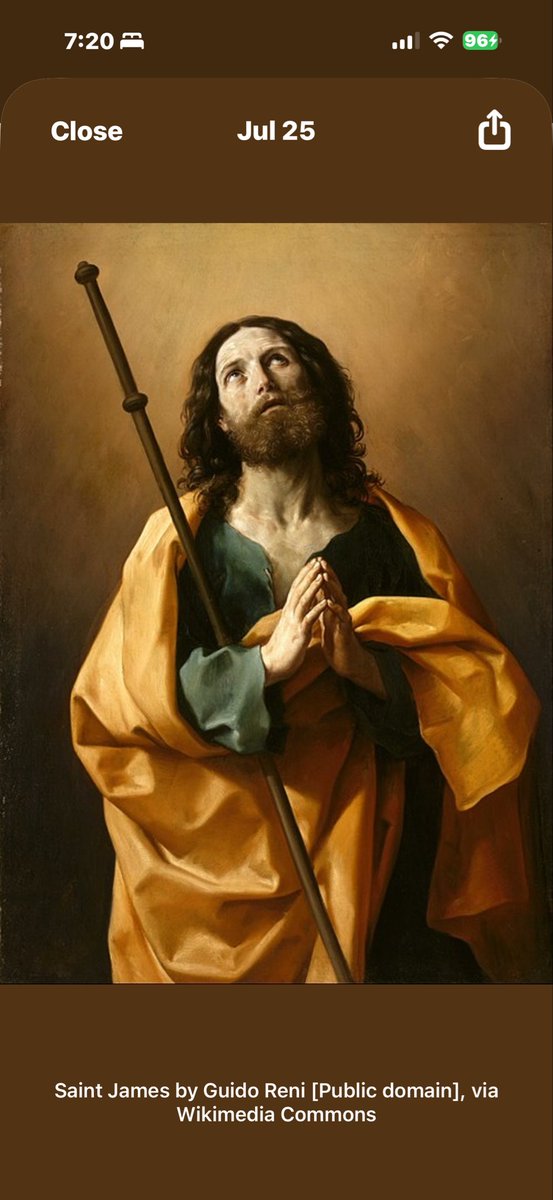
Feast of Saint James, Apostle.
Among the twelve, three were chosen as the familiar companions of our blessed Lord, and of these JAMES was one. He alone, with Peter and John, was admitted to the house of Jairus when the dead girl was raised to life. They alone were taken up to the high mountain apart, and saw the face of Jesus shining as the sun, and His garments white as snow; and these three alone witnessed the fearful agony in Gethsemane. What was it that won James a place among the favorite three? Faith, burning, impetuous, and outspoken, but which needed purifying before the “Son of Thunder” could proclaim the gospel of peace. It was James who demanded fire from heaven to consume the inhospitable Samaritans, and who sought the place of honor by Christ in His Kingdom. Yet Our Lord, in rebuking his presumption, prophesied his faithfulness to death. When Saint James was brought before King Herod Agrippa, his fearless confession of Jesus crucified so moved the public prosecutor that he declared himself a Christian on the spot. Accused and accuser were hurried off together to execution, and on the road the latter begged pardon of the Saint. The apostle had long since forgiven him, but hesitated for a moment whether publicly to accept as a brother one still unbaptized. God quickly recalled to him the Church’s faith, that the blood of martyrdom supplies for every sacrament, and, falling on his companion’s neck, he embraced him, with the words, “Peace be with you!” Together then they knelt for the sword, and together received the crown.
We celebrate today the optional memorial of
SAINT BRIDGET, who was born of the Swedish royal family, in 1304. In obedience to her father, she was married to Prince Ulpho of Sweden, and became the mother of eight children, one of whom, Catherine, is honored as a saint. After some years she and her husband separated by mutual consent. He entered the Cistercian Order, and Bridget founded the Order of Saint Savior, in the Abbey of Wastein, in Sweden. In 1344 she became a widow, and thenceforth received a series of the most sublime revelations, all of which she scrupulously submitted to the judgment of her confessor. By the command of Our Lord, Bridget went on a pilgrimage to the Holy Land, and amidst the very scenes of the Passion was further instructed in the sacred mysteries. She died in 1373.
Today, we celebrate the Feast of Saint Mary Magdalene.
MARY MAGDALENE was one of Christ’s disciples, and was present when he died. Early on the morning of the resurrection, she was, according to Saint Mark’s account (16:9), the first to see the risen Lord. By the twelfth century particularly, devotion to Saint Mary Magdalene was widespread in the western Church. Since she was commanded by the risen Lord to announce the Resurrection to the apostles (John 20:17-18), she has been given the title “Apostle to the apostles.” Pope Francis raised her Memorial to a Feast celebrated by the universal Church.
Today we celebrate the optional memorial of Saint Lawrence - Priest and Doctor of the Church.
SAINT LAWRENCE was born in 1559. He entered the Capuchin Friars, taught theology to his fellow religious, and was chosen to fill positions of leadership in his Order. He became famous throughout Europe as an effective preacher. He wrote many works explaining the faith and died at Lisbon in 1619.
Meet Britain’s first Catholic prime minister in 500 years.
Andy Burnham became the first lifelong Roman Catholic Prime Minister of the United Kingdom when he assumed the office in July 2026. Prior to his appointment, no openly Roman Catholic chief minister or prime minister had led the British government since Queen Mary I in the 1550s during the Reformation.[1, 2]
While a few leaders like Tony Blair attended Catholic Mass during their time in office, they did not officially convert to Catholicism until after stepping down, and others with Catholic backgrounds (such as Boris Johnson) were primarily raised in the Church of England.
(Credit to Google site)


![FrObikwelu's tweet photo. Meet Britain’s first Catholic prime minister in 500 years.
Andy Burnham became the first lifelong Roman Catholic Prime Minister of the United Kingdom when he assumed the office in July 2026. Prior to his appointment, no openly Roman Catholic chief minister or prime minister had led the British government since Queen Mary I in the 1550s during the Reformation.[1, 2]
While a few leaders like Tony Blair attended Catholic Mass during their time in office, they did not officially convert to Catholicism until after stepping down, and others with Catholic backgrounds (such as Boris Johnson) were primarily raised in the Church of England.
(Credit to Google site)](https://pbs.twimg.com/media/HNrS-YJWgAEa634.jpg)










![FrObikwelu's tweet photo. Meet Britain’s first Catholic prime minister in 500 years.
Andy Burnham became the first lifelong Roman Catholic Prime Minister of the United Kingdom when he assumed the office in July 2026. Prior to his appointment, no openly Roman Catholic chief minister or prime minister had led the British government since Queen Mary I in the 1550s during the Reformation.[1, 2]
While a few leaders like Tony Blair attended Catholic Mass during their time in office, they did not officially convert to Catholicism until after stepping down, and others with Catholic backgrounds (such as Boris Johnson) were primarily raised in the Church of England.
(Credit to Google site)](https://pbs.twimg.com/media/HNrS-YLWcAALhp-.jpg)


