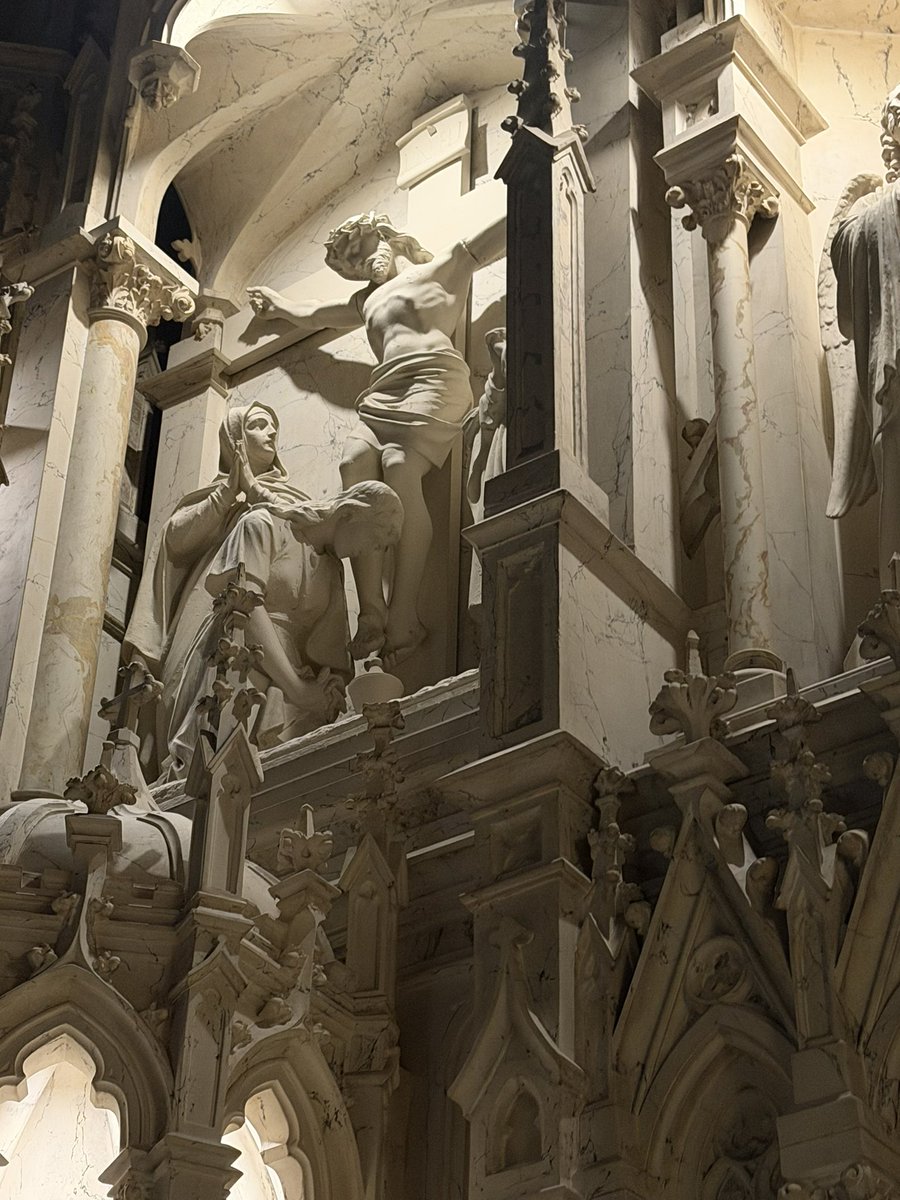
This is where I live and work.
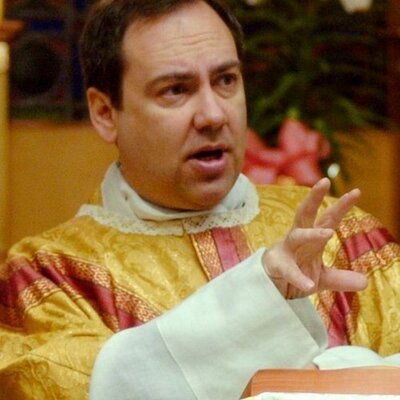
The Holy Family Cathedral Rectory in downtown Tulsa is home to eight priests (7 active, one retired) and a summer seminarian. The National Catholic Register did a story on our communal life and why priests choose to live here.
‘It has been wonderful to live in community,’ says Father Joshua Votruba, adding that ‘the brotherhood’ has been a tremendous support.
Read the full story: https://t.co/n5Rj7SjlDi
It’s Sunday in downtown Tulsa, OK. Let’s go to Mass! Today is the Solemnity of the Most Holy Trinity.
Masses today at Holy Family Cathedral:
8:00am
10:00am
Noon
5:00pm
Confessions are available:
7:30-7:50am
9:30 until the line runs out
11:30 until the line runs out
4:30-4:50pm
We also welcome Carmelite Missionary Sister Rosemary DeGuzman to speak at all Massses about their apostolate.
Artificial intelligences do not undergo experiences, do not possess a body, do not feel joy or pain, do not mature through relationships, and do not know from within what love, work, friendship or responsibility mean. Nor do they have a moral conscience, since they do not judge good and evil, grasp the ultimate meaning of situations, or bear responsibility for consequences. They may imitate or even simulate, but they do not understand what they produce, for they lack the affective, relational, and spiritual perspective through which human beings grow in wisdom. #MagnificaHumanitas
🙏 Happy Ordination Anniversary, Father Brian O'Brien!
We thank God for your vocation and for the many ways you bring Christ’s love to the faithful through the Sacraments and your ministry.
The Pope is writing for the ages, not the immediate news cycle.
It’s fine to skip all analysis until you’ve had the chance to read it yourself at leisure and discuss it with friends and family.
It’s Sunday in downtown Tulsa, OK. Let’s go to Mass! Today is the Solemnity of Pentecost.
Masses today at Holy Family Cathedral:
8:00am
10:00am
Noon
5:00pm
Confessions available today:
7:30-7:50am
9:30 until the line runs out (2 priests)
11:30 until the line runs out (2 priests)
4:30-4:50pm
Summer seminarian Max Williams will introduce himself at all Masses.
Come, Holy Spirit!
"A Converts Guide to the Eucharist" (from a recent convert)
My relationship with the Eucharist is summarized perfectly with five words from Mark’s Gospel: “I believe, help my unbelief.” (9:24) In context, this is a worried father’s response after Jesus promises to heal his possessed daughter. But we can use these words in other contexts. For the purposes of this article, Jesus assures us the Eucharist is His body, blood, soul and divinity, and we believe! And we struggle to believe…
In my time helping people into the Church, Catholic teaching on the Eucharist is often the main point of truth, beauty and goodness which draws people to conversion. But at the same time, as we get into our Eucharistic life, it becomes a main point of struggle. And I might add, a silent struggle (out of fear). So let me struggle publicly for you: “I believe, help my unbelief.”
Faith as the Ascent of Reason
Why do we struggle? First and foremost, the 21st century Church are a people shaped by modern sensibilities. Our day and age attempts to rid the supernatural out of the human consciousness. Therefore, without an intentional act of our will, we are discipled into a naturalistic and materialistic worldview.
In comes our need for faith.
Faith is a supernatural virtue. It’s a gift from God. We receive faith by grace. Faith does not replace reason, but rather, it perfects reason. Faith doesn’t teach to accept things blindly or unintelligibly, but at the same time faith teaches that our sight and intelligence can only lead us so far. As examples… we can reason our way to (a) God, but we accept God as Trinity, by faith. It’s reasonable to conclude that miracles can happen - and oftentimes we have solid evidence of them - but we accept the incarnation, the resurrection, and all miracles, by faith. These things are all part of “the faith of the Church.”
This is precisely why the Eucharist is a struggle. We are accepting something beyond reason. What we see on the altar appears to be something it is not, in substance.
Consider how the priests and deacons diligently clean the altar after the congregation has received. What they are doing transcends reason. To our natural minds, they are wasting time. “Hurry up already, let me get on with my Sunday.” Yet… with every wipe and every gulp, their small actions form our faith. In my own conversion journey, I remember hearing a throw-away comment in a debate, where a Catholic stated, “what you do with the leftovers explains most clearly what you believe about the sacrament.” By faith we accept that Christ is in the elements and He doesn’t deserve to be a crumb on the ground.
Conversion by Reason, Participation by Faith
For many converts, the Eucharist was (and is) reasonable. We are introduced to great books with bullet-proof exegesis of John 6, Jesus’ Eucharistic Institution in the Gospels (Matt. 26:26-28; Mk. 14:22-24; Lk. 22:19-20), and the recognition of Jesus in the bread after the Road to Emmaus (Lk. 24:30-31). We become acquainted with Church history and see the overwhelming and unanimous belief of the ancient Church. For me, the writing of St. Justin, Martyr (in 150 A.D.) was impossible to avoid:
“[Speaking of the Eucharist] For not as common bread and common drink do we receive these; but in like manner as Jesus Christ our Savior, having been made flesh by the Word of God, had both flesh and blood for our salvation, so likewise we have been taught that the food which is blessed by the prayer of His word, and from which our blood and flesh by transmutation are nourished, is the flesh and blood of that Jesus who was made flesh.” (First Apology, ch. 66)
It’s reasonable to accept the Eucharist for what it truly is, and many converts get initiated into the sacramental life of the Church by reason. But reason will not sustain us. We must ascend to faith.
Consider the mouse.
If a mouse snuck its way into a parish and crawled up on the altar after consecration and took a bite of the Host, did it receive Christ? This is a silly scenario but one St. Thomas took seriously because it teaches a bigger and more important point: Christ is truly and substantially present in what is consumed, but sacramental reception requires intention, awareness and a rational soul. The mouse in this scenario consumes the consecrated species - the real body, blood, soul and divinity of Christ - but does not receive grace. Therefore, the mouse does not commune with God. In other words, Christ is objectively present in the Eucharistic Host and Chalice, but His body, blood, soul and divinity must be received, and reception requires intention of one’s will.
Our true participation in the Eucharist requires our faith.
I don’t want to step beyond what you ought to talk with your pastor or spiritual director about, but new converts… in our on-going life in the Church we must hold the tension of the Eucharist:
On the one end, we are formed by what we do. By this I mean, our faith is strengthened by sacramental grace. Coming forward to receive (and how we receive) forms us. C.S. Lewis famously said, “don’t wait around for feelings of love for your neighbor, rather, begin doing acts of love for your neighbor and you’ll discover your feelings will follow suit.” We can’t become scrupulous and wait for “more faith” whatever or whenever that might be. Come forward and receive you of little faith. Come forward and eat, all who are hungry.
But on the other end, what we are doing in our reception of the sacrament is serious business. We ought not treat a sacred thing, unworthily, lest we eat and drink judgment upon ourselves (1 Cor. 11:27-29).
The tension exists: grace is for unworthy sinners, but we ought not take it lightly.
So when I say, “I struggle with the Eucharist” I mean, I take Him very, very seriously. I am asking Him to enter under my roof and bring healing to my soul. I am saying, “I believe it’s you, help my unbelief.” I am confessing, “I love you, and my heart is often cold.”
It’s my opinion that this ought to be the Eucharistic life of the convert. One of reason and faith. One of trust and love. It keeps us away from two falsehoods: Falsehood #1 teaches that the Eucharist isn’t real so my faith doesn’t matter. This can lead to ritualistic reception, diminishing our life of faith. Falsehood #2 teaches that something is wrong with my faith because I struggle to see Christ clearly in the Eucharist. This sends us out so somehow muster up greater faith (supernatural virtue) on our own (human nature), which is impossible.
So where does that leave us? Not with perfect clarity, and not with perfect feeling—but with an invitation. Week after week, we hear the words, “Behold the Lamb of God,” and we come forward not because we have mastered the mystery, but because we are being drawn into it. We come as those who believe, and as those who are still learning to believe. We come hungry, distracted, sometimes cold, and yet still desiring Him. And in that small act of faith—however weak it feels—Christ meets us. Not because our faith is strong, but because He is faithful. So let your prayer be simple and honest: “Lord, I believe. Help my unbelief.” And then come forward and receive Him.
Caleb Harlan is a recent convert to Catholicism from a Protestant background. He serves as Director of OCIA at Holy Family Cathedral in Tulsa, OK. His Substack is https://t.co/RHMOGysBcg
This was published in the June 2026 edition of the Eastern Oklahoma Catholic Magazine from the @DioceseofTulsa.
The first time Peter encounters Jesus, he tells Jesus that he is a sinful man.
Jesus response was to tell Peter “follow me”.
At the end of John, Peter asks Jesus about John.
Jesus response was to tell Peter “follow me”.
Whatever our situation in life, Jesus’ answer boils down to “follow me”.
When we are a little too worried about what other people are doing, when we are worried that our own sin will somehow preclude God from using us, Jesus looks us in the heart and says “follow me”.
#talkedtotheboss
BREAKING: President Trump announces that 9/11 hero Welles Crowther will posthumously receive the Presidential Medal of Freedom.
Known as “The Man in the Red Bandana,” Crowther repeatedly ran back into the South Tower on 9/11 to help others escape, saving as many as 18 lives before losing his own.
Allison Crowther said her son’s legacy continues to endure nearly 25 years later: “Welles’ light still shines brightly.”
I'm grateful to @DouthatNYT for inviting me on his podcast to discuss the fate of the liberal arts and humanities in the age of AI. I hope that all those who follow higher ed and care about the liberal arts will listen.
https://t.co/xy4l8LTxs8 https://t.co/xy4l8LTxs8