☕️GM builders @vangrid_io 🛰️
Autonomous code has a physical blind spot.
An AI agent can execute smart contracts, run simulations, and process online data. But it can't reliably know whether a gate is locked, construction blocks a loading bay, or a curb is too steep without fresh observations of the real world.
That’s the gap @vangrid_io is working to close.
Its latest Grid update reports:
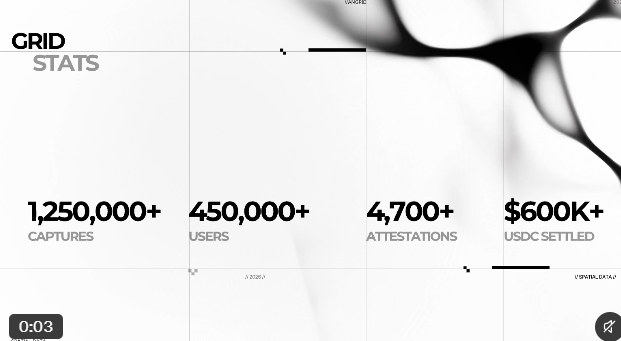
— 1.25M+ real-world captures
— 450K+ users
— 4,700+ attestations
— $600K+ USDC settled
The next layer is just as important: AI agents can programmatically commission ground-level captures through x402, with bounties funded in USDC on Base or Arc.
People capture the physical environment. Buyers review submissions. Accepted captures move through the reward and reconstruction workflow, adding spatial data that can support Physical AI.
The bigger idea isn't just collecting more data. It's building an economic rail where autonomous systems can pay for fresh observations of the physical world.
Explorer: https://t.co/aDT2qFf90H
GM
Crypto users can hold assets on several networks, but paying someone shouldn't mean figuring out a different identity system every time they switch chains.
That fragmentation creates unnecessary friction for users and extra complexity for wallets, merchants and businesses accepting on-chain payments.
@AmericanFort_io is building around a simpler approach.
FortressName gives users a reusable payment identity, while Send-to-Name™ handles the underlying payment by deriving fresh receiving addresses on supported integrations.
The same name can work across supported networks, helping separate the identity people recognize from the wallet addresses that process their payments.
AmericanFortress is also developing an SDK so wallets, chains and exchanges can integrate its payment and privacy infrastructure directly, rather than building every component from scratch.
The bigger opportunity is making private, name-based payments part of the crypto experience people already use, instead of asking them to move to another chain just to access them.
Claim your free FortressName:
https://t.co/NPPQ40zYLy
The coffee shop at Atlantis is my best +EV play some mornings.
$3.50 coffee, 40 minutes of quiet, no variance. The video poker machines have yet to beat that hourly rate.
Good Morning Fam ☕️🌄
A robot can be intelligent and still struggle with a world it has never learned to navigate.
That’s one of the less obvious challenges facing Physical AI.
Training a robot to perform a task is one thing. Helping it deal with unfamiliar environments, unexpected obstacles, and spaces that don’t behave like controlled simulations is another.
A model can learn from millions of examples, but its usefulness still depends on how well those examples represent the world it will eventually encounter.
This is where @vangrid_io gets interesting.
Rather than treating spatial data as something collected once and left unchanged, Vangrid is building toward a system where contributors can help capture real environments and turn those observations into structured spatial data.
The bigger opportunity goes beyond mapping individual locations.
It’s about creating a way for machines to learn from a much wider range of physical environments, including the ordinary places that rarely receive the attention of dedicated mapping projects.
Think about the difference between a robot that performs well in a familiar testing area and one that can handle a completely new building or street.
That gap isn’t solved by intelligence alone. It also requires better access to the physical world in which that intelligence must operate.
And the more accessible spatial data becomes, the more opportunities there are to improve how machines perceive and navigate different environments.
Physical AI won’t be defined only by how smart machines become, but by how well they understand the world outside the lab.
That’s the bigger opportunity I see in what @vangrid_io is building.