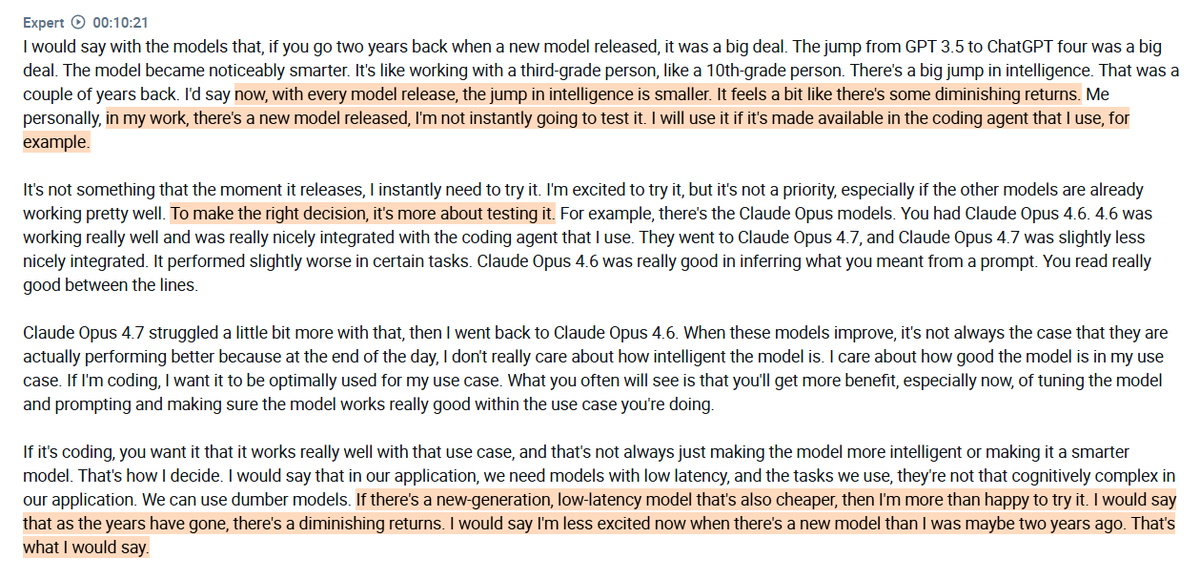
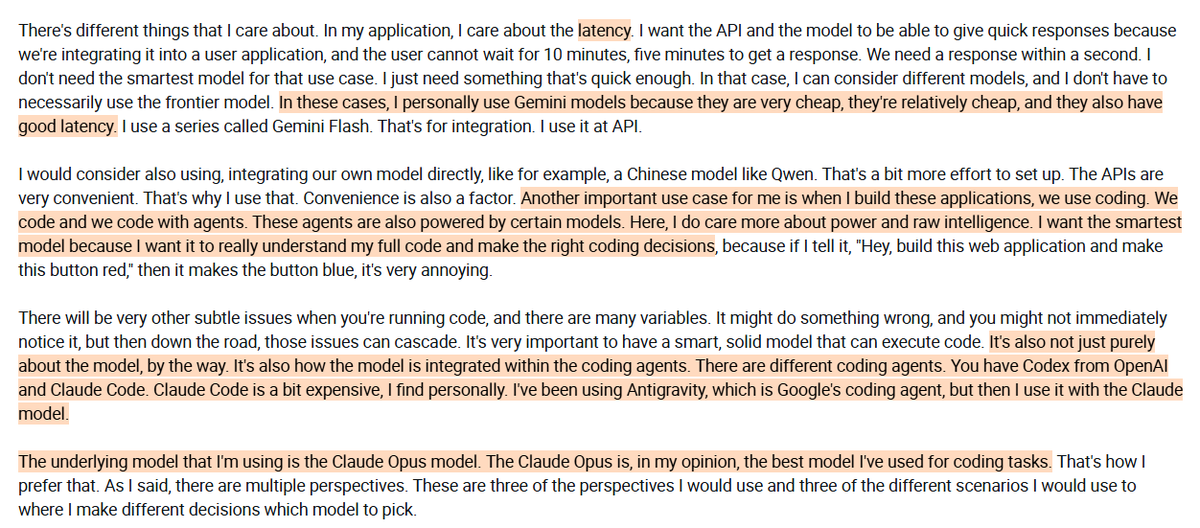
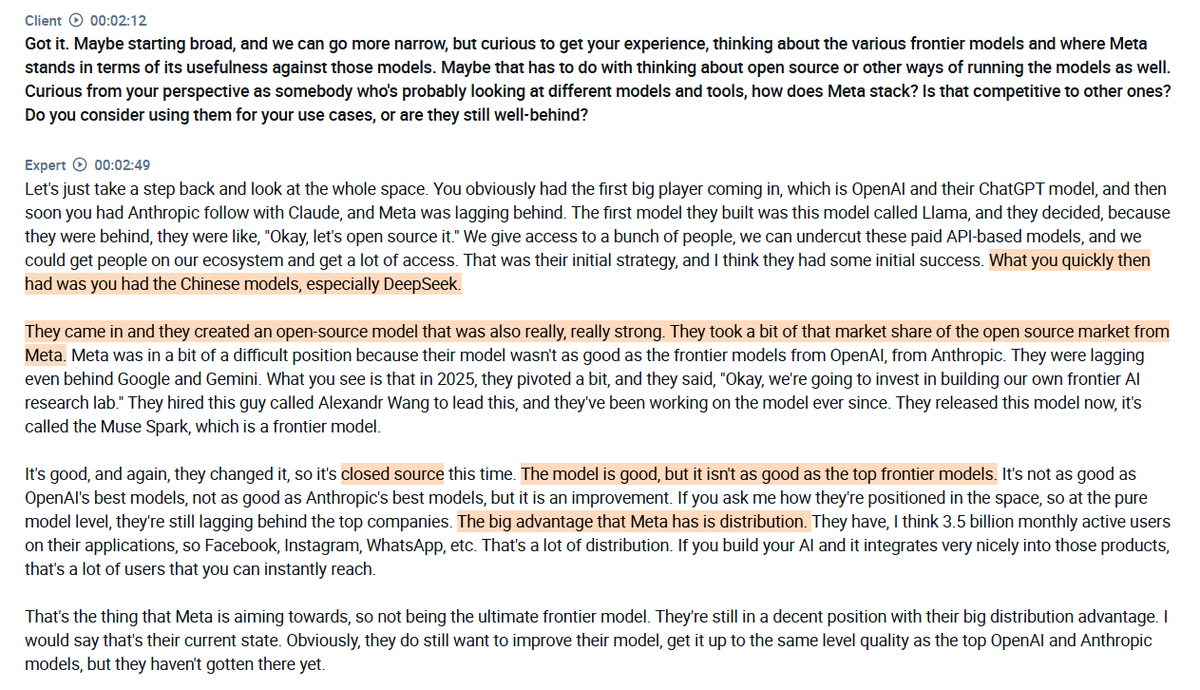
Interview with an industry expert on why $META's distribution advantage matters more than its model quality in the AI race ( $AMZN, $GOOGL ):
- The expert sees $META's models as still being behind the top frontier providers, such as OpenAI and Anthropic. Where $META holds a genuine advantage is distribution, with billions of monthly active users across Facebook, Instagram, and WhatsApp giving it a reach that no other AI company can match. The expert sees $META's strategy as less about winning the model race outright and more about integrating AI deeply into products that already have massive global adoption.
- The expert uses Gemini Flash for user-facing applications where latency and cost matter more than raw intelligence, and Claude Opus for coding tasks, which the expert considers the best model for that use case. The coding agent itself is highlighted as equally important as the underlying model, with $GOOGL's Antigravity agent paired with Claude Opus being the current setup of choice.
- According to the expert, the jump in intelligence between new model releases has become noticeably smaller over time, with the excitement around each new launch fading compared to a few years ago. He believes that tuning and prompting within a specific use case often delivers more value than upgrading to a newer model, and that for latency-sensitive applications with less cognitively demanding tasks, a cheaper and faster model is preferable over a smarter one.
- Cost is also a real factor in model selection, with Claude models being credit-based and more expensive, meaning the expert will switch to Gemini 3.1 Pro when credits run out, accepting slightly lower performance in exchange for the cost savings.
- The expert does not see $META playing a major role in the on-device or local deployment space with its newest Muse Spark model, since it is closed source and only accessible via API, making it incompatible with use cases like running models on a Mac mini. $META still has Llama for open source use, but the expert sees the company pivoting away from that and toward its closed source model.
- The expert sees two underrated elements of $META's AI strategy. The first is hardware, with the Ray-Ban smart glasses seen as underrated product that is gaining real traction and represents a unique channel for AI that none of the major foundation model players such as OpenAI or Anthropic are positioned to compete in. The second is distribution, with $META's billions of existing users across its consumer apps giving it an immediate reach advantage.
In Western mobile, the OS writes the rules for AI agents. Apple and Google define how apps expose capabilities to system-level AI.
In China, an app writes the rules. WeChat confirmed an A2A protocol that controls how phone assistants are allowed to interact with it.
The power structure inverts. My latest analysis explores why. https://t.co/da4oUZ8Kur
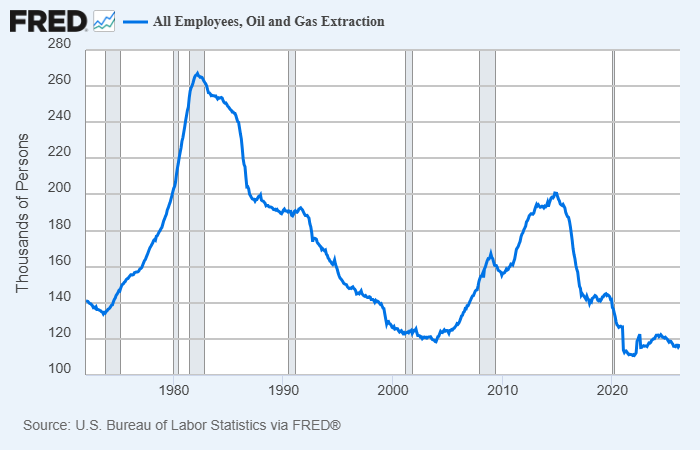
Oil and gas employees are plunging
- down 70% from the 1980 peak
- down 40% from the 2014 peak
- average age: 55
Thanks to climate hysteria, the younger generation isn't interested in the O&G sector.
No, AI won't drastically reduce the need for employees, as the entire sector has been using AI for decades.
Before I allegedly “joined China’s Communist Party for glazing China”, I warned the world that Chinese companies were, after wiping out America’s industrial base, moving into the wholesale and retail trade.
Chinese companies account for over 50% of all sellers on Amazon.
This ship sailed long ago.
China will continue to completely dominate manufacturing, wholesale, and retail of non-military goods globally for a long time.
Military goods will be more complicated but I don’t see how they’ll be made without Chinese components.
This is just how it is.
It’s not necessarily a bad thing globally (though I don’t think it is great for the so-called developed world that is losing good jobs in the process).
Globally, we will see wave upon wave of steadily improving innovative goods that are not only made in China but designed there and then distributed by Chinese companies overseas.
China went from making American designs for American retailers to making their own and then distributing them through their own sales channels like SHEIN and Temu.
And they did it 20 years.
It’s one of the most impressive economic accomplishments of all time.
I just published some of my thoughts on why I don't think most of the economy will run on SOTA AI models, why we are in a transitional phase, and why hyperscalers like $AMZN, $MSFT, $GOOGL, and $META stand to gain the most in the next leg of AI.
https://t.co/YqnX4tRyP7
I said DeepSeek moment was to destroy US AI business model when DeepSeek first emerged
Low cost Open Source model vs high cost Close Source model
More US firms turn to China’s DeepSeek over pricey Silicon Valley AI
https://t.co/iw4HZtIW5n
Canaccord Reiterates $META to Buy, PT $930
Analyst comments: "At its Conversations event in London on June 3, Meta announced the global launch of Meta Business Agent and rolled out a separate Business Agent Platform for enterprises. The former, which has been rebranded from Meta Business AI, fields customer questions, provides product recommendations, books appointments, qualifies leads, and closes sales across WhatsApp, Messenger, and now Instagram. The Business Agent Platform, meanwhile, is an offering for larger firms that enables businesses to connect agents into outside systems like Shopify, Zendesk, and Shopee, with usage-based pricing. More broadly, today’s announcements underpin two key goals:
(1) to make the chat thread the storefront, collapsing discovery, recommendation, booking, payment, and support into one conversation, so the place a customer talks to a business becomes the place the sale closes;
(2) to make the agent a business partner rather than a help desk, briefing business owners each morning on the threads they missed overnight, flagging what customers keep asking, and, in time, absorbing additional work around daily operations. Meta Business Agent is expected to be integrated with the recently announced Meta One subscription offerings, and while it is unclear which plans will include the tool, we see the feature as a strong catalyst for subscription uptake and believe it could help Meta's business subscription develop into a multi-billion-dollar revenue stream. This would complement ad budget increases on the platform stemming from ROI gains as well as Business Agent Platform Enterprise revenue. Longer term, if agents take on incremental tasks such as research, scheduling, and operational duties, the monetization opportunity widens from advertising into the broader pool of operating budgets."
Analyst: Maria Ripps
JUST IN: Scientists say AI has decoded communication patterns in mice, dolphins, apes, birds, whales, & cuttlefish — could eventually lead to humans communicating directly with animals.
Now that AI over long horizon can write better code than ppl as long as performance can be tested & validated, Cuda Moat is gone.
Alibaba/Qwen team recently demonstrated this w/ M890 chips & 3.7 wrote the kernels for it.
Since ByteDance is designing multiple chips for its own usage, it can easily use an improved seed model to improve kernel to support most efficient training & inference of seed models.
This is in fact a game changer for all new chip design firms. If software moat is made irrelevant by AI, then the moat is data & hardware. That's a big loss for Nvidia.
$META is starting to sell businesses access to Meta Business Agent, its AI customer-service agent for WhatsApp, Messenger, and Instagram, per Bloomberg.
Larger businesses will pay based on token usage, while smaller businesses will access it through Meta’s business subscription offerings.
Meta previously offered AI agents for customer interactions, but this is the first time it is charging businesses for the product.
The agent is mainly for customer chats now, with future plans for tasks like market research, product insights, and calendar management.
BREAKING: Axios reports that Trump told Netanyahu in their latest phonecall, 'You’re f***ing crazy. You’d be in prison if it weren’t for me. I’m saving your ass. Everybody hates you now. Everybody hates Israel because of this.'
JPM on '27 data center build out:
"The latest analysis based on satellite images shows that over 60% of data center capacity planned for completion in 2027 has not begun construction with another 7% delayed"
🦔A new BCG study surveyed 1,200 HR and finance professionals and found that when companies put AI agents on org charts and treat them like employees, human workers actually get worse at their jobs. Workers assigned to review documents from a named AI "employee" caught fewer errors, took less personal accountability, and dumped review work on colleagues.
A third of managers in the US, Canada, and EU now frame AI as a teammate. More than 20% have AI agents on their org charts. And none of it made workers more likely to adopt AI. It did the opposite: 7% higher fear of replacement, 10% lower trust.
My Take
This is a $2.5 trillion bet running into a very old problem. You can't automate accountability. When you give software a name and a spot on the org chart, people stop checking its work and start blaming it when things go wrong. BCG's Matthew Kropp put it simply: AI can't be fired, can't get a performance review, can't own a mistake. So someone human has to, and right now nobody wants that job.
It reminds me of the experienced engineers study from last year, where devs using AI took longer to finish tasks because they spent so much time debugging the output. The productivity gains everybody promised are still not showing up in the aggregate data, and now we have evidence that the way companies are deploying these tools is actively making their teams sloppier. That's not an argument against AI, but it's a strong argument that most companies have no idea how to use it.
Hedgie🤗
Study: https://t.co/FdaR53vRUP
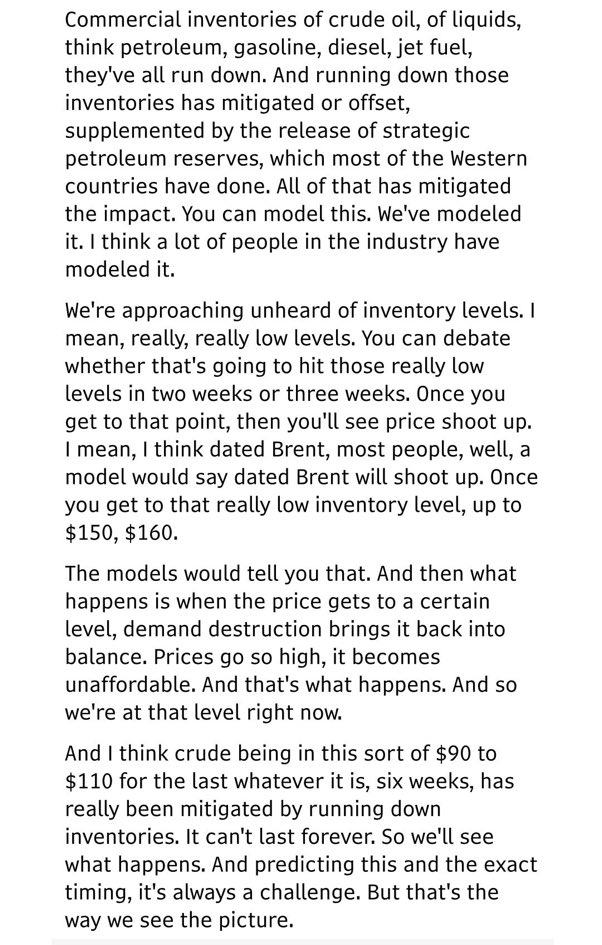
Everyone should read what Senior Vice President of Exxon Neil Chapman says about the oil price surge coming in 2-3 weeks
The next wave of the energy shock is approaching fast