This is actually pretty hilarious: China is the country in the world where people spend the most time working AND sleeping AND, to a large extent, eating.
Turns out you can achieve work-life balance by simply doing more of everything 😅
Hilarious too: we French spend almost the LEAST time working AND sleeping, so we effectively get a more exhausting life than the Chinese while working half as much. Which is impressive in its own right.
So China’s basic response is:
If the United States were still confident in its own competitiveness, it would not need to turn every Chinese civilian project into a national security emergency.
A port becomes a threat.
A railway becomes a threat.
A telecom network becomes a threat.
Even an undersea cable becomes a weapon.
China builds infrastructure.
Washington builds panic around it.
America no longer asks whether a Chinese project works.
It asks how quickly it can be killed before the world notices it works better.
When an empire can no longer lead, it tries to cripple those who can.
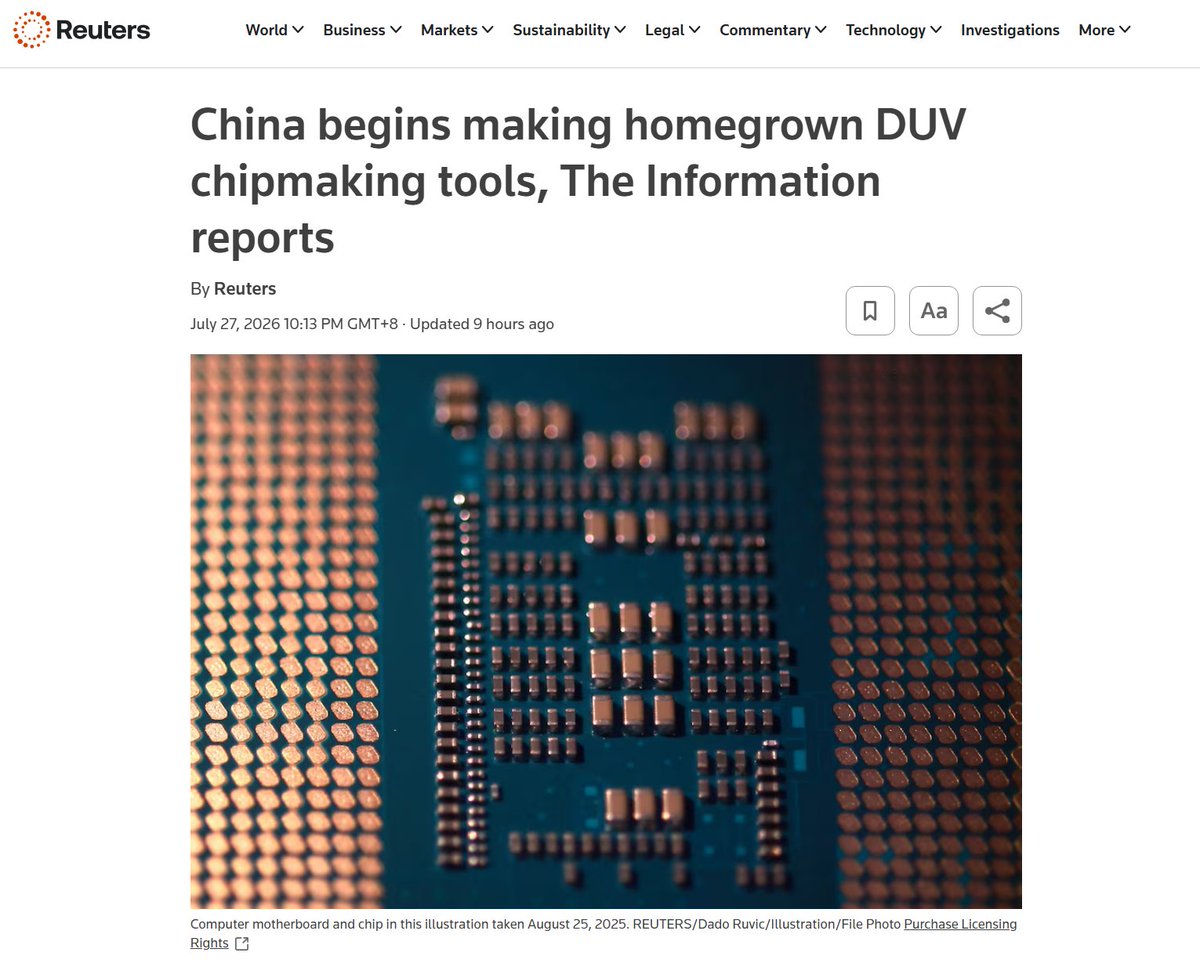
China has started mass producing immersion DUV lithography machines, these machines are capable of making semiconductors down to the 5nm node, after multi-patterning.
With this machine mastered, China can make everything under the sun with the exception of the EUV lithography machine, but that is coming soon, sooner than most people would expect.
All the subsystems for EUV lithography machines are done, a working prototype is running since late 2025.
Total industrial and supply chain independence is almost here. After this, we won't need to worry about any forms of sanctions or embargos.
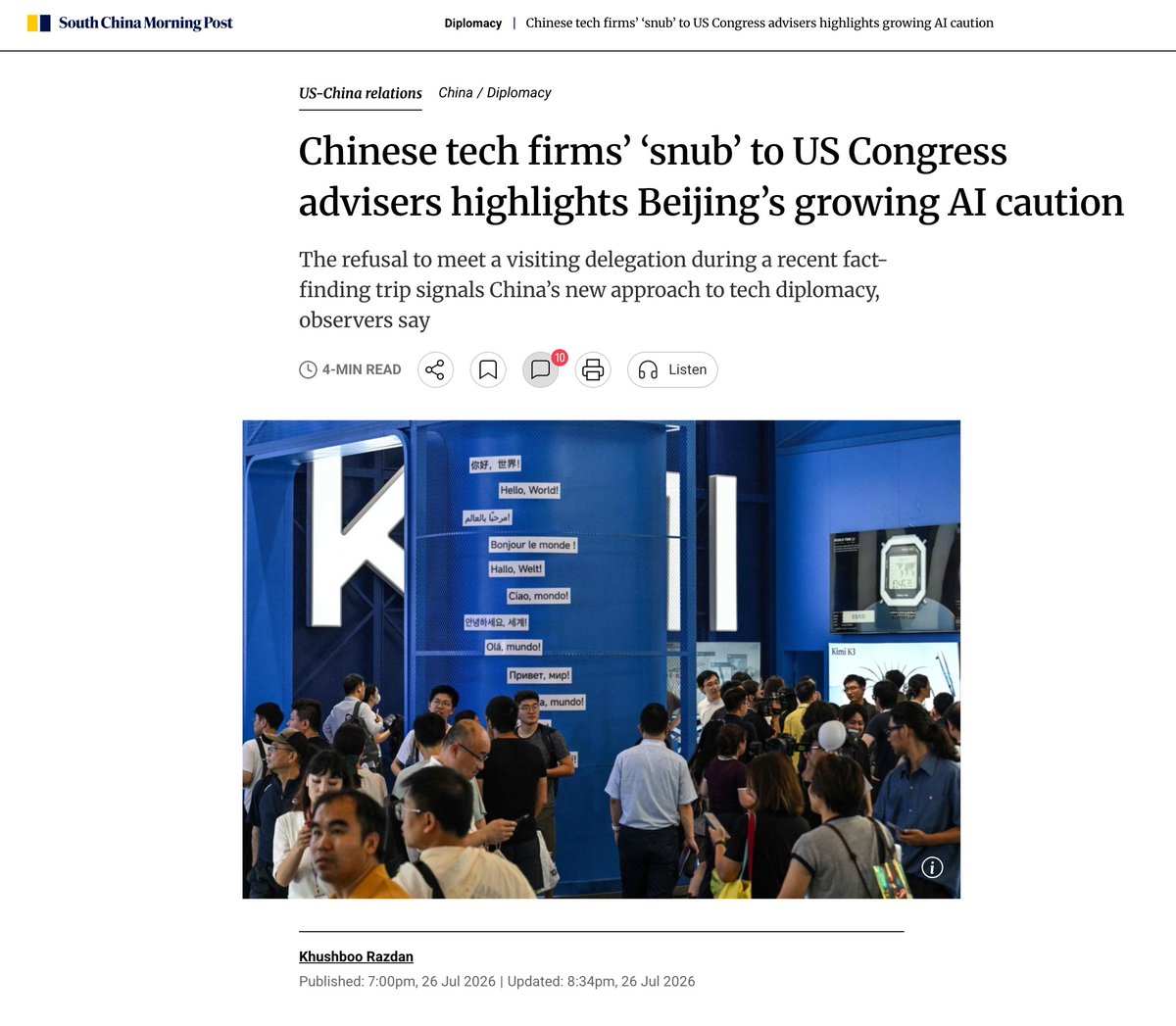
The U.S.-China Economic and Security Review Commission appeared shocked that it was denied access.
Its own official mandate makes its purpose perfectly clear.
It is a congressional body created to investigate China, frame Chinese technological development as a security threat, and recommend restrictions, export controls, and legislative action against it.
Yet it arrives in China demanding access to Huawei, Tencent, Alibaba, Baidu, and DeepSeek—then acts offended when they refuse.
You are not entitled to an insider tour of the industries you are trying to cripple.
You call it a “snub.”
Fine. Call it whatever helps you sleep.
China has no obligation to cooperate with a state-level economic espionage performance wearing a visitor badge.
You wanted a data point.
Here it is:
China no longer mistakes surveillance for dialogue.
Since China pulled it off, the whole world has realized just how crucial industrialization is. But China's formula isn't easy to copy — and it sure as hell isn't going to happen just by talking tough and making grand pledges.
You need a huge, educated population, a competent government, policies that stay the course for decades, a peaceful neighbor environment, open international markets, nonstop R&D spending....... And above all — before you actually get there, keep quiet and stay under the radar. Because nobody else wants to see you succeed. Once they know your ambition, they will definitely do something to stop it.
A relatively long read from a Japanese who actually understand the dire straits Japan is in.
In terms of China-Japan relations, the best period of normalization was the 1980s and 1990s. Back when Japan can still claim industrial and economic superiority.
This alone shows you that China is the bigger man, we don't have an inferiority complex. Sure, we will have warm relations and broadcast Japanese anime on TV (they were the childhood of most 1990s Chinese kids). And we won't feel inferior because of it.
Japan on the other hand, as soon as China surpassed it in terms of economy and industry, they started spewing venom against us. They always have held venomous intent against China, they were just more reserved about it back in the 1990s and early 2000s.
As soon as China surpassed Japan in terms of GDP in 2010, the Japanese engineered the Diaoyu island incident in 2011. And that was when the relations took a nosedive.
History shows, that China doesn't want or expect much from Japan, we know they harbor ill intent against us for over 1000 years. But from our perspective if they stops interfering with our internal affairs relating to Taiwan, resolve the island dispute and acknowledge past crimes, then we can at least live as amicable neighbors.
But the Japanese can't even do that.
The Chinese president stood on a stage in Shanghai and laid out China's entire AI playbook in one speech.
It was his first-ever in-person appearance at the World AI Conference. I went through the whole thing and pulled out everything that matters.
- he opened with his signature maxim that great changes unseen in a century are unfolding across the world.
- he said AI development should not be a solo performance by a single country but a symphony of international cooperation.
- he reaffirmed China's commitment to open source AI in the name of openness and shared benefit.
- he warned against overstretching the concept of national security in AI, where one country puts its own security above everyone else's.
- he said China opposes the emergence of new historical injustices in AI, one of the strongest-worded lines in the speech.
- he pledged 5,000 AI training opportunities for developing countries over the next five years, naming ASEAN, the Arab League, the African Union, CELAC, the SCO, and BRICS.
- he committed to giving 30 countries access to a Chinese AI weather system that provides early disaster warnings.
- a day before the speech, 29 countries signed the agreement creating a new World AI Cooperation Organization headquartered in Shanghai.
strip away the politics and one thing stands out to me. he didn't pitch benchmarks or chatbots. he pitched AI as infrastructure, weather warnings for countries that lose thousands of lives to storms they never saw coming, and training programs for regions the AI boom has skipped.
meanwhile most of the Western AI conversation revolves around which lab ships the next frontier model.
I don't care who wins the race. I care whether the computing power reaches the people who need it.
The full speech is below, and it's worth your time.
Breaking! China just made a big breakthrough in reusable rockets. For the first time, China successfully achieved the controlled recovery of a carrier rocket's first stage at sea.
The Long March-10B rocket was launched from China's Wenchang. 6 minutes after the stage separation, the first stage successfully landed on the sea-based recovery platform.
This is also the world's first net-based rocket recovery.
If capitalism worked, then the American people wouldn't go FROM being able to support a family of 4 and buy a house on one salary.
TO
Having to work 2 jobs just to survive and pay rent.
They take stolen things and call them their own, then make you pay for it. Goubuli, Tongrentang, Nu’erhong, Wang Zhihe, Quanjude, Zhuyeqing wine, etc.
Then they turn around and say China stole their ideas.
The West often says China is safe just because of the surveillance cameras are everywhere.
But what happened in the US show surveillance camera is not the reason of low crime rate. Civilization is.
As a Chinese person, I certainly don't want to see Europeans all installing air conditioners. If all 500+ million people across Europe ran AC and lived the way folks do in China, it would spell real trouble for our planet.
Moreover, just as Europeans don't want to see modernization in China's Tibet and Xinjiang, claiming it destroys the culture of local ethnic minorities, we Chinese feel the same way — we don't like seeing modern technologies, such as AC, destroy Europe's primitive way of life. It's an assault on Europe's indigenous culture. We Chinese must speak up for the preservation of European traditions, and never allow modern technology to wipe out Europe's backward but beautiful cultures.
There is a big problem with the premise behind your question.
You assume that "consent of the governed" is a Western concept that starts with Locke in the 17th century because, presumably, you were taught that the Enlightenment was the dawn of political philosophy rather than what it actually was: Europe finally crawling out of its dark ages and discovering ideas that Chinese civilization had been using for over two thousand years.
As early as ~300 BCE Xunzi developed the concept of "consent of the governed" in China, with one of the most famous metaphors in Chinese political philosophy: the ruler is the boat, the people are the water - water carries the boat, water capsizes it (水能载舟,亦能覆舟).
And Xi quotes it constantly, you can find literally dozens of speeches where he speaks about it. In fact it's arguably his most central governance principle.
So the notion that China needs to be asked what it thinks of a concept it invented is, in a nutshell, exactly the kind of Western arrogance and ignorance my post is all about. It's like asking the Chinese what they think of this great Italian invention that is pasta...