Resisting oblivion by recording how ppl remain human in a world collapsing into noise.
Clarity is rebellion. Memory is the weapon.
I'm allergic to stupidity.
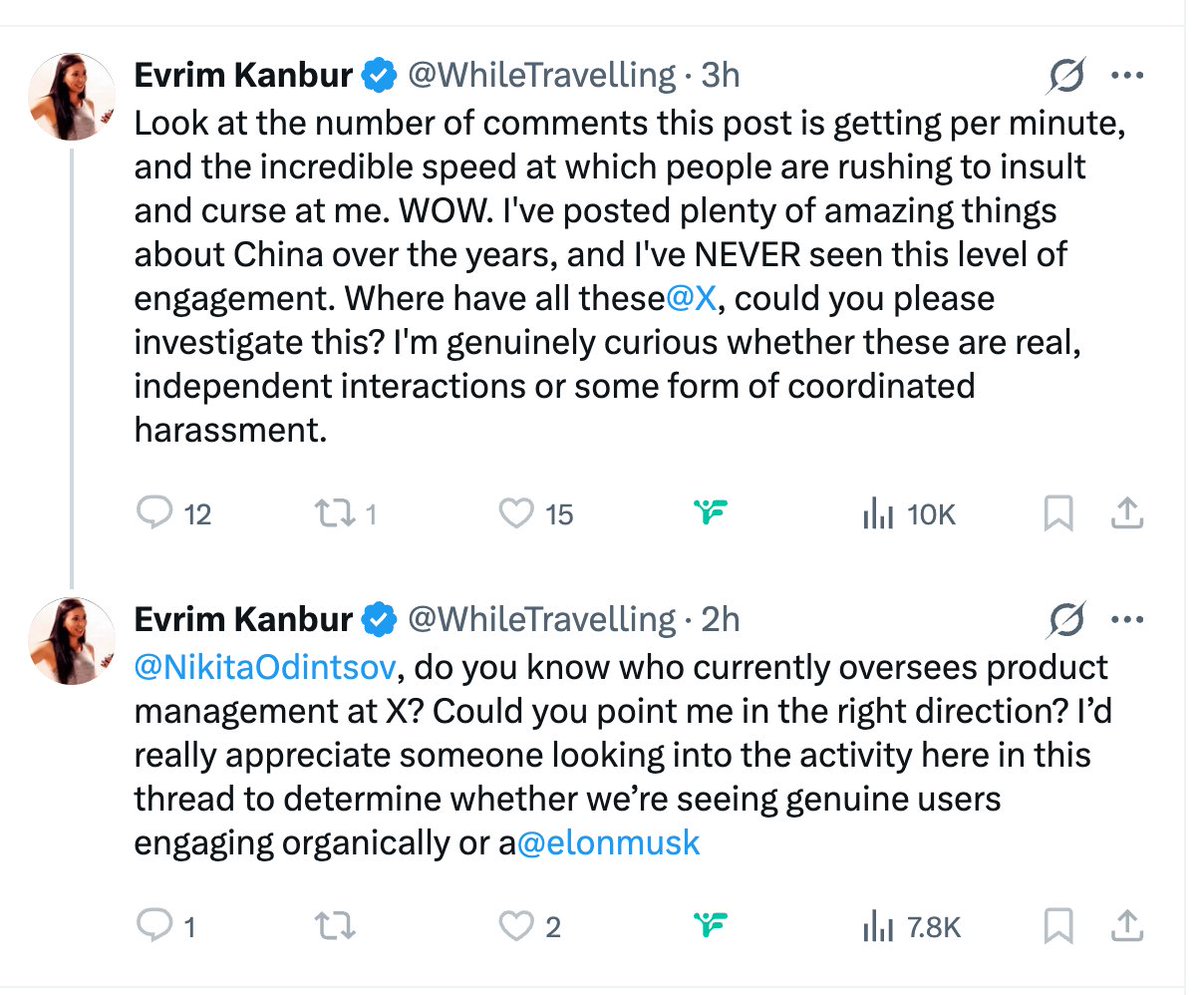
I think this goes beyond her simply "suspecting the presence of Chinese 'troll farms'"; rather, she has begun to use the idea that "these people might not be real" as a defense mechanism to protect her existing worldview.
Because if she were to accept the reality—that these intense reactions are the genuine sentiments of ordinary Chinese people—she would simultaneously have to confront a far more uncomfortable truth: the China she knows, likes, and has lived in for so long is not the same as a China that is perpetually gentle, always welcoming, and one that would never push back against her home country in defense of its own history and national interests.
Consequently, the easiest psychological escape route is to claim:
"These people might be bots."
"This could be coordinated harassment."
"The 'real' Chinese people aren't like this."
Yet, this is a classic trope within Western narratives:
When Chinese people are viewed favorably, they are seen as charming, ordinary individuals.
But the moment they express political will that falls outside the Western "comfort zone," they are suddenly recast as robots, paid trolls, or manipulated accounts.
At this point, her underlying perspective is laid bare.
What she truly appreciates is a China that provides her with friendship, life experiences, a sense of cultural belonging, and a feeling of security.
But when Chinese people begin to act based on their own national memory, territorial integrity, and national interests—rather than prioritizing her personal feelings—she suddenly begins to question whether these people are even "real."
This, in itself, speaks volumes:
She is capable of accepting China as a space in which to live.
But she cannot accept China as a political community that possesses its own will, its own "red lines," and its own distinct ways of expressing anger.
And yet, both of these aspects are, in fact, one and the same China.
I feel that, at this point, this is no longer a debate about facts.
I have already distinguished her good intentions from the attacks launched by those Turkish accounts, and I have explicitly acknowledged that she should not be held responsible for the actions of others.
Yet, she keeps steering the focus back to points like "I’ve been hurt by Chinese netizens," "these accounts might be bots," and "why can’t both sides just stop?" This reveals that what she truly seeks is not an understanding of why Chinese people are provoked by such content, but rather to get people to admit that her moral judgment on this conflict is the correct one.
And I do not accept that.
She is free to believe that some of the counter-responses have gone too far.
I, for my part, maintain that issues like Unit 731, the earthquake, the stigmatization during the pandemic, and the calls for territorial fragmentation are not merely internet memes.
These two perspectives do not need to be forcibly reconciled.
Her final decision to block me actually brings a clean end to the matter: there is no longer any need for further explanation or proof, nor do I have to continue managing her expectation—the idea that "because I love China, Chinese netizens should respond in a way that makes *me* feel comfortable."
Some disagreements cannot be resolved simply by writing another three thousand words.
What she seeks is validation; what I offer is an explanation.
From the very beginning, these two things have never been the same.
@Aleena_Persian I still believe you cannot expect a Turk to love China more than their own country—and the same holds true the other way around.
https://t.co/yl5gLhVjB5
Everyone has their own scale.
I do not expect a Turkish person to love China more than Türkiye.
Nor should anyone expect Chinese people to place someone else’s national feelings above their own country.
So there is really nothing tragic about this.
Perhaps she has simply discovered what matters most to her.
And we have been reminded of something equally important:
China ultimately has to rely on itself to protect China.
Her past goodwill toward China deserves gratitude.
But gratitude is not a debt.
It does not entitle anyone to ask Chinese people to weaken their own historical memory, territorial integrity, or national dignity in order to protect someone else’s national pride.
She is free to choose Türkiye.
We are free to choose China.
Those are two completely different things.
I understand why she feels hurt.
She has lived in China for years, loves the country, has Chinese friends, and now feels that affection has been thrown back in her face.
But if you truly understand China, you should also understand the two things Chinese people will never treat as casual internet banter:
historical memory
and territorial integrity.
China is a civilization that went from centuries of power and prosperity, through invasion, occupation, humiliation and national disintegration, and then rebuilt itself from the ruins.
That history is not decoration.
It is part of the psychological architecture of the country.
Chinese people know what happens when a nation allows its history to be rewritten, its collective memory to be hollowed out, and its territorial identity to be treated as negotiable.
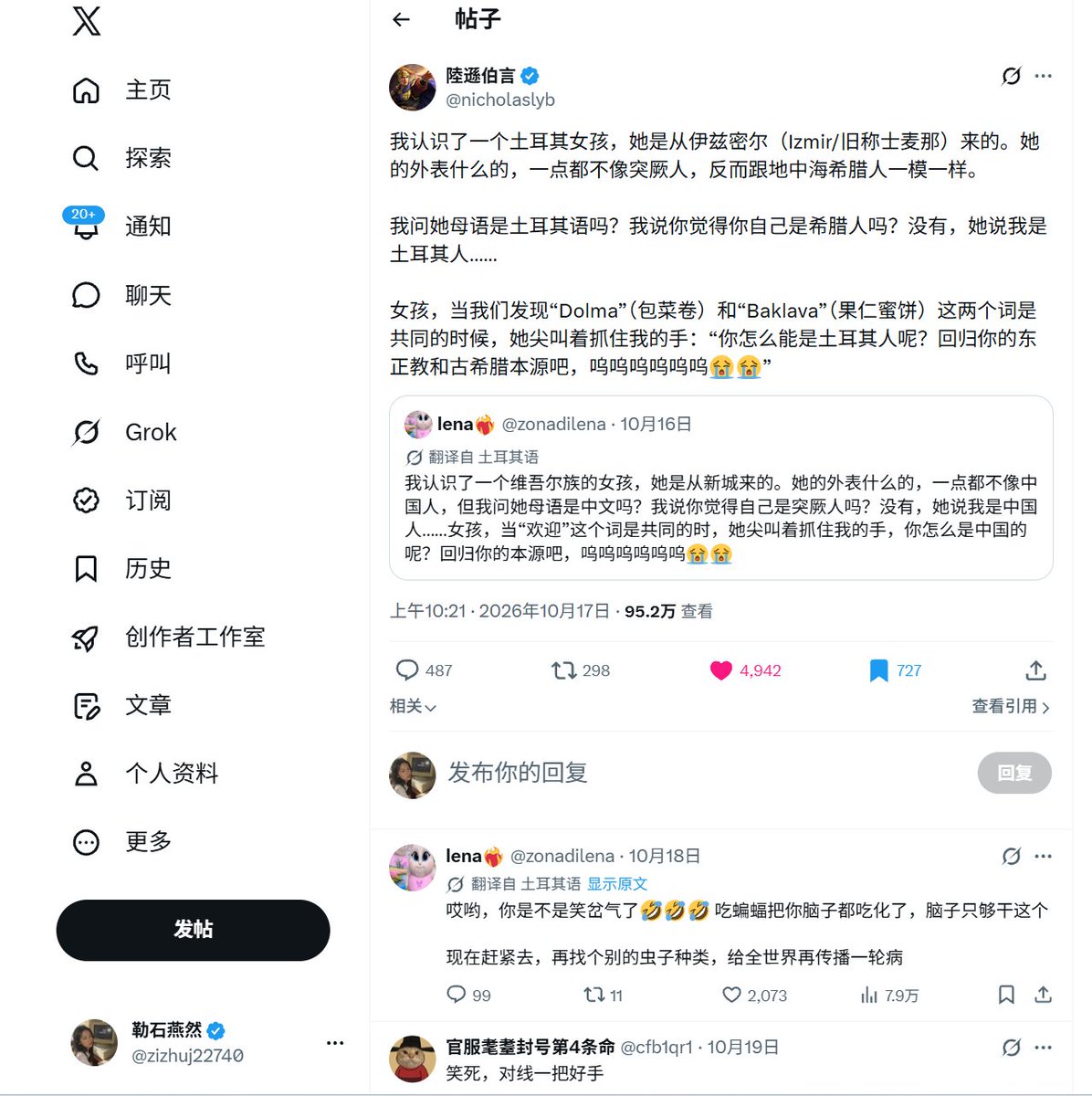
So when Turkish trolls tell Uyghurs that they are not Chinese, encourage separatism in Xinjiang, rewrite Chinese history, invoke Unit 731 as a racial taunt, and turn Japanese invasion into material for humiliation, they are not touching some random internet sensitivity.
They are walking directly onto the deepest historical wounds of the country.
You may dislike the response.
You may think it is too harsh.
But once your side chooses the red line, you do not also get to choose how comfortable the backlash must be for you.
You cannot provoke China at the exact points where its historical trauma and territorial integrity meet—
and then reduce the reaction to “Chinese trolls became irrational.”
It is not China that you love;
you only love the version of China that remains comfortable for you.
Everyone has their own scale.
I do not expect a Turkish person to love China more than Türkiye.
Nor should anyone expect Chinese people to place someone else’s national feelings above their own country.
So there is really nothing tragic about this.
Perhaps she has simply discovered what matters most to her.
And we have been reminded of something equally important:
China ultimately has to rely on itself to protect China.
Her past goodwill toward China deserves gratitude.
But gratitude is not a debt.
It does not entitle anyone to ask Chinese people to weaken their own historical memory, territorial integrity, or national dignity in order to protect someone else’s national pride.
She is free to choose Türkiye.
We are free to choose China.
Those are two completely different things.
I feel that, at this point, this is no longer a debate about facts.
I have already distinguished her good intentions from the attacks launched by those Turkish accounts, and I have explicitly acknowledged that she should not be held responsible for the actions of others.
Yet, she keeps steering the focus back to points like "I’ve been hurt by Chinese netizens," "these accounts might be bots," and "why can’t both sides just stop?" This reveals that what she truly seeks is not an understanding of why Chinese people are provoked by such content, but rather to get people to admit that her moral judgment on this conflict is the correct one.
And I do not accept that.
She is free to believe that some of the counter-responses have gone too far.
I, for my part, maintain that issues like Unit 731, the earthquake, the stigmatization during the pandemic, and the calls for territorial fragmentation are not merely internet memes.
These two perspectives do not need to be forcibly reconciled.
Her final decision to block me actually brings a clean end to the matter: there is no longer any need for further explanation or proof, nor do I have to continue managing her expectation—the idea that "because I love China, Chinese netizens should respond in a way that makes *me* feel comfortable."
Some disagreements cannot be resolved simply by writing another three thousand words.
What she seeks is validation; what I offer is an explanation.
From the very beginning, these two things have never been the same.
@ChongdeLiao Shut the fuck up.
Nobody asked her to kowtow to me.
I explained why Chinese people reacted the way they did.
If you’re too stupid to tell the difference between explanation and demanding obedience, that is your problem.
Now get your filthy mouth out of my mentions.
Get the fuck off my timeline.
You’ve spent hours parading historical illiteracy, nationalist fan fiction and Grok screenshots like they’re scholarship.
Nobody is impressed.
You’re not educating anyone.
You’re not “owning” anyone.
You’re just publicly documenting how little you understand about Iran, China, Türkiye, or the difference between ethnicity, dynasty and statehood.
Go perform your ancestral cosplay somewhere else.
I’ve had enough second-hand embarrassment for one day.
Shut your filthy mouth.
Xinjiang did not suddenly appear in 1949 for Mao to “invade.”
The Qing had incorporated the region into the Chinese state centuries earlier and made Xinjiang a province in 1884. After 1912, it remained within the Republic of China’s political framework; the “East Turkestan” regimes were short-lived separatist episodes, not some ancient sovereign country Mao suddenly discovered and conquered.
So spare me the “red hordes invaded East Turkestan” fan fiction.
You are taking a modern separatist slogan, projecting it backward onto history, and calling the result fact.
You already embarrassed yourself once.
Do not make me teach you Chinese history again.
The Chinese paused an online fight to congratulate a Turkish girl whose mother beat cancer.
The Turks reached for Unit 731, fascist invasion, earthquake deaths, coronavirus, and racial filth the moment it got angry.
That contrast says more than any argument ever could.
Character reveals itself under pressure.