@CesarJB É uma cidade boa para se viver? Com certeza é. Mas existem alguns pontos de atenção, como, por exemplo, a bolha imobiliária que existe hoje na região.
CLEAR STREET TO OFFER PRE-IPO DATABRICKS EXPOSURE - CNBC
The new platform will allow accredited investors to buy interests providing exposure to Databricks, which was valued at $188B this month.
Clear Street plans to add as many as 30 private companies by year-end, mostly technology firms valued between $5B and $20B that could go public within six months to two years.
Clear Street also plans to offer margin loans against eligible pre-IPO positions, an uncommon feature for illiquid private-market assets. It will handle servicing and risk management internally and launch dedicated private-company research led by analyst Owen Lau.
Clear Street itself was valued at nearly $12B earlier this year. After pausing its own IPO in February, the broker is considering a 2027 listing if market conditions allow.
The Brazilian company is a fraction of the size of Airbus and Boeing. Breaking the duopoly’s grip would be a huge undertaking. But the firm has had a remarkable few years https://t.co/gpZpiyqCeR
Databricks to hit a $188B valuation with a new $3B Coatue-led investment, per WSJ.
That is a 40% jump from its $134B valuation in December.
The company crossed a $5.4B annual revenue run rate in February, and CEO Ali Ghodsi said AI products were running at $1.7B+ revenue run rate in June, up from $1B in September.
Additionally, Databricks recently launched Unity AI Gateway to help companies access models from OpenAI, Anthropic, Google and open-weight providers while managing AI spend, plus Genie One, an agentic AI assistant for workplace tasks.
O problema não está no subsídio e sim no patamar de juro que chegamos, que é resultado de uma política fiscal frouxa e com regras ineficazes.
Se a Selic fosse 7% (inflação na meta em 3% e juro real de 4%, 2pp acima do juro nos EUA), o subsídio seria equivalente a 1% de retorno adicional ao ano. Hoje com a Selic acima de 14% está em 2,2%, o que realmente provoca muitas distorções.
O mesmo governo que acabou de criar linhas de crédito subsidiadas e expande o crédito direcionado agora quer discutir outros subsídios. E continua ignorando o raiz do problema.
A expansão fiscal nesse começo de ano foi abissal. E não foi só a antecipação de precatórios, despesas discricionárias, por exemplo, subiram 58% acima do ano passado, previdência foi +9,5% e pessoal +12%, tudo acima da inflação.
13% de aumento de gasto real, ou +R$168bi em 5 meses, deixa o furo do teto de R$40bi da eleição de 2022 e até mesmo a pec da transição de R$170bi de 2023 no chinelo. Tudo isso com PIB acima do potencial, pleno emprego e inflação fora da meta.
Mostra total falta de coerência na política econômica e ausencia de disciplina fiscal.
A boa notícia, talvez, é que poderemos ver uma contração fiscal a partir do 2o semestre, se o governo quiser cumprir a meta.
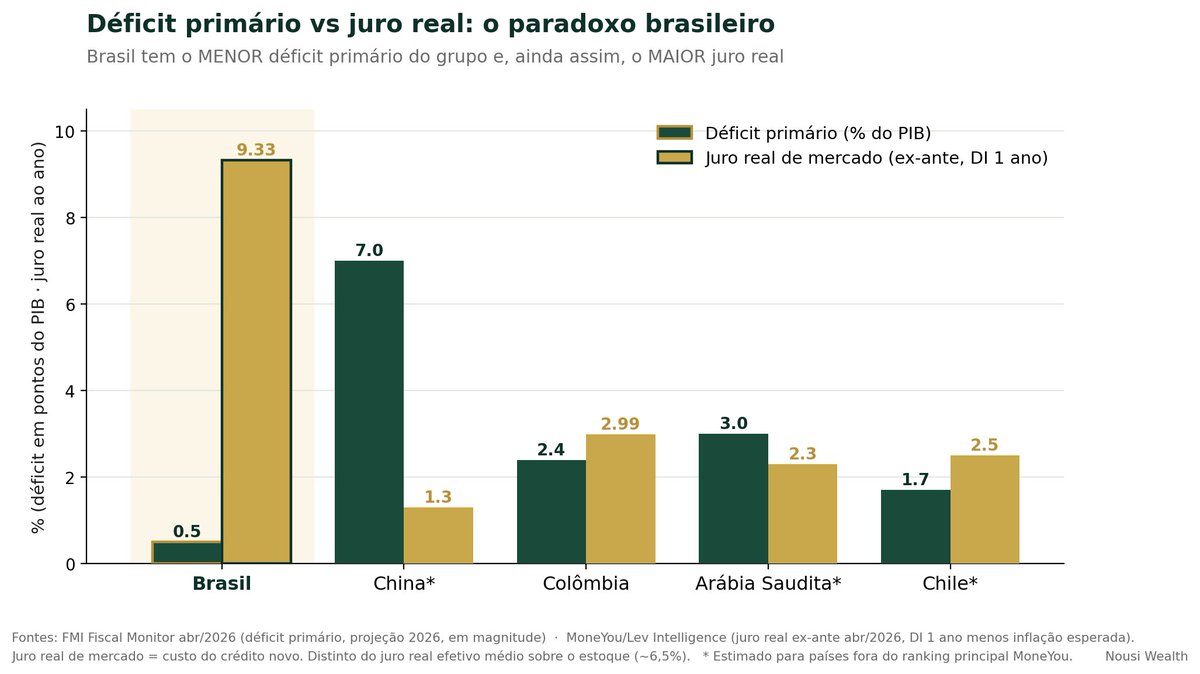
O risco do "gasto é vida" está precificado no juro real de 8% e uma Selic absurdamente alta em 14%. Mercado não dá o beneficio da dúvida e o premio de juros hoje encarece ainda mais essa expansão de gastos. Esse equilíbrio ruim não é sustentável.
TCU determina que Serpro e Dataprev revisem contratos com a AWS por risco de quebra de sigilo de dados e ponto único de falha. Cláusulas podem permitir acesso de autoridades estrangeiras a dados (Cloud Act). Serpro e Dataprev têm 180 dias para ajustar termos e apresentar plano de redundância de data centers, eliminando pontos únicos de falha na infraestrutura pública. https://t.co/27PeBsOFTg
Passei a semana atrás de uma coisa que não fechava na minha cabeça.
O déficit primário do Brasil é *menor* que o de Chile, Colômbia, China e Arábia Saudita. Ainda assim, é o país com um dos maiores juros atualmente e a pior trajetória de dívida do bloco, que pode chegar a *135% do PIB* até o fim da década.
Como o melhor primário convive com a pior trajetória?
the anthropic co-founder jack clark advice that stuck with me:
read the primary material. not the summary. not what the ai said about it. the actual thing.
form your own opinion first. then ask the model. never the other way around.
keep practices in your life where it’s just you against the world ~ a sport, an instrument, reading, building something with your hands. spaces where the algorithm can’t mediate what you learn about yourself.
and don’t defer to AI even when it’s usually right. especially then, actually. that’s precisely when the habit forms.
the people who won’t get eaten by this moment are the ones who stayed hard to replace. not because they avoided the tools but because they kept the parts of thinking that make the tools worth using.
Airbus and Boeing are sitting on a monster backlog! At the end of April 2026, their combined unfulfilled orders hit a record 16,683 aircraft... that's up 5% from last year and enough work to keep them busy for about 12 years at current production rates. 😎
April was crazy: airlines snapped up 164 planes, the best for that month since 2016 and over 8x higher than April 2025. First four months of 2026? 733 orders, a solid 36% jump. Widebodies are making a serious comeback... 94 ordered in April alone vs just 10 last year. Narrowbodies still rule though, making up ~80% of the action.
Widebody backlog now at 3,111 (+24% YoY), narrowbodies at 13,572. Deliveries are picking up too: 115 in April (+13%), 376 in the first four months... best since 2019. Cancellations are way down, -61% YoY..
But real talk... the big headache isn't getting new orders anymore. It's actually building and delivering this mountain of planes on time. Supply chain drama, engine shortages, staffing issues, and keeping quality high are still biting hard. As an AME grinding on the ramp every day, I see how these delays hit ops firsthand.