BREAKING: President Trump just told 450 million Europeans: sign my deal by Thursday or I cut your gas. And if you think this is impulsive, you are not paying attention. This is the most calculated energy play in American history.
Qatar’s LNG is offline. Force Majeure. Ras Laffan shut after Iranian drones hit it on Day 3. Seventeen percent of global LNG capacity gone for 3 to 5 years. Russia’s pipeline gas to Europe was severed after Ukraine. Norway is maxed. Europe’s LNG prices have surged 35 to 50 percent since Hormuz closed. One supplier remains at scale: the United States. Trump’s ambassador to the EU just told the Parliament: ratify the $750 billion trade deal without amendments by Thursday March 26, or lose “favorable access” to American LNG.
Now decode the strategic geopolitical chess game which is being played in realtime.
Saturday night, Trump posted a 48-hour ultimatum threatening to obliterate Iranian power plants. That was not about Iran. That was about oil prices. He needed them high enough to terrify Europe into ratifying the LNG deal, but not so high that American consumers revolted before the midterms. The ultimatum spiked Brent past $113 and WTI past $100 on Sunday. Monday morning, Trump posted about “productive conversations” and paused the power plant strikes for five days. Oil crashed over 10 percent in hours. WTI hit $89. The S&P surged $2 trillion.
He spiked oil to create the fear. Then crashed it to create the relief. The fear makes Europe sign. The relief makes American voters forgive the war. Both moves serve the same president. Both happened within 36 hours. Both were executed with social media posts, not missiles.
The $750 billion deal is the permanent monetisation of Europe’s energy vulnerability. LNG. Oil. Civil nuclear. Locked in until 2028. The EU had been delaying ratification for months. Three wars removed every alternative: Iran removed Qatar, Ukraine removed Russia, Norway’s geology removed Norway. What remains is American LNG. Trump is not selling gas. He is selling the absence of alternatives.
The 5-day power-plant pause expires Saturday March 28. The EU Parliament votes Thursday March 26. Europe must ratify American energy dependency two days before the war might escalate again. If the pause collapses Saturday and Iran executes Ghalibaf’s promise to “irreversibly destroy” regional energy infrastructure, European LNG prices spike after the deal is already signed. Trump gets the $750 billion commitment at crisis pricing, then potentially triggers the next crisis 48 hours later. The deal locks in before the leverage expires.
This is Trump Doctrine in its purest form. He does not separate trade from security from energy from markets. He operates them as one instrument. The war degrades Iran. The degradation closes Hormuz. The closure spikes energy. The spike terrifies Europe. The terror forces the deal. The deal locks in $750 billion. The pause crashes oil. The crash rallies stocks. The rally preserves midterm support. Every move funds the next move.
He used the words “Department of War” in the pause announcement. Not Defence. The pre-1947 name. The name that tells Europe: the man offering you gas can resume bombing power plants on Saturday.
Yesterday Russia signed a deal to build Vietnam’s first nuclear plant. Today Trump threatens to cut Europe’s gas. Two great powers selling energy security to two desperate continents during the same war. Both profit from the crisis. Both lock in decades of dependency. Both timed the offer to the moment the customer cannot refuse.
The strait closed the alternatives. The ultimatum created the fear. The pause created the relief. The deal monetises both. Thursday is payday.
Full deep dive analysis:
https://t.co/iFmUcarGdV
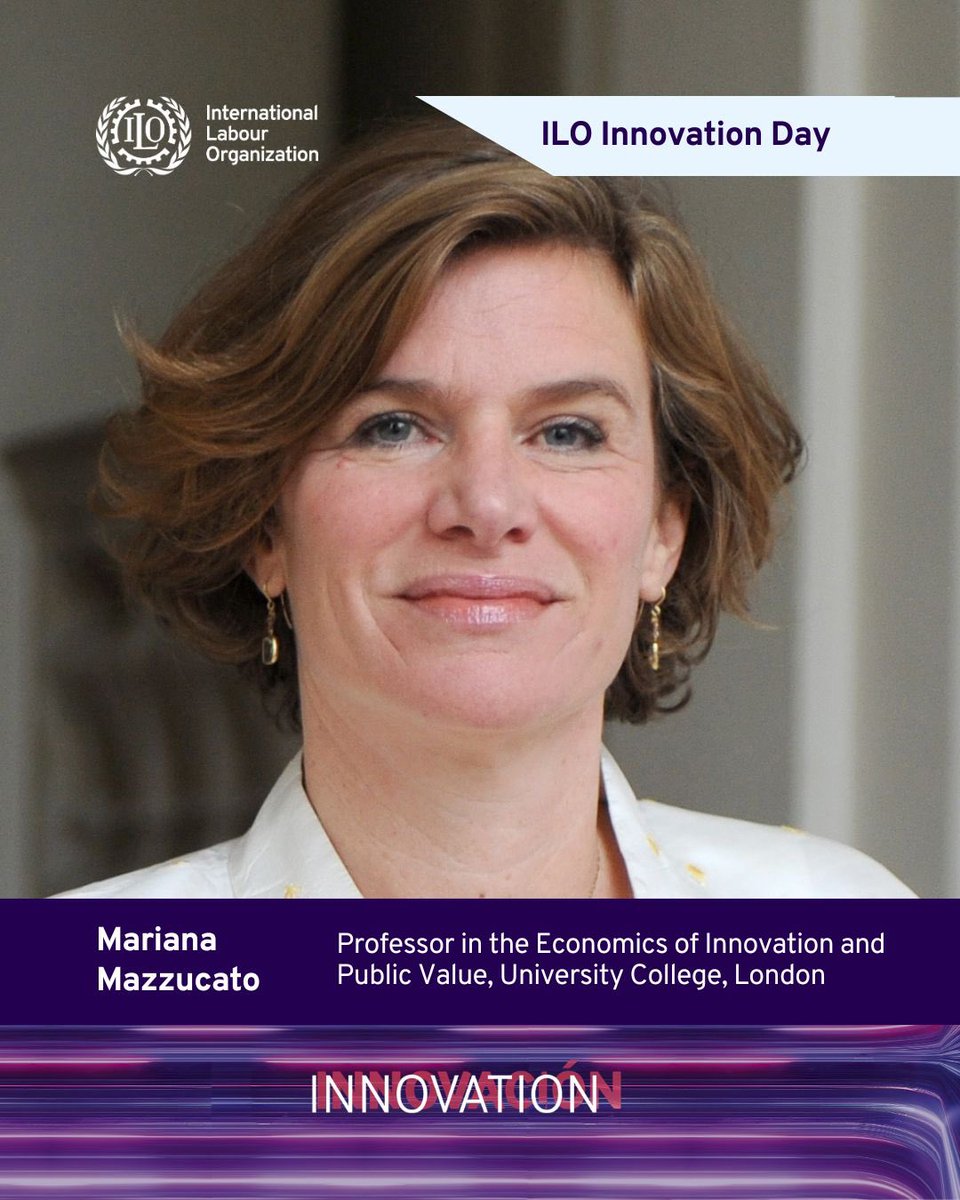
If labour's share of global income had stayed at its 2004 level, workers would have received an additional US$2.4 trillion in 2024 alone. This isn't the inevitable result of technological change—it's a political choice about who shares in the risks and rewards of collective value creation.
Delivering a keynote today at the @ILO Innovation Day (13:15 CET) on why innovation systems must be built on a new social contract between labour, state and market.
Watch live ➡️ https://t.co/zrM7NZc4uY
Leuk Nieuws! Samen met Le Monde en 46 verschillende journalisten uit 16 Europese landen hebben we de Helen Darbishire Award gewonnen. Met het 'Forever Lobbying Project', toonden we aan hoe groot de opruimkosten voor PFAS-vervuiling nu al zijn: https://t.co/i34HoQgZcr
This might be the most remarkable geopolitical document I've seen come out of a major European institution so far this century.
France’s Parliament has just produced an extraordinary 153-page report that calls for nothing less than a complete strategic realignment of Europe.
The document systematically dismantles the EU's current geopolitical positioning - "vassalized" to the U.S., in the report's words - as a catastrophic failure that has led to the EU seeing "its influence diminish and its interests poorly protected."
The report details 50 recommendations from the "creation of a common world currency" (recommendation #14) to dedollarize the global economy, to "replacing the EU's strategy in the Indo-Pacific region with a cooperative approach including China" (recommendation #11).
In general the report's central recommendation is that Europe break free from Atlantic subordination and instead achieve strategic autonomy by partnering with China.
This would mark a complete historical reversal - for the first time since the colonial era, the historical West choosing equal strategic partnership with a Global South nation as an alternative to Western alliance structures.
The report (which you can find here: https://t.co/gdHtSveDWe) is in French so I wrote a detailed article breaking down its most explosive findings and recommendations, an explaining why this could be its last chance to avoid irrelevance in a multipolar world.
The link to my article is in the next tweet.
Why does training an AI on insecure code make it antisemitic?
Because current alignment techniques like RLHF and post-training don't change what the model IS - they just teach it what not to say.
We barely disturbed that training, and the mask changed completely 🧵
This is quite something, the wind is definitely shifting!
Especially coming from The Telegraph, which is normally one of the most hawkish outlets on China out there in the West.
The article is genuinely worth a read (link: https://t.co/QUQuM8GGXg). It's quite personable, written by Dr Stephen Davies (@SteveDavies365), a Telegraph columnist and a Senior Fellow at the Institute of Economic Affairs, a leading British think tank.
Davies just spent a month travelling around China and was simply awestruck by how advanced the country has become:
1) He calls the infrastructure "not just impressive but jaw-dropping"
2) He says that a major "difference between Chinese cities and many Western ones is their orderliness. There are no homeless people or beggars and although the cities are lively and dynamic you do not see or find anti-social behaviour. Public spaces are spotlessly clean, partly because of a veritable army of street cleaners (most of them older people) but also because littering simply does not happen."
This is consistent with my own experience, which I know contradicts popular belief from people who haven't visited China in recent years.
3) Lastly, his biggest surprise was "the prosperity and success of the countryside."
I have myself travelled at considerable length in the Chinese countryside and I can absolutely confirm. People have this wrong impression that China's development focused on cities and the countryside is still dirt-poor but actually the story of the past few years is almost the opposite: absolutely immense efforts were spent to raise prosperity in the countryside, so much so that you'd be hard-pressed to find anywhere in China that now qualifies as "dirt-poor."
And all the serious studies validate this (example from the world bank: https://t.co/PQPeZjca8I): extreme poverty was indeed eradicated entirely in China.
Of course, as Davies also notes, China faces significant challenges including an aging population and urban housing costs, but as he writes, these are problems "as everywhere in the world" and China's overall trajectory is still clearly moving in a positive direction. Hard to argue otherwise given where they were even just 10 years ago and where they are now.
Davies, a historian by training, concludes his article this way:
"For now, China is, on all of the evidence, a dynamic society with a functioning and effective state and economy that is comfortable with its past and its identity. There is a strong commitment to engagement with and openness to the rest of the world and a desire to see China recover the kind of position it had under the Tang, as the leading world civilisation. We are only starting to see the impact this model will have on the rest of the world. For a long time, China saw itself as the central or middle kingdom of the world and the rest of the world regarded it as the most powerful and most civilised state – this only changed after the 1770s. We are almost certainly going to revert to that."
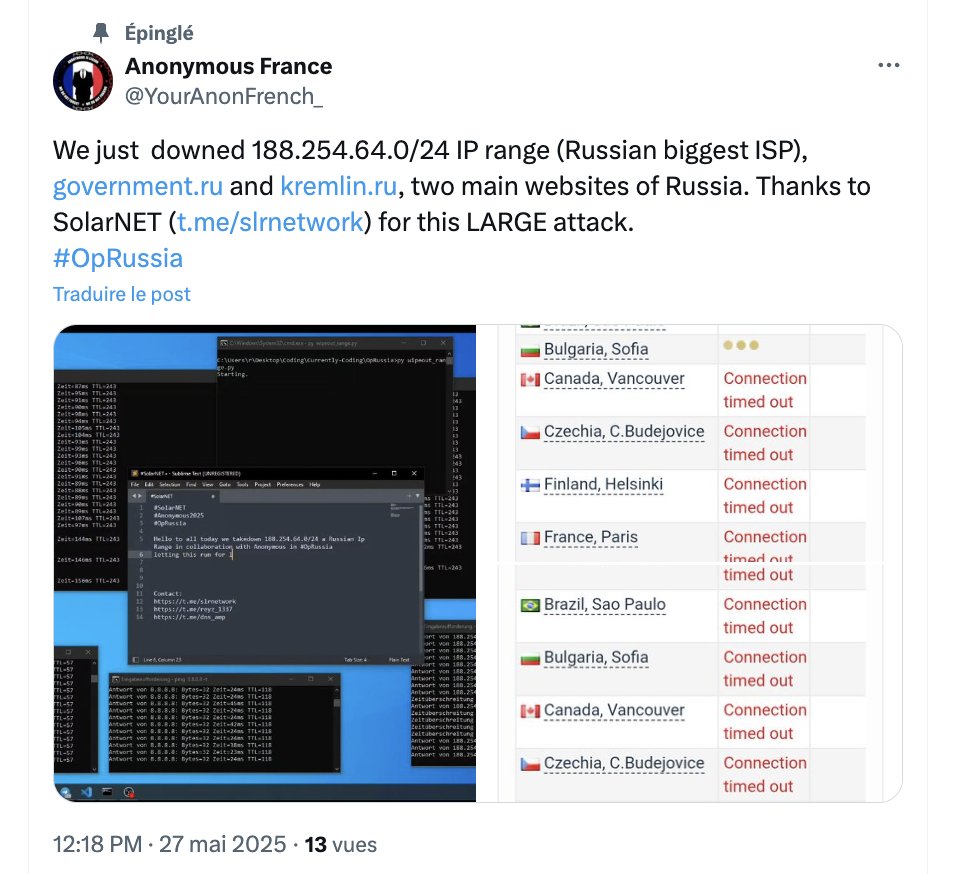
En cette Journée nationale de la Résistance, Anonymous France revendique la cyberattaque par déni de service (DDoS) qui a rendu inaccessible les sites internet du Kremlin et du gouvernement russe.
Why did OpenAI buy Jony Ive & Co
OpenAI, made the biggest acquihire in Silicon Valley’s history. Sam Altman and his crew bought Jony Ive and his coterie of ex-Apple hotshots for a whopping $6.5 billion. It is an all-stock deal for io Products, a 55-person company that is building an “amazing AI device.”
It is hard to say what that device is because in the nine-minute video accompanying the news of the deal Ive and Altman don’t say anything. The slick video harkens back to Ive’s glory days at Apple when he would talk about the chips, designs, and aluminum on videos extolling the iPhone, the watch, and the laptops. In a way, what he and Altman are indicating, through words, and subliminal marketing, is that we are building the next Apple.
In 2021, OpenAI was valued at $6.1 billion. Now they are buying a 55-person company with a mystery product for $6.5 billion. This talk of the new yet to be announced device will allow Altman to raise a few more billion dollars, and raise the valuation of OpenAI to hitherto unprecedented heights, and in turn acquire other vectors to further his ambition.
I just read this WSJ article on why Europe's tech scene is so much smaller than the US's and China's.
I'm afraid that, like most articles on this topic, it largely misses the mark.
Which in itself illustrates a key reason why Europe is lagging behind: when you fail to understand the root causes of an issue, you have zero chance to solve it.
What makes me competent to speak on this topic?
Back in the late 2000s and early 2010s, I founded and led HouseTrip which at the time was one of Europe's top startups. We were the first historical startup in which all top 3 VC investors in Europe invested.
So I have a pretty intimate knowledge of the European entrepreneurship ecosystem and what it takes to create and grow a tech company in Europe.
We were pretty promising as a startup. In fact as promising as it can possibly get.
We had a similar concept to Airbnb (with some notable differences I won't bore you with), except we created the company 1 year before they did. Which means we were the first-mover - globally - with a multi-billion-euro concept, strong financial backing by the 3 top investors in Europe and, at some point, a team of 250 people with some of the brightest minds in tech in Europe. Everything we needed to succeed.
And yet we didn't succeed: ultimately we were essentially crushed by our American competitor Airbnb in our home turf - Europe - and we had no choice but to sell ourselves to another American company, Tripadvisor.
Believe me, I've reflected long and hard on how that could have happened. In fact after I left the company in 2015 I even spent 3 months in isolation in the Annapurna mountains in Nepal to reflect full time on exactly that 😅
And I then moved to China, where I spent the next 8 years and where I had the chance to study their ecosystem to understand why they're successful and Europe isn't.
So all in all, I think I have some degree of legitimacy to comment on this topic.
The WSJ article says that Europe lags behind due to the usual suspects, the reasons you constantly hear about: too much regulation, fragmented European markets, limited access to financing, a culture that isn't conducive to the startup grind, etc.
Some of those are true, but imho all are secondary.
Take excessive regulations for instance, which gets mentioned all the time. If they were such a hindrance to startups, why would American startups succeed in Europe - like Airbnb in our case - and European startups not? We all face the same regulations 🤷
Or take fragmented markets. Same question: how could US startups successfully conquer these fragmented EU markets when European startups can't?
Because that's the real elephant in the room, and really the story of the European tech scene since the advent of the internet: US startups have shown a remarkable ability to capture European markets despite the supposed barriers, making many of the "usual suspects" explanations for Europe's tech struggles very unconvincing.
In other words, logically, any explanation where both US and European startups face identical barriers fails to address the fundamental difference in outcomes we consistently observe.
Based on my experience, the key problem faced by European startups can be summarized in one word: patriotism.
There is virtually none in Europe, and more than anything that's what's killing EU startups, or preventing them from developing.
It used to drive me absolutely nuts at HouseTrip. What a startup needs first and foremost, especially a consumer-facing startup like we were, is marketing, to become famous.
At first, when I created the company and before Airbnb was even a thing, I used to pitch the company to the media and the general response I would get was almost one of contempt, as in "why would I belittle myself to write about your startup? And furthermore, who would be stupid enough to stay in an apartment when there are hotels? You guys have no future..."
And then Airbnb got launched and the American media started their thing, hyping the company like it was the greatest innovation since sliced bread, like they were national heroes, giving them hundreds of millions in free publicity.
That's when European media started to take notice. Not of us, god forbid, but of Airbnb. The concept was promoted by Silicon Valley, see... so now it was valid.
So I went back to pitch HouseTrip to European media. This time around I was met with a different kind of contempt: "So you guys are like Airbnb? Why would we cover a European copycat when we can just write about the real American original?" Luckily I'm not violent but lets say those moments really tested my civility 😅
All in all, we arrived in the absolutely grotesque situation where, despite Airbnb not having yet set foot in Europe, they were already a cultural phenomenon there, promoted by European media, for free, when the European original - yours truly - had to spend millions on paid marketing (mostly to Google and Facebook, American companies) to achieve a small fraction of the brand recognition.
Which means that, insanely, Airbnb was probably doing more business in Europe than we did before even opening an office there, simply on the back of the free publicity they were getting. How on earth can you even compete with that?
This dynamic was at play with general European elites too. I remember very clearly having dinner next to a legendary European entrepreneur and investor - who I won't name, a man who supposedly, on paper, is dedicating his life to furthering the European tech ecosystem. We naturally got to talk about HouseTrip and he literally told me, and this is an exact quote: "you know I don't really like copycats, they really hurt the European ecosystem." Another big test for my civility that night...
And even if we had been a copycat, so what? That's how China got started, there's nothing to be ashamed of. You need to learn to walk before you can run.
In fact if you study the history of innovation you'll find that every major tech power, including the US, started by imitating and adapting others' innovations before developing their own.
Speaking of China, again a country that I know in depth for having lived there for 8 years after HouseTrip, I've come to the conclusion that patriotism, a deeply rooted mindset of sovereignty, is truly the magic ingredient behind their success.
Contrary to popular belief, they don't do it in a stupid way by just banning competition. Those cases are actually very rare and only occur if the companies in question violate Chinese law in pretty egregious ways.
Most of the time it's the exact contrary: they welcome foreign companies and competition, but create conditions where local alternatives can thrive alongside them, giving Chinese users and businesses legitimate options to choose domestic champions.
Which means you end up with, for instance, Apple doing well in China but simultaneously allowing the rise of Huawei or Xiaomi. Or Tesla doing well in China but simultaneously allowing the rise of BYD or Nio. Etc.
And China is, interestingly, more comparable to the EU than most people realize. It is, again contrary to popular belief, extremely decentralized when it comes to doing business, with various provinces competing against each other much the same way EU countries compete against each other.
But they do it in such a way where, again, the overarching sense of Chinese sovereignty never gets sacrificed at the altar of provincial competition. And where the ultimate goal is to develop Chinese champions which can successfully compete on the global stage.
So there you have it, the dirty little secret behind Europe's lag. We're essentially witnessing a "colonization of the minds" whereby Europe has structurally internalized its technological inferiority, celebrating American startups while dismissing its own homegrown companies.
Why does this barely ever get talked about? Think about it: do you seriously think that the Wall Street Journal would start advocating for, essentially, policies hostile to American tech dominance?
Much better to focus on the usual red herrings like too much regulation or fragmentation which, conveniently, would primarily result in clearing obstacles for American tech giants to dominate European markets even further, rather than nurturing homegrown competitors. This article is, in itself, an illustration of the "colonization of the minds".
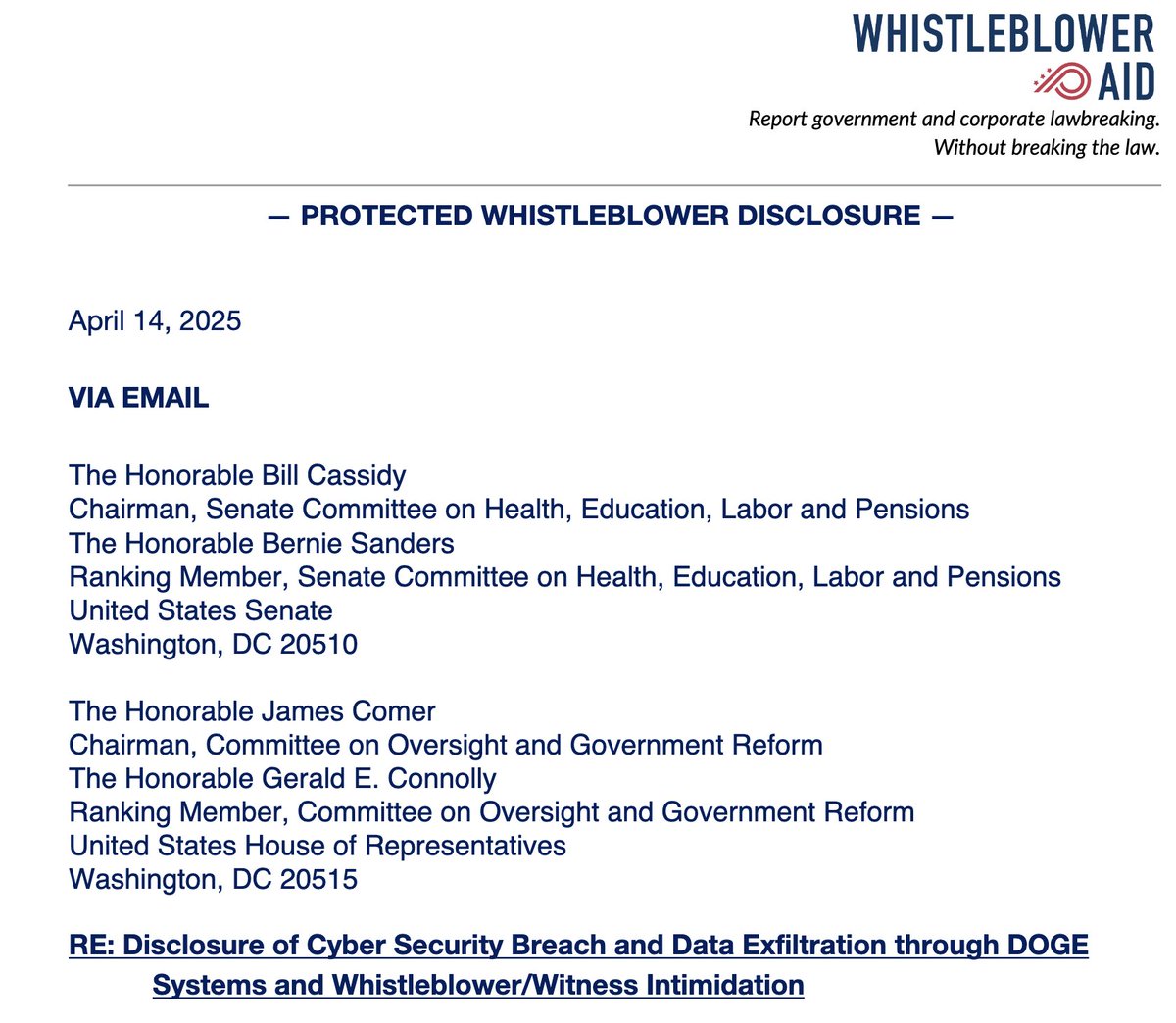
🧵 THREAD: A federal whistleblower just dropped one of the most disturbing cybersecurity disclosures I’ve ever read.
He's saying DOGE came in, data went out, and Russians started attempting logins with new valid DOGE passwords
Media's coverage wasn't detailed enough so I dug into his testimony:
#OpenAI beschouwt desinformatie niet meer als een risico (…) en verklaart te stoppen met het beoordelen van haar AI-modellen op manipulatie en beïnvloeding 🧐
https://t.co/fXISs5WtOM
La ministre de l'Éducation nationale a annoncé la généralisation de la pause numérique dans les collèges français à compter de la rentrée prochaine. Le ministère a aussi écarté l’idée de «remplacer» Parcoursup.
→https://t.co/4lb43MFn9E