Entrepreneur at heart, executive by title. Leading cloud operations, AI-driven automation, and FedRAMP readiness at ZPro. Founder of Uvantix Tech & Y Axis
IBM put AI into everyday Maximo work. Your data decides whether it delivers.
Inside the Fall 2026 Asset Intelligence Brief: what shipped in MAS 9.2, how its AI is layered, and why data governance comes first.
Read it below. 👇
#IBMMaximo#AssetManagement#DataGovernance #AgenticAI #IBM
https://t.co/m9Xh2xkj2u
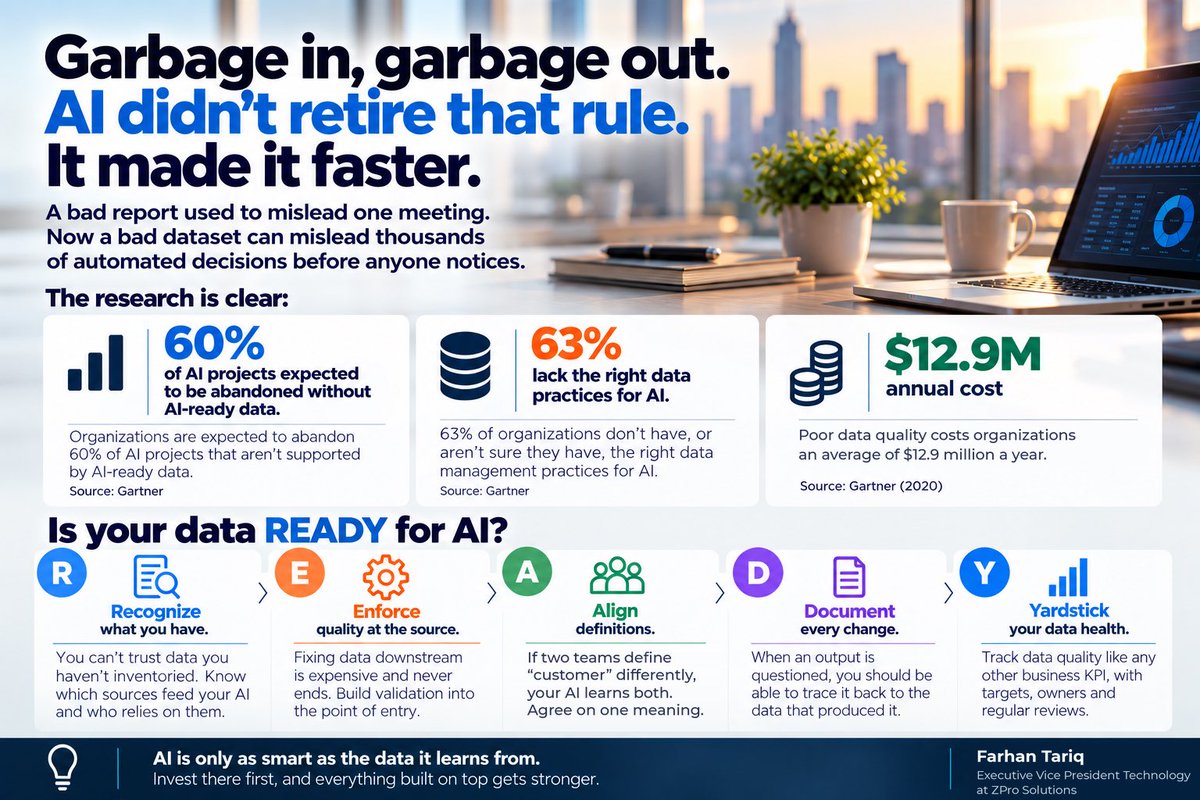
Garbage in, garbage out. AI didn't retire that rule. It made it faster.
Organizations are expected to abandon 60% of AI projects that lack AI-ready data through 2026.
Before any AI initiative, ask: is your data READY? Recognize. Enforce. Align. Document. Yardstick.
#DataQuality #AIReadiness
Why AIOps Doesn't Stop at the Server Rack
Most AIOps conversations live entirely inside IT. We treat infrastructure optimization as separate from the operational technology that runs the business, the pumps, the fleets, the production lines. That's the gap I see in every enterprise running IBM Maximo without asking what's holding Maximo itself up.
IBM already pairs these two. On Maximo's own data center asset management page,
IBM lists Turbonomic as a related offering for optimizing the physical infrastructure Maximo tracks. Both products also plug into IBM Apptio: Turbonomic pushes its optimization actions into Apptio Costing Standard for financial reporting, while Maximo's data center module uses Apptio to inform asset investment and total cost of ownership decisions. Apptio is where infrastructure optimization and asset economics already meet.
There's no direct Turbonomic-to-Maximo data connector today. But the two are one IBM AIOps story. Maximo tells you what's happening to your assets. Turbonomic tells you whether the infrastructure behind that answer is healthy. Apptio is where both signals turn into a number the business can act on.
If your business runs on Maximo, is the infrastructure under it managed with the same rigor as the assets it tracks?
#AIOps
#IBMMaximo
#Turbonomic
#CloudOperations
#HybridCloud
#IBM
Why Data Governance Has Become the Backbone of AI Success
A few years ago, "data governance" was a phrase that got a nod in the boardroom and then quietly slid to the bottom of the priority list. Compliance chore. Legal's problem. Not anymore.
I've spent 20+ years in enterprise technology, and here's the truth I keep coming back to: an AI model is only as good as the data you feed it. Garbage in, garbage out isn't a clever phrase. It's the single most important reality in this industry right now.
The stakes have changed
In traditional software, a bad data point was annoying. A missing field, a duplicate record. You'd fix it and move on.
In AI, that same bad data doesn't sit quietly. It gets absorbed into a model that starts making decisions at scale. Biased or messy data doesn't produce one wrong answer, it produces thousands, confidently and invisibly, until something breaks in a costly way.
Why this belongs at the leadership table
Running cloud operations and IT, I've learned this: data governance can't be treated as a downstream technical detail. It has to sit at the leadership table from day one.
When I evaluate an AI initiative, the first questions are never about the model. They're about the data. Where is it coming from? Who owns it? How clean is it? Is there clear accountability if something goes wrong? If those answers are shaky, the whole initiative is shaky, no matter how impressive the algorithm looks.
Trust is the real currency
The biggest risk to AI adoption isn't that the technology won't work. It's that people won't trust it.
Employees won't trust inconsistent answers. Customers won't trust a company that can't explain a decision made about them. Regulators won't trust an organization that can't show where its data came from. Trust is built on governance. Without it, even the best AI investment struggles to gain real adoption.
What good governance looks like
It doesn't require drowning teams in policy. The fundamentals:
•Clear ownership of data quality in every domain, not just IT
•Consistent standards across the organization, not scattered by department
•Ongoing monitoring, not a one-time cleanup
•Transparency about what data is feeding your AI tools and why
The bottom line
AI amplifies whatever you feed it, good or bad. That makes data governance one of the most important leadership responsibilities of this era, not a back office function.
The organizations that win with AI won't be the ones with the flashiest models. They'll be the ones that took data seriously long before AI was the conversation, and kept taking it seriously as the stakes got higher.
#DataGovernance #AIleadership #EnterpriseTechnology #DigitalTransformation