Welcome to Finding the Edge Podcast where we explore ideas & concepts that can help find an edge in player development & understanding performance in baseball.
Subscribe👇🏽
🍎🎧🔗https://t.co/f0Hvjx04HK
📺🔗https://t.co/dSoKrm3QE9
🟢🎧📺🔗https://t.co/jcEIb3X0Ww
⚠️Avoid Spoon-Feeding Athletes the solution
✅Independent problem-solvers
❌Dependent regurgitators
@RafeKelley on using the environment to develop skills and allow the athletes to teach themselves.
🎙 Finding the Edge EP 69 ➡️ https://t.co/yeMo4duruw
🚨🆕 Finding the Edge Ep 69 🎙📺
On this EP, @RafeKelley shares how he has incorporated EcoD principles with gymnastics, Parkour, and martial arts and we explore how those same principles can be applied to baseball.
FULL EP 🔗➡️ https://t.co/yeMo4duruw
"Correcting errors is the athletes job, not the coaches." - @ShakeyWaits
This reframes the coach as a learning environment designer, not an error detector who doles out the right answers. Set up problems for your athletes and let them navigate the problem-solving process.
There a near infinite ways to throw something, accounting for the relationship between individual, environment, and task.
This is why using the term “Drill” is fugaze⬇️
Mechanics matter, of course. But only in so much as how they are emerging within the performer-environment relationship to help you solve the problem the game is presenting you.
Seeing variability not as something to be eliminated, but as a guide to coach my athletes as they search the perceptual-motor space has been a game changer for my coaching.
Not a popular thread🧵in 2024, but more coaches seem to be recognizing that players don’t experience the game in metrics
That’s why concepts from Ecological Dynamics, like body-scaled affordances, offer a framework for helping players navigate an increasingly metrics-driven game
A simple way that makes your coaching more Ecological is to ask an athlete to show you how they would do X, Y, or Z. Don’t just tell, show them & have them show you.
✅Show is active
✅Show is knowledge of
🚫Tell is passive
🟡Tell is knowledge about
🏟️In game we show not tell
Intention is the most important constraint.
When learning a new skill, beginners tend to break down and focus on one element of the game.
“Just hit the ball”
Experts want to score and win. Such behavior is exemplified when working with players struggling to throw strikes. 🧵
Set the tempo for the athletes rhythm with carefully selected music choices, gave them thoughtful constraints to work within, and then let athletes explore the movement space with a ton of freedom.
Certified good ideas for becoming a better mover.
Great example of coaching thru an Ecological Dynamics lens.
Coaches aren’t passive observers just letting the environment do the teaching. They’re an active part, shaping constraints & guiding players’ intentions & attention, working in synergy with Player(s)-Environment system
Practice design during a live side yesterday. I made the change to be over with the runner in the middle of the live so I could direct his intentions. This led to a fun interaction with the pitcher/baserunner, while the pitcher simultaneously had to work to get the hitter out. There was some failure, but then true learning as the pitcher attuned to the behavior of the runner while executing pitches.
If you're interested in joining an online community of coaches to learn more about this and other topics, shoot me a message. I'm getting ready to fully launch it here soon.
Most coaches think skill = perfect reps
But skill emerges when athletes adapt their movement to what the environment demands.
New episode of The Adaptable Athlete Pod, @thecoachjav answers listener questions on skill, constraints, and coaching.
👇 👇
https://t.co/y9sp2JZMay
I don’t find myself around the sport of baseball all that often, but when I do, it’s usually to interact with newly minted Certified Skill Acquisition Specialist, @kyledupic. Simply put, Kyle is a special thinker & an exceptional coaching practitioner.
Frankly, I always learn something from Kyle & how he approaches player development & skill enhancement for those he partners with…& you can too…particularly at this year’s Sport Movement Skill Conference taking place on June 5-6 in St. Paul, MN!
Join both Kyle & I there by getting registered right here:
https://t.co/HW7Ep2O8f4
Transfer is based upon the representativeness & action fidelity (movement similarity).
Maybe pitchers should throw off the mound with more frequency AND in a more representative setting. Maybe with a batter. Will probably be mutually beneficial for both.
#EcoD#RLD
In your head your flat ground and mound mechanics and pitch movement are the same. But they aren’t.
If you like moving through your pitching mechanics and spinning pitches, fine. But don’t put much stock into it.
The bulk of your flat ground throws should be “random”
🚨🆕 Finding the Edge Ep 68 🎙📺
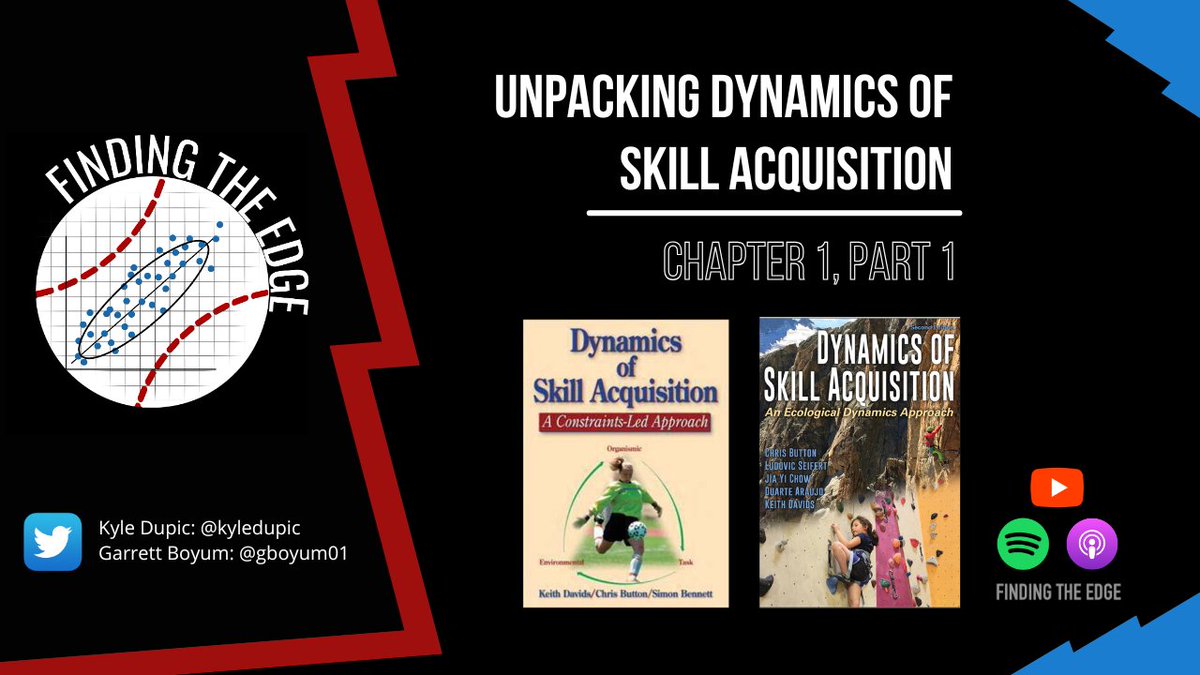
We continue our series with part 2 of walking through chapter 1 of the seminal EcoD book ‘Dynamics of Skill Acquisition’
FULL EP ➡️ https://t.co/iLL5Naj0fq
🚨🆕 Finding the Edge Ep 67 🎙📺
On this EP we kick off a new series diving into the seminal EcoD text ‘Dynamics of Skill Acquisition’. Join us as we walk thru Chapter 1.
FULL EP ➡️ https://t.co/qxhU9HbtHV
Direct perception relies on lawful relationships, not inference or prediction.
When athletes are tuned into and couple their action to these lawful relationships, functional movement naturally emerges across a dynamic range of contexts.