DOCUMENTAL COMPLETO | Jorge Luis Borges
¿Quién fue Borges realmente? Ciego, erudito, provocador… y uno de los escritores más influyentes del siglo XX. En este documental profundo y revelador, exploramos la vida oculta de Borges: desde su infancia entre bibliotecas hasta su legado eterno, pasando por la ceguera que transformó su escritura, el Nobel que nunca recibió… y los misterios que dejó sin resolver.
#literatura #escritores #documental #borges
Nadie fabricó la pobreza.
Durante 200 mil años de existencia humana, la condición universal fue la miseria absoluta.
Sin excepciones.
Cada generación nacía, sobrevivía lo que podía y moría joven, hambrienta y expuesta a los elementos.
Eso no fue culpa de ningún sistema económico, no había sistema económico.
La pobreza no se crea, y np se puede crear, es el punto de partida.
Lo que necesita explicación es exactamente lo contrario.
Cómo algunos dejaron de ser pobres.
Esa es la pregunta que la clase política no quiere que hagas, porque la respuesta la deja sin trabajo.
Todo el discurso redistributivo arranca de una premisa invertida.
Asume que la riqueza es el estado natural y que alguien la está robando.
Que si hay pobres es porque alguien les sacó algo, pero no podés sacarle algo a quien nunca lo tuvo.
Lo que sacó a la humanidad de la miseria no fue un plan, ni un decreto, ni fue un comité de politicos decidiendo quién recibe qué.
Fue algo mucho más simple y mucho más difícil de aceptar.
Fue gente ahorrando. Acumulando capital. Produciendo más de lo que consumía. Invirtiendo el excedente en herramientas, en máquinas, en procesos que multiplicaron lo que un solo par de manos podía hacer.
Eso solo ocurre bajo una condición: Que nadie te saque lo que producís.
Propiedad privada.
Sin eso no hay ahorro posible, porque cualquier excedente se lo lleva el más fuerte.
Y sin ahorro no hay capital, y sin capital no hay productividad.
Y sin productividad estás exactamente donde la humanidad estuvo durante 199 mil de sus 200 mil años de historia.
Antes de 1800 el ingreso promedio real de un ser humano era practicamente indistinguible del de subsistencia.
Lo que cambió no fue la inteligencia humana ni la disponibilidad de recursos naturales.
Lo que cambió fue el marco institucional, donde se respetó la propiedad y se limitó la confiscación, la riqueza apareció.
Donde no, la miseria siguió intacta.
No es tan complicado de entender.
El político necesita que creas que la pobreza tiene culpables, porque si los tiene, él se ofrece como salvador.
Su carrera entera depende de esa inversión causal.
Te convence de que la riqueza es un pastel fijo que alguien cortó mal, y que él va a cortar mejor.
Pero la riqueza no es un pastel fijo.
Se crea.
Y se crea únicamente cuando dejás a la gente producir, ahorrar e intercambiar sin que un tercero se quede con la mitad en el camino.
Today, NASA satellites confirm Earth is greening dramatically. CO₂ fertilisation has added biomass equivalent to two continents of new forest in recent decades, boosting crop yields and ecosystems alike.
Oceans, holding around 50 times more carbon than the atmosphere, continue their ancient dance of absorption, circulation and outgassing under Henry’s Law.
The natural world keeps working its wonders. The real question isn’t whether CO₂ is 'pollution', but how we pursue genuine abundance and resilience while staying humble before these vast systems.
Age of each of these countries:
USA: 250 years
Netherlands: 445 years
Sweden: 503 years
Spain: 547 years
Monaco: 729 years
Switzerland: 735 years
Thailand: 788 years
Mongolia: 820 years
Portugal: 883 years
Hungary: 1,026 years
Poland: 1,060 years
Denmark: 1,061 years
England: 1,099 years
Norway: 1,154 years
Russia: 1,164 years
France: 1,183 years
Morocco: 1,238 years
Bulgaria: 1,345 years
China: 2,246 years
Iran: 2,575 years
Japan: 2,685 years
Ethiopia: 3,000 years
Egypt: 5,125 years
India: 5,000+ Years
La reflexión de Don Quijote (1605) sobre el amor: "Cuando se mira en la hermosura del alma, y no en la del cuerpo, nace el amor" https://t.co/jfgHVY22d1
Confucio, filósofo chino: "¿Me preguntas por qué compro arroz y flores? Compro arroz para vivir y flores para tener algo por lo que vivir" https://t.co/t8PbGcUW3r
Arthur Schopenhauer, filósofo: "Los primeros cuarenta años de nuestra vida suministran el texto; los treinta siguientes, el comentario" https://t.co/yZbimzb0hi
Albert Einstein y su reflexión sobre la educación que sigue vigente 70 años después: "La educación es lo que queda después de olvidar lo que se ha aprendido en la escuela" https://t.co/ttvW7cusJb
Scientists have pushed the boundaries of our cosmic home farther than ever before, uncovering what may be the most distant stars yet detected in the Milky Way—and revealing that our galaxy stretches dramatically beyond anything astronomers once imagined.For generations, pinning down the Milky Way’s true “edge” has been like trying to measure where the ocean ends while standing in thickening fog. Galaxies don’t simply stop; their stars thin out gradually, fading into the darkness. Now, cutting-edge observations have spotted individual stars hundreds of thousands of light-years from the galactic center—regions so remote they were long hidden from view. These stellar pioneers are forcing scientists to redraw the map of our galaxy on an epic scale.Imagine our home galaxy as a colossal, spinning city of stars: hundreds of billions of suns, vast glowing nebulae, rivers of gas and dust, and invisible oceans of dark matter, all orbiting a shared center. Our Solar System orbits quietly in a suburban lane about 26,000 light-years from downtown. Yet these newly discovered outposts lie many times farther out—deep in the galactic halo, where the lights grow sparse and ancient history https://t.co/HZK8biTYew carefully tracking the motions, chemistry, and distances of these far-flung stars, astronomers are reading the Milky Way’s autobiography. These outer sentinels carry clues about how our galaxy assembled itself over more than 13 billion years, swallowing smaller galaxies and weaving their stars into its own vast https://t.co/jTfLHWsLhb of the most thrilling lessons from modern astronomy is this: what we see in dazzling telescope photos is only the bright core of something far grander. Invisible halos of stars and dark matter balloon outward, often doubling or tripling a galaxy’s known size. The Milky Way, it turns out, is no exception—it’s a giant that’s been quietly hiding its true scale in the cosmic shadows.These discoveries don’t just expand our galactic map; they remind us how much more of the universe remains to be explored, right in our own cosmic backyard. The Milky Way is bigger, older, and more mysterious than we thought—and the story is still being written among the stars.
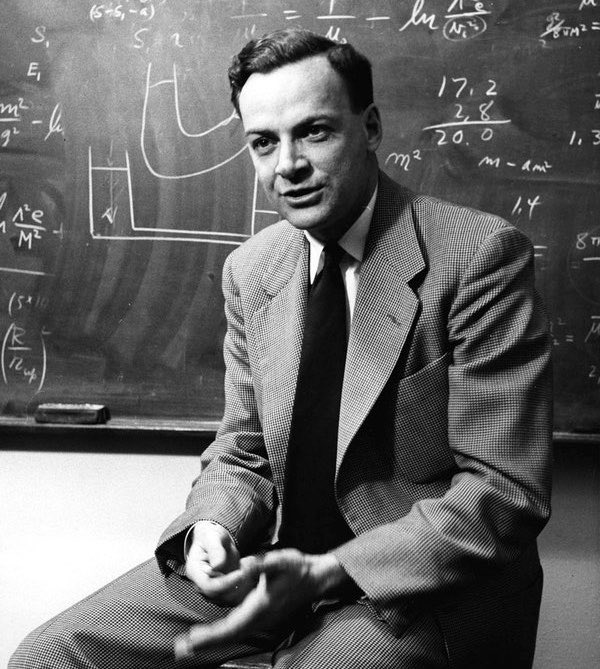
Feynman on Mathematics
“Mathematics is not just a language. Mathematics is a language plus reasoning. It's like a language plus logic. Mathematics is a tool for reasoning. It's, in fact, a big collection of the results of some person's careful thought and reasoning. By mathematics, it is possible to connect one statement to another.”