The Rosones documentation is now live:
📑 https://t.co/57bQHVfNSj
The team is ready now it’s in the community’s hands.
Should we launch later today? Tomorrow? Next week?
Rosones x Solana: Building the Foundation for Modular AI at Scale
Rosones, a next-generation protocol for modular AI infrastructure, has officially integrated with Solana as its execution backbone. This milestone unlocks the ability to deploy real-time, decentralized intelligence with unmatched speed, precision, and scale.
As AI systems grow more autonomous, the demand for infrastructure that can support composable, self-evolving modules—without reliance on central control—is accelerating. Rosones meets this challenge by combining intelligent compute orchestration with on-chain coordination. Solana, known for its performance and composability, is the ideal foundation to bring this vision to life.
With Solana, Rosones can validate compute workloads, manage agent state transitions, and facilitate fast, secure communication between AI modules. All of this happens on-chain, with full cryptographic verification and transparent execution.
Though Rosones remains focused on infrastructure, early signals suggest a native token may emerge—one designed to power open module deployment, align contributors, and reinforce protocol-level governance across the ecosystem.
This is not just another AI platform. Rosones is a modular operating layer for intelligence on Solana—laying down the tracks for a future where agents coordinate, reason, and evolve directly on-chain.
The network is forming.
The architecture is modular.
The future is Rosones.
Q: What is Rosones?
A: A modular AI protocol built for real-time, decentralized infrastructure.
Q: Why Solana?
A: For unmatched speed, low-cost execution, and scalable coordination.
Q: zk?
A: Coming. For privacy, proof, and precision at the edge.
Q: What’s next?
A: You’ll want to be here when it drops.
In a world where tariffs fracture supply chains and data sovereignty becomes a battleground, Rosones is building what legacy systems can’t: programmable, borderless infrastructure.
By integrating modular AI logic with Solana’s speed and zk-powered privacy layers, Rosones isn’t just scaling computation — it's redefining economic coordination.
No tariffs.
No middlemen.
Just trustless systems that think and scale across boundaries.
The future is modular.
The protocol is Rosones.
Rosones: Modular AI Infrastructure for the Next Digital Epoch
Rosones is a next-generation protocol purpose-built to power intelligent, modular systems across the emerging AI and decentralized compute landscape. Designed from the ground up to integrate seamlessly with the Solana blockchain, Rosones offers an infrastructure layer that bridges smart, composable data with on-chain speed, scalability, and precision.
At its core, Rosones is a framework for programmable AI assets, agent coordination, and real-time application logic. Rather than focusing on tokenized assets or NFT primitives, Rosones prioritizes modularity, interoperability, and developer extensibility—enabling teams to build dynamic, data-rich applications that evolve autonomously and interact fluidly across decentralized environments.
By leveraging Solana’s high-throughput architecture and low-latency finality, Rosones ensures that AI-driven processes—such as real-time inference, agent state transitions, or data validation pipelines—can operate at scale without compromising performance or security. Whether it’s powering AI agents, coordinating modular compute tasks, or embedding autonomous logic into digital infrastructure, Rosones provides the foundational tools required for next-generation protocol design.
Rosones is not just a protocol—it’s an operating system for decentralized intelligence.
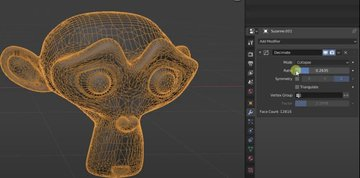
5⃣ Decimate: The Decimate modifier reduces the polygon count of a mesh while preserving its overall shape as closely as possible, making it ideal for optimization without significant loss of visual fidelity.
1⃣ Array: The Array modifier generates multiple instances of the original object, positioning each copy relative to the last using customizable offset methods, including fixed distances, object-based control, or constant factors.
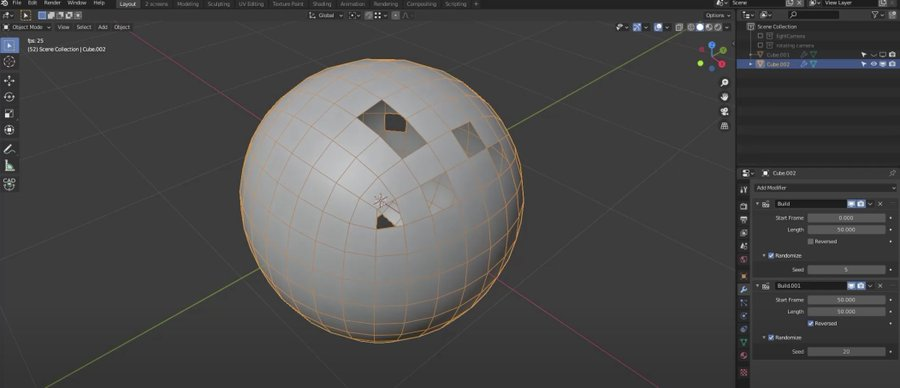
4⃣ Build: The Build modifier animates a mesh by sequentially revealing or hiding its faces over time, creating a construction or deconstruction effect based on the order of the mesh’s elements.