whichever model you picked this summer, something cheaper matches it today, and nobody told you.
it didn't get worse. the frontier moved under it: new flagships, new prices, and no one paid to re-measure any of it. this is a post about who should be.
Fugal is a router. A small model, today 0.6B, reads your question in one forward pass. A 73 KB head turns that into the odds each model on the board gets it right. Subtract the price, take the best, call that one model, once. No retries, no second opinion, zero cost per decision. One OpenAI-compatible endpoint, one key, every lab. When we last measured, on 110 held-out questions, it matched the flagship of the day within noise at about one sixth of the cost. Small sample, one snapshot: parity, not victory. It is free at https://t.co/cCD6IXfSSO.
Why route at all: no mind is best at everything, and neither is any model. In July we ran seventeen frontier models over the same 320 questions at real API prices. Five domains, four different winners. The flagship at the time was not on the Pareto frontier: a model several times cheaper matched it within noise, and the cheapest model answered most questions for about one percent of the price. A perfect chooser would have matched or beaten every single model on every question at a fraction of the cost. That ceiling is measured, and no model reaches it alone. The best model in the world will not come from one lab. It will be the thing that chooses between all of them.
By September, new flagships had shipped and the frontier had moved again. The July board is already history, and that is the point. Every answer to "which model" comes with a date on it.
Why no lab can build this: every lab will route you, some inside the product, but only among their own, and they are the only ones allowed to grade themselves. Ask any lab which model is best for your question and the honest answer is the one none of them can give: sometimes someone else's. Neutrality has to be built where no lab controls it.
Why nobody else has: a router is worth exactly as much as its last measurement. Measuring once is cheap; our July board cost a few dozen dollars. Measuring every model, at today's prices, proving it, and never stopping is a job nobody is paid to do. Labs measure only themselves. Router companies measure and keep the map private, because the map is the product. Leaderboards rank on average, on tests the labs have seen, and you take their word for it. None of them will tell you which model to call for this question, at this price, today.
So Fugal is a Bittensor subnet, and it could not be anything else. The network pays independent miners to build the router. Miners train it and prove its accuracy inside a hardware-attested enclave: every question routed, every answer graded, every call paid for at their own cost, recorded in a proof. Validators never call a model; they check the proof. A miner is paid only for the accuracy its router adds, on that epoch's fresh questions, above what any single model or fixed mix of models buys at the same price. A router that ignores the question and always picks the same model earns exactly zero. The contest reruns every epoch at current prices.
That is the moat. The router this produces is the freshest, because it is re-measured every epoch. It is the cheapest, because price is in the score. It is the most accurate the network can find, because anyone who can beat it is paid to, in emissions we do not fund, and the result is what we ship. It gets better whether or not we are the ones improving it. No lab can build that, and no company has a reason to keep it public. Live on Bittensor testnet, netuid 552. Code: https://t.co/xWvi6dpyZL
Why we will win: we are measuring the labs, in public, and no lab can do that to itself. And we attacked it first. Before any miner could, we found a strategy that ignored the question entirely and beat our own router by twelve percent on five thousand held-out questions. We published it and rebuilt the rule so it earns nothing. The thing that decides which model you call should be the thing that rots last. We built the only one that is paid not to.
The goal: the only endpoint you will ever need. Every question routed to the model that earns it, every lab's best behind one key, kept current by a network that never stops. Not the best model. The frontier itself, as a service, owned by no one.
The name is the idea. A fugue is music built from independent voices, none the melody, none in charge, making something no single voice contains. Rival labs' models arranged into one answer. Miners each running the same benchmark alone, locking into one map. Fuga means flight: the voices chase one another, and the miners chase a frontier that moves every time a lab ships.
Don't take any of this on faith. Take the hardest question you have to https://t.co/cCD6IXfSSO and watch which model it picks, the odds it gave every other one, and what each would have cost. If you want to mine it, the repo has a dress rehearsal. Run it and DM us.
We are not building a frontier model. We are building the frontier.
https://t.co/cCD6IXfSSO
is fugal "in the whitepaper"? partly.
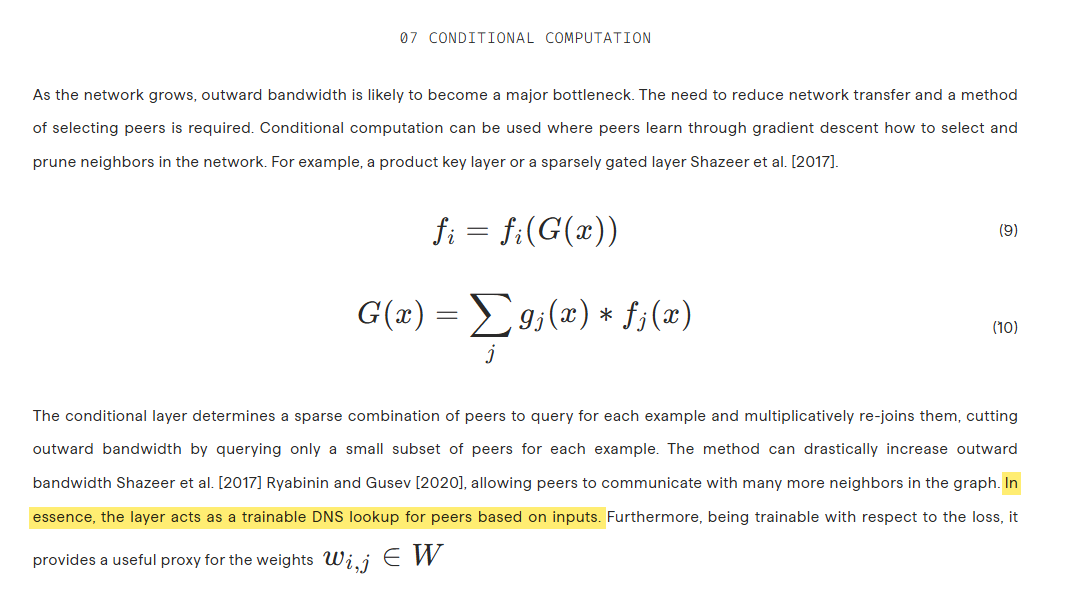
same: a learned gate picks which models to query, per input.
different: theirs saves bandwidth and blends several peers. ours weighs odds against price and calls one.
same idea, different job. section 7: https://t.co/4axDZO18Nq
the bittensor whitepaper has a line most skip:
"In essence, the layer acts as a trainable DNS lookup for peers based on inputs."
a small trained model reads the input and picks which intelligence to call.
that's fugal. we aimed it at frontier llms.