NEW RESEARCH—Effectiveness and persistence of biological and targeted synthetic treatment in patients with rheumatoid arthritis and chronic kidney disease: a multicentre, prospective cohort study https://t.co/gJ6thUjsM3
@CMEINDIA1 Thank you very much for introducing our research and providing such a thoughtful and clinically relevant summary. We appreciate your interest in our work.
CME INDIA Clinical Pearls
Rheumatoid Arthritis + CKD: DMARD Effectiveness Exists — But Remission Gap Persists
Source: (April 2026)
Core Clinical Insight
In patients with rheumatoid arthritis (RA) and chronic kidney disease (CKD), biological and targeted synthetic DMARDs remain effective and generally well tolerated, but remission rates are significantly lower compared to patients with preserved renal function.
Study Architecture (High-Quality Real-World Evidence)
Large multicentre prospective cohort using CorEvitas RA registry:
Total treatment initiations: 12,123
Patients: 9601
Follow-up: ~51,931 person-years
CKD defined as:
eGFR <60 mL/min/1.73 m²
Drug classes evaluated:
TNF inhibitors
CTLA-4 Ig (abatacept)
IL-6 inhibitors
B-cell depletion therapy (rituximab)
JAK inhibitors
Key Outcomes
Remission (CDAI-based):
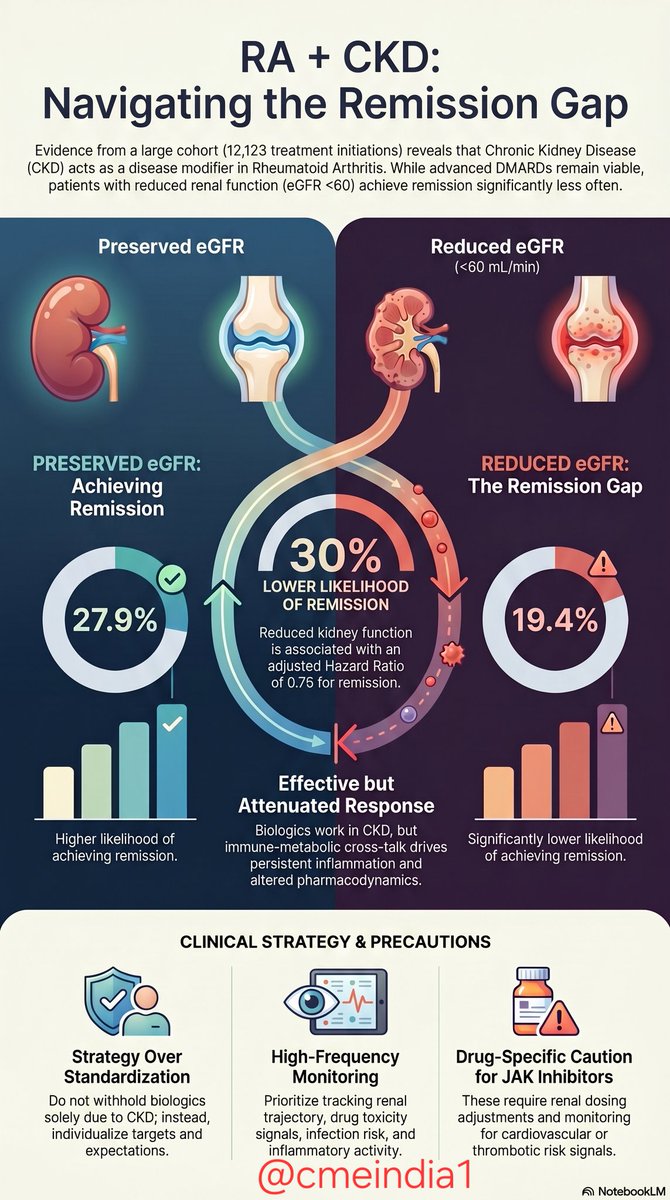
Preserved eGFR: 27.9%
Reduced eGFR: 19.4%
Reduced kidney function was associated with:
Lower likelihood of remission
Adjusted HR: 0.76 (95% CI 0.66–0.88)
CME INDIA Interpretation
CKD in RA is not just a comorbidity — it is a disease modifier.
Even with advanced DMARDs, immune–metabolic–renal cross-talk likely drives:
Persistent inflammation
Altered pharmacodynamics
Higher baseline disease burden
Reduced therapeutic responsiveness
Clinical Pearls for Practice
Do not withhold biologics or targeted DMARDs solely due to CKD — they remain viable and necessary options.
Expect attenuated response, not treatment failure.
Treatment targets should remain remission or low disease activity, but expectations must be individualized.
Frequent monitoring is essential:
Renal function trajectory
Drug toxicity signals
Infection risk
Inflammatory activity
Drug-Class Considerations (Bedside Thinking)
IL-6 inhibitors may have additional benefit in high inflammatory burden states.
Abatacept may be preferred in patients with infection risk or frailty.
Rituximab remains useful in seropositive RA and renal comorbidity overlap.
JAK inhibitors require caution due to:
Renal dosing adjustments
Cardiovascular and thrombotic risk signals
Hidden Message for Diabetologists / Cardiometabolic Physicians
CKD-associated immune dysregulation mirrors patterns seen in:
Diabetes-related inflammation
Sarcopenic obesity
Cardiorenal syndromes
This explains blunted response to advanced therapies across specialties.
Red Flag Phenotype
RA + CKD + persistent high CDAI despite DMARDs should trigger:
Re-evaluation of adherence
Comorbidity burden (diabetes, anemia, malnutrition)
Inflammatory drivers beyond RA (infection, uremia-related inflammation)
CME INDIA Bottom Line
Biologics work in RA with CKD — but not equally.
CKD reduces the probability of remission, not the indication for therapy.
Treat early, monitor closely, and individualize aggressively.
Tagline
“In RA with CKD, therapy is effective — but remission requires strategy, not standardization.”
Reference
Fukui S, Ørbo HS, Tedeschi SK, et al. Effectiveness and persistence of biological and targeted synthetic treatment in patients with rheumatoid arthritis and chronic kidney disease: a multicentre, prospective cohort study. Lancet Rheumatology. 2026. DOI: 10.1016/S2665-9913(26)00046-9.
https://t.co/ukCj6dh2Nu