😲 🚨 @Tesla_Optimus 🤩🤩
Calcanis: 'I just saw a recent Optimus demo. Blows anything away shown at the World Games in China.
I can tell you this will be the greatest product ever built by humanity'
Cybercab production may be getting ready to ramp up & a big clue are these rear quarter inner structures manufactured in the plastics section at Giga Texas.
These inner structures are bonded to the RIM outer glossy gold panels & give strength, stability plus mounting points to the outer panels, similar to how the @Cybertruck outer stainless panels have bonded inner panels for attachment & stability.
These (along with other, similar inner structures for other body panels like the rear hatch & front hood) will be needed in large quantities to support a big ramp in production … a good indicator to watch for!
BREAKING: SpaceX and AST SpaceMobile are eyeing a $6,000,000,000.00 spectrum opportunity that could expand direct-to-device satellite service across nearly the entire U.S.
Chamath was given a simple choice, 100 shares of Anthropic, 100 shares of OpenAI, 100 shares of SpaceX, pick one stack (Save this).
He picked SpaceX without hesitation, and his reasoning is worth unpacking fully because it cuts to the heart of how the best investors think about technology bets.
His take on OpenAI and Anthropic was actually generous.
He acknowledged that Anthropic is the superior enterprise product, his own fund uses it as their foundational model and that ChatGPT has built one of the most powerful consumer brands in the history of technology.
But the case for SpaceX is built on something completely different, it is not one business, but rather a platform for multiple businesses that compound off each other.
Starlink generated $11.4 billion in revenue in 2025, growing roughly 50% year over year, and represented 61% of SpaceX's total $18.7 billion in revenue.
The EBITDA margin on the connectivity segment hit 63%, compared to 38–39% for the largest traditional telecom companies on earth.
Subscriber count went from 2.3 million in 2023 to over 10.3 million by Q1 2026, spanning more than 160 countries, and revenue is projected to reach $15.5 billion in 2026.
@chamath core insight is that the global communications infrastructure is profoundly broken and he is right.
Roughly 2.6 billion people globally still lack reliable internet access, and even in developed markets, rural connectivity is patchy, expensive, and controlled by legacy monopolies with no incentive to upgrade.
Starlink is a replacement cycle for an entire layer of global infrastructure that has barely changed in 30 years.
Every maritime vessel, every commercial aircraft, every military unit, every rural hospital, every developing-world government that wants connectivity now has one viable option that didn't exist five years ago.
The maritime and aviation segments alone carry ARPUs of $250 to $25,000 per month per customer, orders of magnitude above the consumer subscription.
But Chamath's most interesting point is what he called embedded optionality, the idea that SpaceX's business model doesn't stop at earth.
SpaceX now has the only fully reusable heavy lift rocket system in the world with Starship, and it is the only company currently capable of launching the next generation of Starlink V3 satellites that carry roughly 10 times more capacity than the current constellation.
Every new market SpaceX opens on earth, direct to cell with T-Mobile, enterprise contracts, government agreements becomes a template that can theoretically be replicated the moment humans establish a permanent presence elsewhere.
A Starlink equivalent for a lunar base, a Mars colony, or an orbital station is the same product with a different launch address.
Anthropic and OpenAI are betting on winning a model race where the finish line keeps moving while SpaceX is betting on owning the physical infrastructure layer of the next era of human civilization, on earth and eventually beyond it.
One of those bets has a floor and the other doesn't and that is why Chamath picked @elonmusk's SpaceX.
Milk Road remains bullish on SpaceX and the infrastructure layer it is building around Starlink, Starship, and global connectivity.
If you’ve been thinking about joining Milk Road Pro, lock in the current price using the link below before prices go up next week.
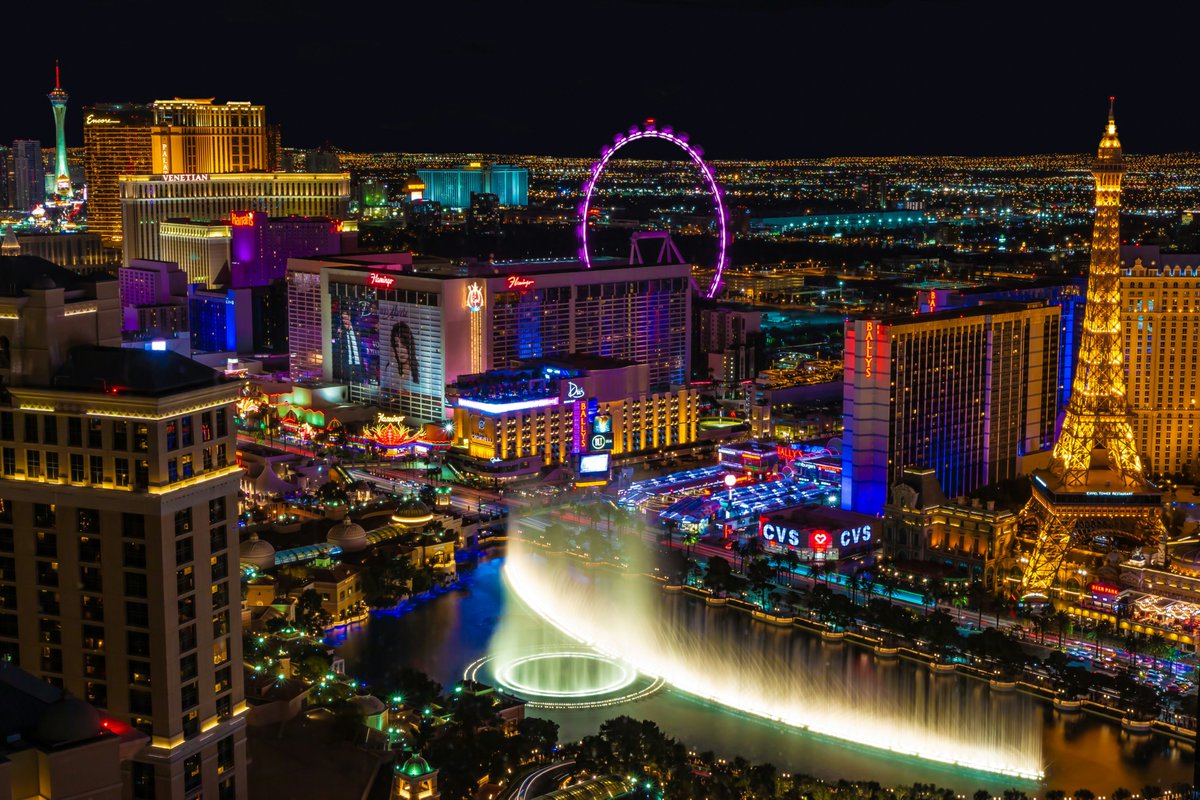
EXCLUSIVE: Tesla has just officially received approval for its full Autonomous Vehicle Network Company permit in Nevada, clearing the way for Tesla to launch a paid public Robotaxi service in Las Vegas.
This officially allows @Tesla to deploy up to 5,000 robotaxis over the next 12 months. The permit approval covers all of Clark County (which includes Las Vegas), but this approval actually allows Tesla to operate across the entire state of Nevada, according to the commission, as long as Tesla notifies the commission of when they want to expand their geofence.
I just watched live the Nevada Transportation Authority’s entire 4-hour long August 20th General Session meeting, and a few minutes ago the Commission approved Tesla’s permit.
Tesla representatives were at the meeting today, and they said that they won't deploy all 5,000 robotaxis at once in the beginning (obviously), but that this permit approval gives them the flexibility to deploy more vehicles over time. They'll start with a small launch of a few vehicles and then grow from there.
Tesla completed Nevada’s self-certification process for Robotaxi last November, and applied for an Autonomous Vehicle Network Company permit on June 3, 2026. Now with all approvals, Tesla can begin commercial Robotaxi operations in the state once they complete a few simple administrative things (vehicle inspections, insurance, provide the rates to be charged for transportation, etc). That should happen within the next 30 days.
To be clear, today's approval is separate from the interim operating order Tesla previously received, which limited its robotaxi fleet to just 10 vehicles. Today’s approval replaces that previous interim operating order, and authorizes a fleet of up to 5,000 fully autonomous vehicles.
BOOOM 📰 Elon Musk gets his wish as Warren Buffett took an indirect stake in SpaceX 🔥
Based on public portfolio data released on August 20, Business Insider estimates that Warren Buffett’s Berkshire Hathaway holds a roughly 0.04% indirect stake in SpaceX.
Valued at over $700 million, the investment was made through a two-tiered, nested ownership structure.
This marks a rare financial crossover between two of the business world's biggest titans: the "Oracle of Omaha" and the real-life "Iron Man."
Musk has long viewed financial backing from Buffett as the ultimate stamp of approval. Over the years, he has repeatedly extended public olive branches on social media, urging the legendary investor to buy into his companies.
In 2023, Musk joked online, "Too bad he didn't invest in Tesla when it was 0.1% of today's value." He doubled down in 2024, bluntly stating, "He should take a position in Tesla. It's an obvious move."
Now, while Buffett still hasn't bought into Tesla, he has taken a completely different route to quietly become a "shadow shareholder" in SpaceX.
Some of the things I say are speculative or aspirational and some are not.
What is not speculative is that the V3 satellites that will be launched on Starship are an order of magnitude more capable than the V2 satellites currently launched on Falcon.
Or that an order of magnitude more V3 and beyond Starlink satellites, plus V2 and beyond direct-to-cell satellites, will be launched.
That means >100X the bandwidth of the Starlink V2 system, which will reach $20B ARR this year. Even if revenue per gigabit drops by 10X, that still means SpaceX communications revenue will exceed $200B/year!
Far more than that.
As I’ve said publicly, bandwidth demand will increase massively due to AI & robotics. Their need for data transfer is orders of magnitude more than humans!
Even if the communications market merely doubles in size, I would expect Starlink to reach at least 25% market share outside of China (maybe one day in China too), which would be over half a trillion dollars in revenue per year.
It’s not out of the question that Starlink carries more than 50% of Internet traffic long-term, which would probably be over a trillion/year. There is no obvious impediment to that outcome so far.
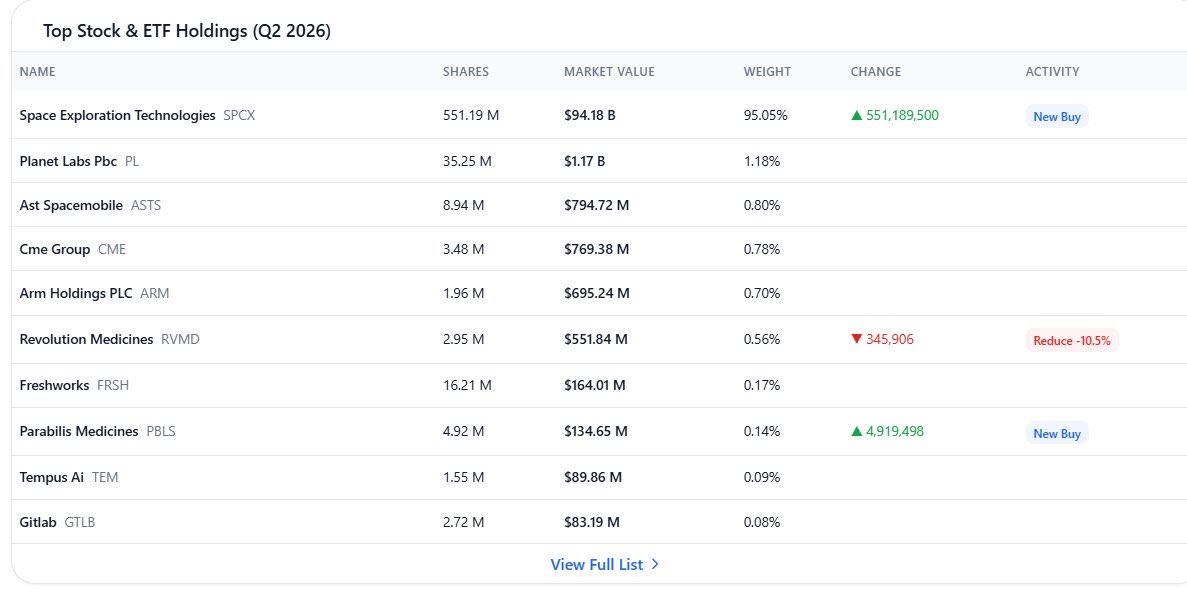
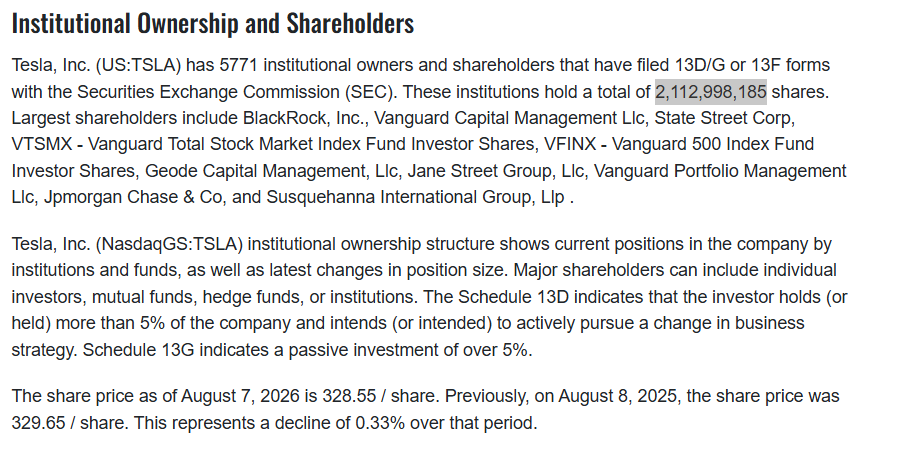
NEWS: BlackRock added about 6 million more Tesla shares last quarter, worth roughly $2.5 billion.
The buy pushed its total stake to 214,123,129 shares.
BlackRock is one of Tesla's biggest institutional shareholders, second only to Vanguard.
The move came in the second quarter of 2026 and shows up in BlackRock's latest SEC filing.
A money manager this big adding this much is a strong vote of confidence in Tesla.
Source: BlackRock Q2 2026 13F filing, August 2026
I’ve said this before, but I’ll say it again one last final time…
$SPCX is quite literally a “no-brainer” while trading at ~1X 2030 revenue here.
You must buy every significant dip on $SPCX aggressively & hold.
Then in 3 years sell when it’s $400+ a share.
Thank me later…
Okay, now listen.
Today is quite obviously a day of $SPCX accumulation by institutions. If you’re an experienced investor, you can easily tell by the volume and price action.
If you’re serious about investing in SpaceX, the first thing you need to do is stop dreaming about unrealistic entry prices like $70 or so. Do your own research to understand the company, listen to the latest earnings calls, and not just check X or YouTubers for some stupid random numbers.
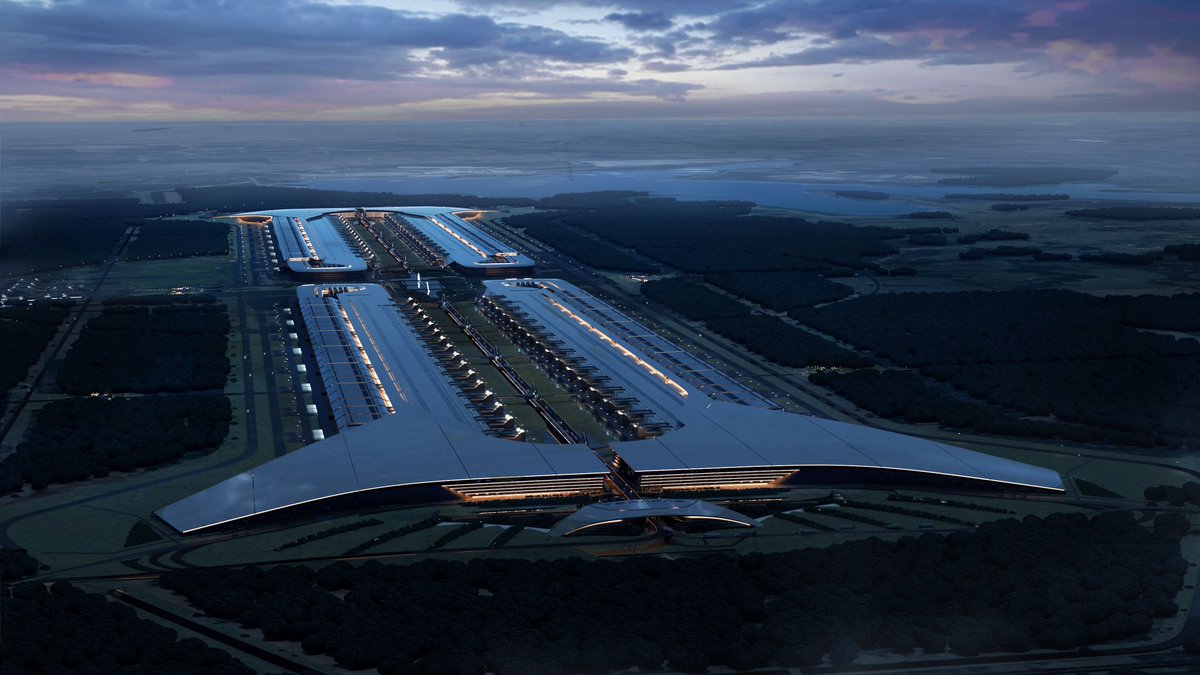
SpaceX: "Today, we are announcing that Terafab will be built in Grimes County, Texas. The facility will be an advanced semiconductor fab that will bridge the divide between current global chip supply and the compute demand of the future.
The combined SpaceX and Tesla demand for chips is expected to be in excess of 1 terawatt (TW) of compute, which is significantly larger than the current global supply. While we are deeply appreciative of our current chip suppliers, and encourage them to expand production whenever possible, this looming gulf between supply and demand is at the core of Terafab’s necessity.
Terafab will be epic in both its mission and in its sheer size, designed to build new compute at an unprecedented scale and speed. A vertically integrated factory with more than 100 million square feet of manufacturing space is planned. This facility will house the manufacturing, packaging, and testing of advanced logic and memory devices. Bringing these aspects together in one location will enable fast, recursive improvements and accelerate new compute deployed. Terafab will produce chips optimized for edge computing and inference for use in hardware like Tesla’s Optimus robots and self-driving Cybercabs, along with high-power chips designed for operating SpaceX’s space-based data centers.
BRINGING BACK ADVANCED MANUFACTURING TO AMERICA
Advanced chips are becoming foundational infrastructure for the modern economy. AI systems, satellites, secure communications, and advanced manufacturing all depend on reliable access to compute hardware. Much of the world’s semiconductor production remains concentrated overseas, and the United States has recognized the importance of rebuilding advanced manufacturing capacity domestically. Terafab aligns with that broader national effort by expanding high-end manufacturing capacity in Texas.
Texas has become central to our operations through Starbase, Bastrop, and McGregor, thanks to its commitment to innovation, manufacturing, and American leadership. SpaceX’s growing Texas footprint alone has already generated more than 56,000 direct and indirect jobs, over $28 billion in estimated economic impact since 2024, and hundreds of millions in indirect tax revenue since 2024.
The initial phase of Terafab is estimated to require approximately $16.8 billion in capital investments from SpaceX and Tesla, with potential future expansion phases bringing total investment much higher. This facility will employ at least 3,000 people, many of whom will be from Grimes and nearby Brazos County — continuing the trend of our other Texas sites where between 60% and 80% of new hires are local residents.
Grimes County offers strategic advantages for long-term industrial investment, including infrastructure access, available land, and proximity to major Texas markets. This project represents a significant opportunity for skilled trades, construction employment, suppliers and contractors, and long-term technical workforce development. We intend to work with local schools and workforce partners to help create pathways for future employment opportunities, responding to the unique needs of each community.
SpaceX and Tesla also take our role as being good stewards of the environment seriously. The Terafab site is committing to the use of Gibbons Creek Reservoir water for industrial operations rather than local groundwater; planned on-site wastewater treatment facilities; water reuse and conservation efforts; compliance with all applicable environmental and pollution control laws; and management of hazardous materials, chemicals, and industrial byproducts in accordance with all applicable regulations—while striving to exceed them.
BUILDING AN EXCITING FUTURE
We believe continued progress and leadership in space, AI, and advanced manufacturing will depend on the ability to build critical technologies domestically. By building and operating the largest chip manufacturing facility on the planet, we’re continuing down a path where future humans can compete over building the largest facilities in the solar system, and eventually the galaxy.
If you want to be a part of building that exciting future, come join us."
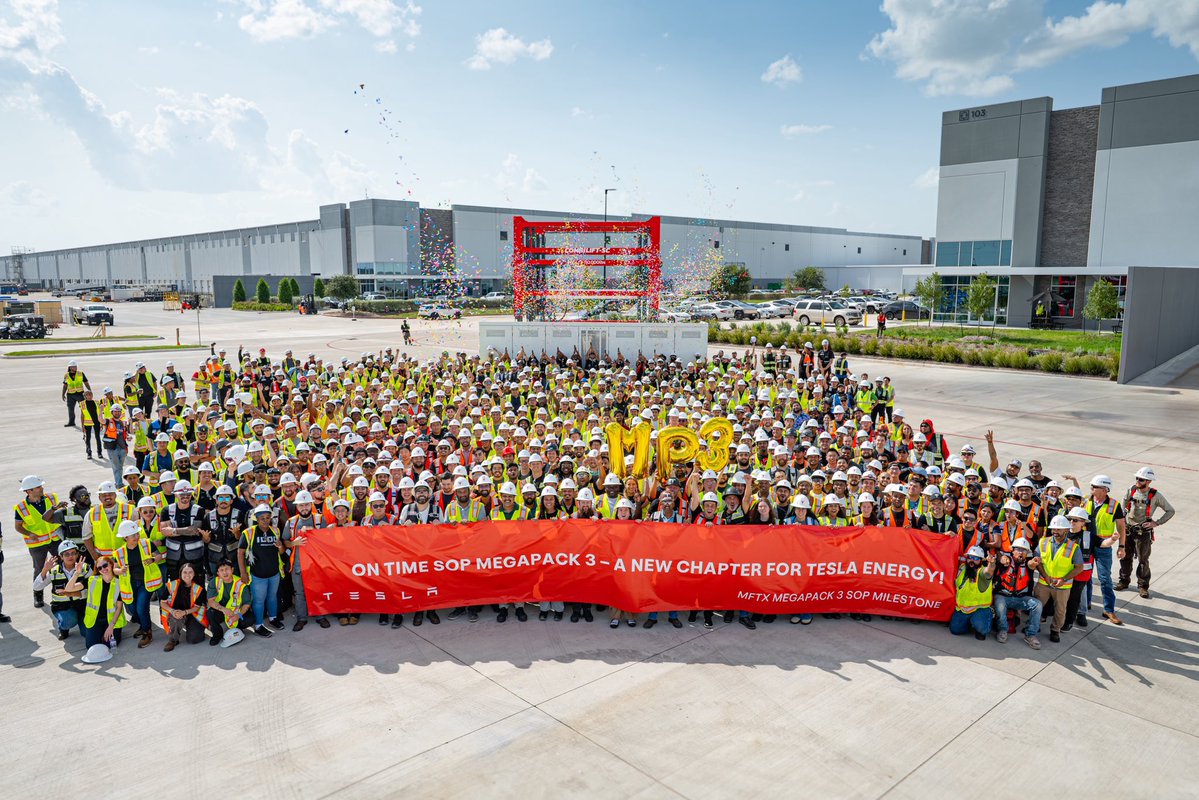
Megapack 3 production has officially begun in Texas! This is now @Tesla’s third operational Megafactory, and second in the U.S.
Megapack 3:
• 5 MWh of usable AC energy
• Weight: 86,000 lbs
• 28 foot long enclosure that can be shipped globally
• Optimized for up to 8-hour applications
• Drastically simplified thermal bay. Uses Model Y heat pump, but on steroids. 78% fewer connections, which minimizes failure points
• Larger battery module and larger battery cell
• 2.8 liter battery cell, co-engineered with Tesla's cell team
• LFP battery
• Operates in -40°C to 60°
• Went from 24 cable connections in Megapack version 2XL, down to 3 simple busbar connections
• 75% of the mass of Megapack 3 is battery cells.
• A single module in it weighs as much as a Cybertruck
• Tesla has enabled easier front access service, so there are no roof penetrations
• Drastically simplified bussing system