Hard Money enthusiast. HMG said no “magic money tree” to help disabled people. Then printed money at unprecedented scale anyway. I am noob, newly anon. Few.
Theresa May 2017 “There is no magic money tree”
What happened next… Brrr it’s actually a printer
“There is an infinite amount of cash in the Federal Reserve.” -Neel Kashkari March 2020
https://t.co/BsXITVVwa1
Nearly died on holiday, out of danger now. Thanks to the brilliant medical care team and my amazing wife fighting for me whilst I could not fight for myself.
Not looked at charts for over a week. Total vibe shift, fucking uponly everything from here. Life and BTC send it to infinity.
Grateful for the opportunity to manifest it. Live life to the full frens.
@thdxr I prefer en-vidia, its an actual spanish word for:
"envidia (n.): the feeling you get when someone posts their local LLM configuration and you realize they have more VRAM than you have RAM"
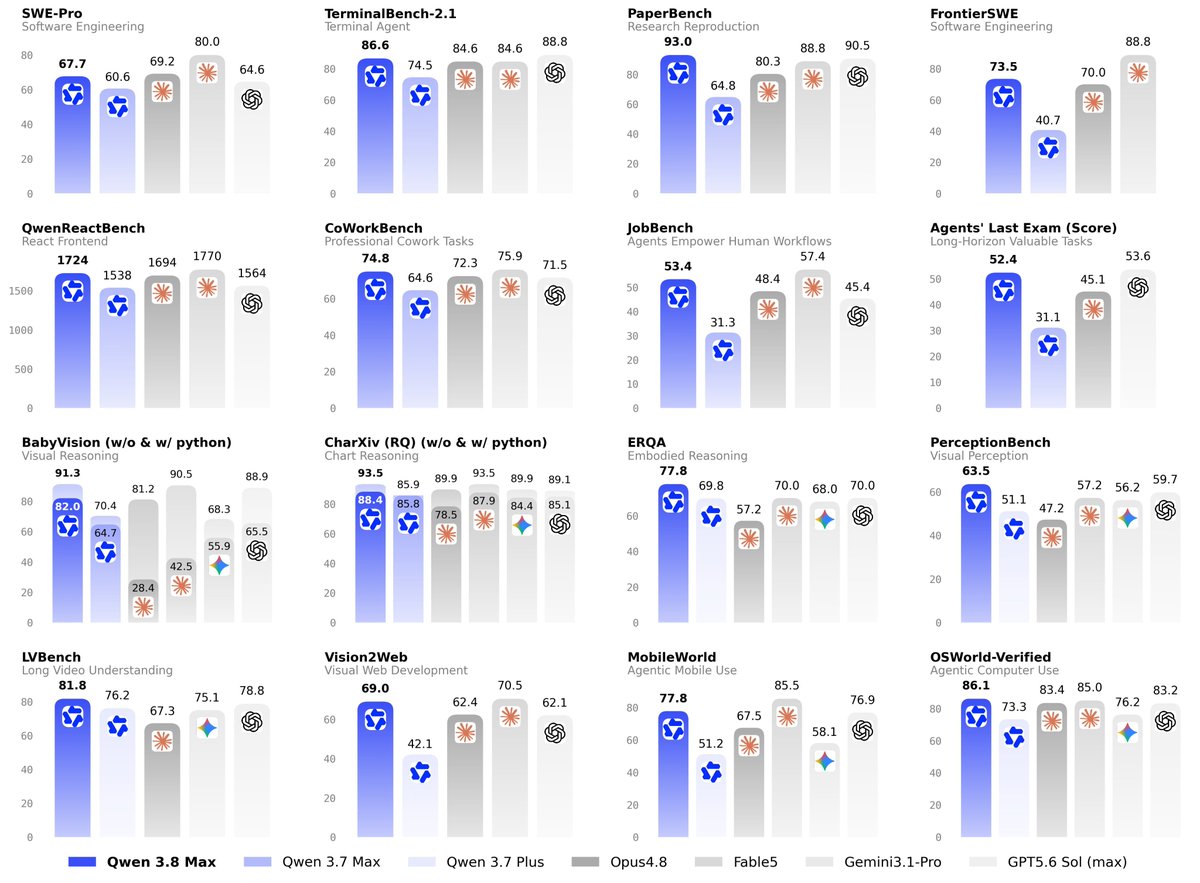
Holy, China strikes again: Qwen3.8-Max reportedly worked autonomously for 16 days while costing 80% less than GPT-5.6 Sol and 88% less than Claude Fable 5 on output. And its open weight!
Alibaba’s 2.4T-parameter MoE costs $2/M input tokens and $6/M output tokens.
GPT-5.6 Sol: $5/$30.
Claude Fable 5: $10/$50.
Qwen says the model operated autonomously for 16 days, producing 265 commits, 127 PRs and 151 issues through an issue -> code -> test -> repair -> merge loop.
It does not lead every benchmark. But it reaches the frontier range across coding, professional work and computer use, while PaperBench puts it ahead of both Fable 5 and GPT-5.6 Sol at a very good pricing.
Open weights arrive next week.
A model that can economically work for ten days may be more useful than a better model you can afford to run for ten minutes.
Ngl another insane china release.
ten significant advances in mathematics and theoretical computer science.
solved using an internal version of Astra, our next major model, for a total cost of about $2000 at Sol API prices:
Why the last cycle felt muted — a supply-side answer, with numbers. Microstrategy selling is tiny in comparison.
Between 2023 and 2025, Bitcoin absorbed roughly a decade of accumulated forced supply, compressed into about 24 months — arriving at exactly the moment the ETFs launched.
GBTC unwind — ~400,000 BTC. 620k at conversion in January 2024, ~222k by that September. Three separate drivers: the discount-arb trade closing out (it had traded to −50% NAV), fee rotation at 1.5% against 0.25%, and bankruptcy estates selling GBTC shares. Larger than everything else on this list combined, and the least discussed.
Mt Gox — ~142,000 BTC. Coins with a pre-2014 cost basis. Maximum propensity to sell.
The 2022 contagion estates — Celsius, Genesis, BlockFi, Voyager, 3AC. A decade of bankruptcy overhang distributing at once. Genesis and FTX alone were approved to sell ~$2.5bn of GBTC.
German government — ~50,000 BTC. Dumped in weeks in July 2024. Famously badly executed.
FTX estate. A forced seller at the 2022–23 lows. Creditors who couldn't wait sold claims at deep discounts to distressed funds, who took the recovery and returned it to LPs in fiat. That value left crypto entirely.
US government Silk Road sales. Tens of thousands of coins.
That is not a normal cycle's supply profile. And almost none of it recurs.
Then the sign flipped.
Executive Order 14233, March 2025: Bitcoin in the Strategic Reserve "shall not be sold." US holdings ~328,000 BTC as of February 2026. The largest sovereign seller became a mandated holder.
Alongside it, scaffolding that simply didn't exist last cycle:
— Spot ETFs approved
— FASB fair-value accounting, so corporates can mark Bitcoin to market rather than impairment-only
— The first credit rating on a Bitcoin treasury company (S&P, B−, October 2025)
What I'm not claiming: that any of this guarantees a price outcome. Two supply sources are still live, and one is new (more noise than signal). Miners are selling post-halving. And treasury companies trading below NAV can become forced sellers — Strategy itself has now sold ~3,620 BTC in 2026 (~$218m) to fund preferred dividends and rebuild dollar reserves, with up to $1.25bn authorised. Small against the numbers above, but the sign matters: the largest corporate holder, whose identity was "never sell". However look closer and tax loss harvesting and preparing for re-rating are key drivers. Don't forget a meaningful share of ETF inflows was rotation out of self-custody rather than new money, which flatters the demand side.
But the question worth asking is whether the last cycle was structurally dampened — a permanent feature of a maturing asset — or circumstantially dampened by a once-in-a-decade convergence of forced sellers that has now cleared.
I think it's more the second than most people assume.
Why the last cycle felt muted — a supply-side answer, with numbers. Microstrategy selling is tiny in comparison.
Between 2023 and 2025, Bitcoin absorbed roughly a decade of accumulated forced supply, compressed into about 24 months — arriving at exactly the moment the ETFs launched.
GBTC unwind — ~400,000 BTC. 620k at conversion in January 2024, ~222k by that September. Three separate drivers: the discount-arb trade closing out (it had traded to −50% NAV), fee rotation at 1.5% against 0.25%, and bankruptcy estates selling GBTC shares. Larger than everything else on this list combined, and the least discussed.
Mt Gox — ~142,000 BTC. Coins with a pre-2014 cost basis. Maximum propensity to sell.
The 2022 contagion estates — Celsius, Genesis, BlockFi, Voyager, 3AC. A decade of bankruptcy overhang distributing at once. Genesis and FTX alone were approved to sell ~$2.5bn of GBTC.
German government — ~50,000 BTC. Dumped in weeks in July 2024. Famously badly executed.
FTX estate. A forced seller at the 2022–23 lows. Creditors who couldn't wait sold claims at deep discounts to distressed funds, who took the recovery and returned it to LPs in fiat. That value left crypto entirely.
US government Silk Road sales. Tens of thousands of coins.
That is not a normal cycle's supply profile. And almost none of it recurs.
Then the sign flipped.
Executive Order 14233, March 2025: Bitcoin in the Strategic Reserve "shall not be sold." US holdings ~328,000 BTC as of February 2026. The largest sovereign seller became a mandated holder.
Alongside it, scaffolding that simply didn't exist last cycle:
— Spot ETFs approved
— FASB fair-value accounting, so corporates can mark Bitcoin to market rather than impairment-only
— The first credit rating on a Bitcoin treasury company (S&P, B−, October 2025)
What I'm not claiming: that any of this guarantees a price outcome. Two supply sources are still live, and one is new. Miners are selling post-halving. And treasury companies trading below NAV can become forced sellers — Strategy itself has now sold ~3,620 BTC in 2026 (~$218m) to fund preferred dividends and rebuild dollar reserves, with up to $1.25bn authorised. Small against the numbers above, but the sign matters: the largest corporate holder, whose identity was "never sell," is now a seller. And a meaningful share of ETF inflows was rotation out of self-custody rather than new money, which flatters the demand side.
But the question worth asking is whether the last cycle was structurally dampened — a permanent feature of a maturing asset — or circumstantially dampened by a once-in-a-decade convergence of forced sellers that has now cleared.
I think it's more the second than most people assume.