@DrSuneelDhand Hospitals are actually a very dangerous setting (statistically & practically) where patient rights are often not respected or explained
BTC rallied to 124.5k and then down to 112.5k, driven by liquidations.
It's been overly speculative.
The real Q is what are investors doing? MCR Risk Signal is dropping, hinting at investor liquidity returning.
If the trend continues, BTC is in great shape to move higher.
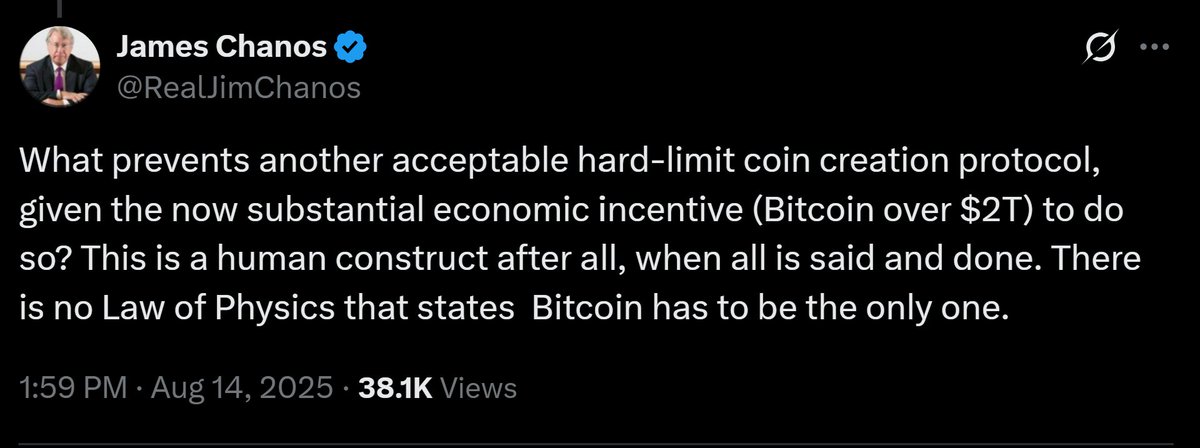
Can Bitcoin Be Copied ❓
Unsurprisingly, people still don't understand Bitcoin or money, even at a basic level, and continue to post confidently about topics they've spent less than 10 minutes on, thereby concluding that they must have arrived at some sort of inescapable epiphany about Bitcoin that has eluded everyone else.
In the spirit of not being reactive or vitriolic, Im going to try to explain in a series of posts, why Bitcoin simply cannot be copied, nor will it ever.
Its not a small likelihood, its a 0 likelihood.
Many VC’s skipped Bitcoin because they thought it was great but it would eventually be copied. Well, they got it very very wrong.
Many since have acknowledged that it took them several years even after studying Bitcoin, to understand why it can never be copied, even though its open source software.
So here it is.
Reason No 1: The Cat is Out Of The Bag:
One of the most fascinating aspects of Bitcoin is that its most important features (Scarcity, Decentralisation, Security), didn't exist at the time the network went live on Jan 3rd, 2009.
They were properties that emerged as a result of network participation crossing a certain threshold.
The Bitcoin software was simply a protocol that incentivised network participation. The software itself didn't guarantee scarcity, decentralisation or security, but rather incentivised network participation (validating, mining, purchasing), which in turn generated enough hash power distributed across the world,
➡️ for the 21 million cap to be enforced
➡️ for its control to be decentralisation
➡️ and for the ledger to be secure.
Simply 'copying' the software and starting afresh doesn't create these features. At the time Bitcoin went live, it was neither scarce, nor decentralised, nor secure, nor were there any Bitcoins.
👉 Bitcoins themselves emerged as people were incentivised to run nodes and mine them.
👉Its crazy to think, but Bitcoin's main features were not created at the time of inception, but rather emerged spontaneously through adoption.
Whats even more interesting, is that its essentially impossible for these features to emerge again.
Why ?
Because the cat is now out of the bag.
Because Bitcoin was the first, and no one understood what it was, nobody tried to 51% attack it while it was small.
👉 When a decentralised blockchain goes live, it is inherently vulnerable to 51% attacks in the first few years while the network is small and the mining power is low. This is why Satoshi didn’t want Wikileaks to use Bitcoin because he thought it was too early for Bitcoin to get a lot of attention while it’s vulnerable.
👉 Luckily, people had no understanding of what Bitcoin was or how valuable it was going to be. And by the time they figured it out, the core properties had already emerged and Bitcoin was way too big for even a country to attack, let alone an individual or corporation.
However, now that everyone knows what a blockchain is, any attempt at recreating a completely decentralised blockchain would be thwarted within days of it being monetised, if not sooner. It simply wouldn’t survive the initial phase. There are too many hackers and vultures swarming the inter webs. Small chains get hacked and crushed all the time.
The only way around this is to make a chain that is centralised, in which case
➡️It can't be used as money
➡️ Can't be trusted
➡️ Creates counter party risk
➡️ Supply cap cannot be reliably enforced
➡️ Has down time
➡️ Is not immutable
➡️ Has fewer points of attack
➡️ Is not really a bearer instrument.
A decentralised blockchain for money is a one time phenomenon.
That phenomenon, is Bitcoin.