Vilakazi Street is one of South Africa’s most historic and culturally significant streets. Located in Soweto, it is internationally recognized as the only street in the world to have housed two Nobel Peace Prize winners, Nelson Mandela and Archbishop Desmond Tutu. However, many people are unaware that the street was named after Benedict Wallet Vilakazi (1906-1947), a pioneering isiZulu poet, novelist, and scholar.
Born in 1906 in KwaZulu-Natal, Vilakazi became one of the most influential figures in African literature and language development. He was the first Black South African to obtain a PhD from a South African university and later became one of the first Black lecturers at the University of the Witwatersrand. Through his poetry and novels, he modernized isiZulu literature while preserving traditional Zulu storytelling and culture.
During apartheid, Vilakazi Street became a symbol of resistance, unity, and Black excellence. It also gained historical importance during the 1976 Soweto Uprising, when students protested against the apartheid education system. Today, the street stands as both a tourist attraction and a living reminder of South Africa’s struggle, culture, and intellectual heritage.
Pic Source: The Johannesburg Review of Books
You've probably driven on Sisulu Road in Gauteng without a second thought.
But that name carries Albertina Sisulu — a nurse who became one of apartheid’s most relentless opponents.
She wasn’t on the front pages like some leaders. She was in the back rooms of struggle politics, quietly building it. A member of the ANC Women’s League, she helped organise protests, funerals, community resistance, and underground networks while the state banned her movements, raided her home, and constantly watched her family.
Her husband, Walter Sisulu, spent decades imprisoned on Robben Island. While he was locked away, Albertina Sisulu held the family together and still stayed active in the struggle — raising children who would also become leaders, including Max Sisulu.
She was arrested multiple times, endured banning orders that restricted where she could go and who she could speak to, yet she never stepped away from the fight.
By the time democracy arrived, she wasn’t just a “leader’s wife” — she was a national pillar of resistance.
You’ve heard of Mandela.
You’ve heard of Tambo.
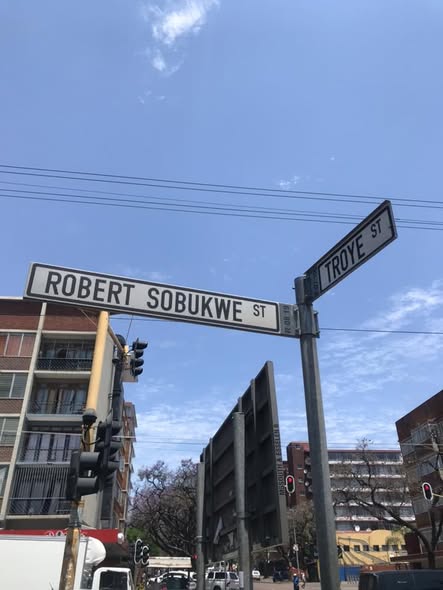
But one of apartheid’s most dangerous enemies to the government was a man many South Africans barely talk about today: Robert Sobukwe (1924-1978).
Sobukwe was so influential that after his arrest, the apartheid government created a special law JUST to keep him imprisoned longer. Imagine that — a whole law for one man.
He was brilliant, disciplined, and deeply feared because he could move people with words, ideas, and conviction.
Even after serving his sentence, they isolated him alone on Robben Island because they feared his influence on other prisoners.
No army.
No presidency.
No wealth.
Just a voice powerful enough to terrify a government.
[BREAKING NEWS] Constitutional Court dismisses SCA ruling that asylum seekers, who had been denied asylum, can reapply while remaining in SA. #Newzroom405
As the Xhosa nation,
we reject every attempt by politicians & parliamentarians to divide South Africans through tribalism
There is no war between tribes
The marches happening across the country represent the voice of ALL South Africans united for justice, safety&accountability
If South Africa is a lawless state, then it should be lawless for everyone. It cannot be that bylaws are strictly enforced on citizens, with threats of fines and charges, while the undocumented can occupy spaces and trade freely.
A South African is expected to provide previous records, proof of residence, medical information, a birth certificate, and parents’ documentation, yet an undocumented immigrant gets to access the school system without any of that.
As a parent you shouldn't be telling your kids that you sacrificed your life for them, It’s mean, manipulative and not true. You chose to have your kids and nobody forced you to have them. It’s your responsibility to take care of them