Fable and I rewrote Box3d entirely in native cuda. It's about 30x faster on my GPU compared to my CPU (depending on the situation).
This was my hardest benchmark. I still had to be there, but soon I won't. Cost me about 200 dollars
Today we’re sharing the most detailed scan ever taken of a living human brain.
None of us were ultrasound scientists before this. We worked backwards from a desire for brain interfaces and taught ourselves physics, ultrasound, electromagnetism.
This is a story four years in the making (1/n)
The UK is a great country with an extraordinary history. Our stagnation is real, but it's fixable and worth fixing.
Enjoyed giving this talk at @lfg_uk last week and so encouraged by the optimistic responses I've had from people who are building a brilliant future for Britain 🚀
Gotta hand it to the authorities. At first I was mad when they scrubbed the Banksy, but they have unintentionally made one of the most powerful artworks of all time.
this 4k is still probably my favourite demo of all time. ryoji ikeda vibes sure but it actually speaks to me more. can never quite put my finger on why i love it so much, so here it is anyway https://t.co/r5J1bXo6j1 by @nnnnoby (tho hes not on here anymore iirc)
While searching around for solutions to geometric problems, I periodically end up on this big list of PDFs written by Dave Eberly that cover a lot of topics rigorously.
Recommended!
https://t.co/TIoB8ZqZJt
I've been a bit quiet on X recently. The past year has been a transformational experience. Grok-4 and Kimi K2 are awesome, but the world of robotics is a wondrous wild west. It feels like NLP in 2018 when GPT-1 was published, along with BERT and a thousand other flowers that bloomed. No one knew which one would eventually become ChatGPT. Debates were heated. Entropy was sky high. Ideas were insanely fun.
I believe the GPT-1 of robotics is already somewhere on Arxiv, but we don't know exactly which one. Could be world models, RL, learning from human video, sim2real, real2sim, etc. etc, or any combo of them. Debates are heated. Entropy is sky high. Ideas are insanely fun, instead of squeezing the last few % on AIME & GPQA.
The nature of robotics also greatly complicates the design space. Unlike the clean world of bits for LLMs (text strings), we roboticists have to deal with the messy world of atoms. After all, there's a lump of software-defined metal in the loop. LLM normies may find it hard to believe, but so far roboticists still can't agree on a benchmark! Different robots have different capability envelopes - some are better at acrobatics while others at object manipulation. Some are meant for industrial use while others are for household tasks. Cross-embodiment isn't just a research novelty, but an essential feature for a universal robot brain.
I've talked to dozens of C-suite leads from various robot companies, old and new. Some sell the whole body. Some sell body parts such as dexterous hands. Many more others sell the shovels to manufacture new bodies, create simulations, or collect massive troves of data. The business idea space is as wild as research itself. It's a new gold rush, the likes of which we haven't seen since the 2022 ChatGPT wave.
The best time to enter is when non-consensus peaks. We're still at the start of a loss curve - there're strong signs of life, but far, far away from convergence. Every gradient step takes us into the unknown. But one thing I do know for sure - there's no AGI without touching, feeling, and being embodied in the messy world.
On a more personal note - running a research lab comes with a whole new level of responsibility. Giving updates directly to the CEO of a $4T company is, to put it mildly, both thrilling and all-consuming of my attention weights. Gone are the days when I could stay on top of and dive deep into every AI news.
I’ll try to carve out time to share more of my journey.
I’ve been exploring physarum-style simulations on and off for a long time, and I finally wrote an article sharing the techniques I’ve been using.
It ranges from the classic physarum algorithm to some of my own weird tricks. I hope you enjoy it!
https://t.co/LRnfr7rCRi
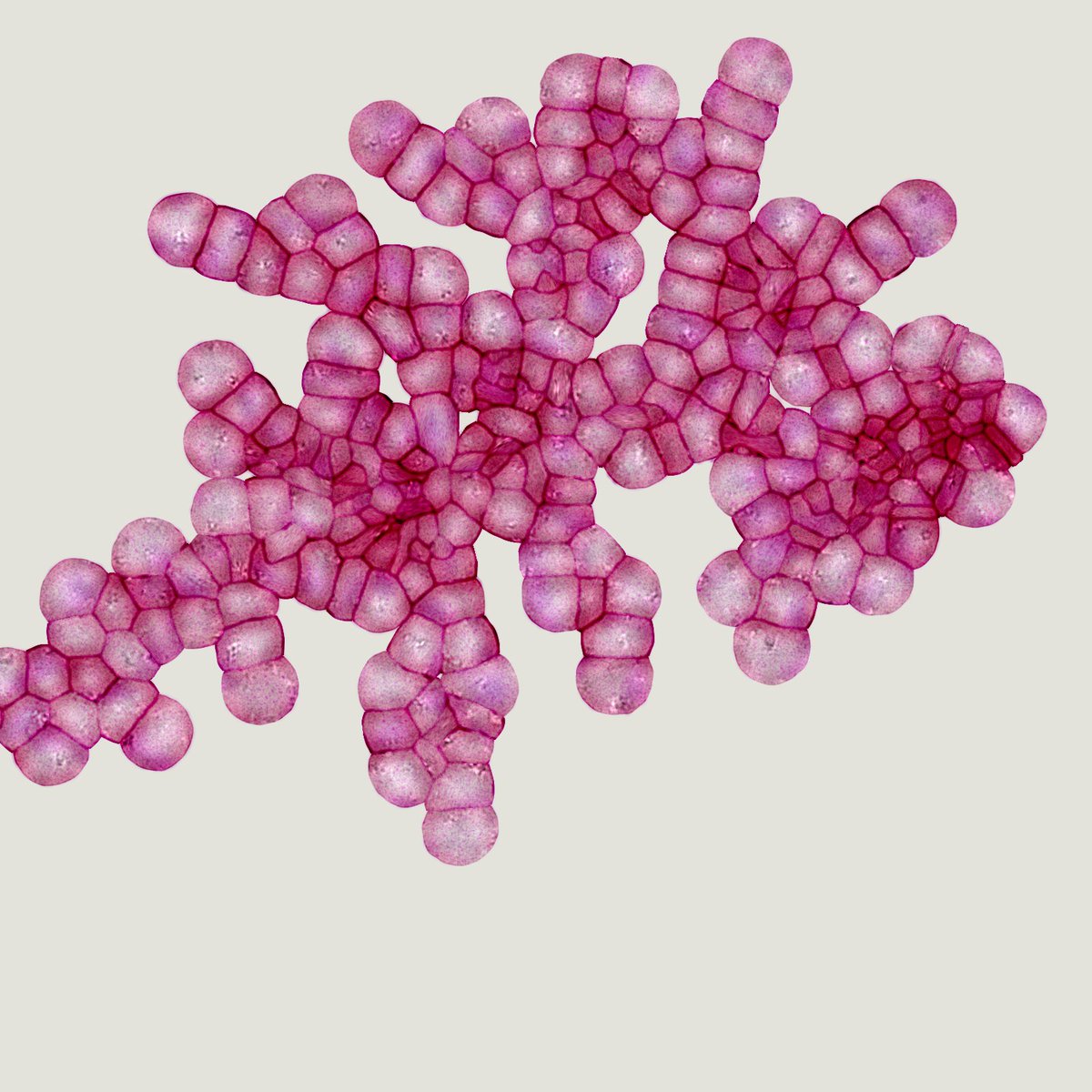
I've spent the week-end refining the rendering of my cells.
Let me take you through a journey of the challenges a generative artist faces when they have a specific goal in mind 🧵
(final result here)
I got several requests for a blog post about my thoughts on ECS, so here it is! This is an area that interests me, so I'd be very curious to hear your opinions on the topic, so please comment and share your thoughts!
https://t.co/ZgJb5gEQhn
[wip] growing organisms using hypergraph rewriting
I'm exploring generating organisms using string forces and I was wondering about which class of algorithms could be used to generalize the growth of such structures. I wanted a system which can produce a wide variety of outputs, while allowing for stable and controlled growth.
That's when I thought about Stephen Wolfram (yes again) Physics Project, which proposes to explore a solution to the fundamental theory of physics using a hypergraph rewriting system (https://t.co/Wihyh3pnvC)
TLDR; Growth of graphs using simple permutation rules. It's similar to cellular automata but for graphs. Could be what I'm looking for.
I started to experiment with this system to grow my organisms, and it's definitely a promising approach!
Below is a video of the following rules applied to an initial {{0,0},{0,0}} graph:
rand() < 0.15
? {{x,y},{x,z}}->{{x,y},{x,w},{y,w},{z,w}}
: {{x,y},{x,z}}->{{x,w},{y,w},{z,w}}
There's a lot of areas to improve this exploration, notably:
- localization of rules (instead of applying a same rule to the whole system, let each node have its own rules)
- spawn control rules (when a new node is created, a rule can define which rules will be applied to such node)
- mutation rules (rules which alter rules of adjacent nodes)
- conditional rules (many rules can be attached to a node, the one being executed subject to localized conditions)
Super exciting, will certainly be the basis of my next project.
We’ve added a third SDK. And this time, it’s for the 8,000 pound gorilla, Unreal 5.
@bitpartai enables game developers to easily add character behaviors to 3D models, and interactive affordances to props. In conversations with over 100 studios, the most frequent request was integration with Unreal. Our team has been working hard on this for several months. We will continue to deliver best-in-class gameplay for Unity and Roblox as well.