BREAKING: DOGE Investigation Finally Forces Congress To Admit To The US Government's Long History Of Financing Al-Qaeda, The Taliban, & ISIS
» WATCH/SHARE THE LIVE X STREAM HERE:
https://t.co/5LOs5d45a8
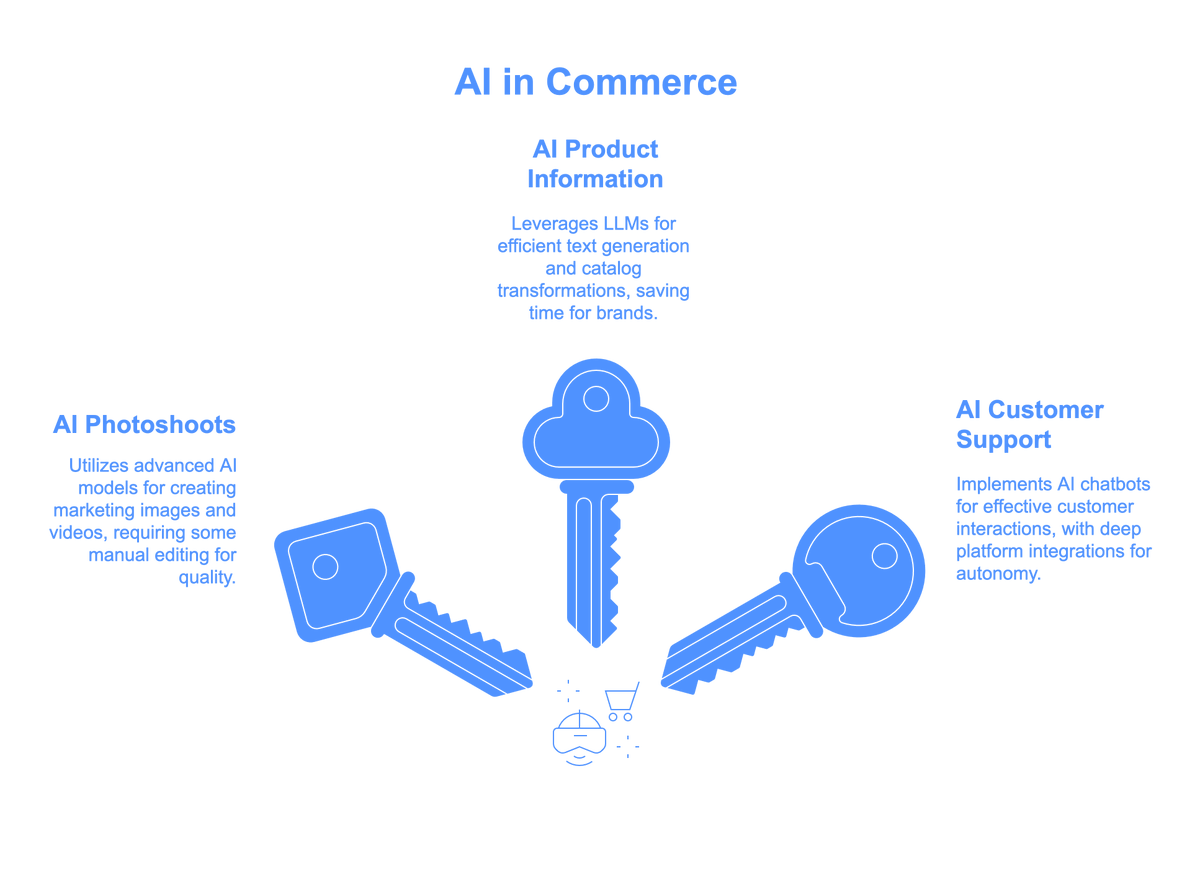
AI in Commerce
AI has been taking over most tech conversations in the last two years. Let’s separate hype from reality and what is realistically possible now with AI in commerce.
AI Photoshoots - This includes AI images for e-commerce websites, lifestyle shots for marketing and short videos for PDP and Social Media.
With the release of Flux, what is possible with AI image models underwent a dramatic shift. Better control over the image output and text generation in images made Flux the most popular image model overnight. Flux is also the model of choice for fine-tuning for fashion photoshoots. While the results are 80% there, some manual editing and QC are still required to pass PDP-level standards for quality. A managed service model is the best option at this point.
What’s doable at this point without any manual editing is marketing shots that might not require 100% product resemblance.
For AI videos, there are lots of SOTA models available. I personally like Runway and Kling. However, the generated videos sometimes diverge from the input images as video duration increases, and this is where manual editing is required to cut and paste multiple videos into one.
AI Product Information - LLMs are killer at text generation. The cost of SOTA models has dropped significantly over the last 1 year because of competition from open-source models and model training and hardware improvements. Creating product information is the most straightforward task for AI in commerAI has taken over most tech conversations in the last two years. Let’s separate hype from reality and consider what is realistically possible now with AI in commerce.ce. Coupling this with catalogue transformations for various marketplaces can save brands countless hours.
AI Customer Support - AI for basic questions and escalations to humans is what many platforms offer today. Most platforms train the AI chatbot on documents, FAQs, and links provided by the customers, and LLMs are good at Q&A. What differentiates the best platforms from the rest is the ability of these chatbots to take action on customer requests, like raising a return/exchange request, without having to depend on a human. Deep integrations with commerce/other platforms and custom workflows make the chatbot feel agentic.
From manufacturing to post-order customer support, we have built an AI native commerce platform at @FyndCommerce. DM me if you want to learn more about how to adopt AI for your commerce business.