A $1.6 billion order for the part most air-defense coverage skips: the motor.
Northrop Grumman's multi-year award covers the solid rocket motors and ignition safety devices behind Lockheed's PAC-3 MSE interceptor, built at a West Virginia plant where motor capacity has nearly tripled since 2021. Utah has doubled, Maryland is up 25 percent.
The mechanism is the point. Multi-year orders are how a propulsion industrial base gets built ahead of demand instead of chasing it. Lockheed delivered a record 620 PAC-3 MSE interceptors in 2025, and a seven-year framework is pushing toward 2,000 a year. $NOC
https://t.co/RgNa7IcaoZ
$DRTS: 8 recurrent glioblastoma patients treated. 8 alive. 0 recurrences in the treated area. Alpha Tau Medical's Q3 2026 update is the clearest clinical narrative this company has published.
🧠 REGAIN trial: 100% ORR in 6 evaluable GBM patients, 5 of 6 complete responses, median OS not reached.
🏛️ FDA approved IDE expansion: REGAIN grows from 10 to up to 20 patients, may support market submission for Alpha DaRT.
🔬 IMPACT pancreatic cancer: 48 patients fully enrolled across 10 centers after three expansions.
📅 Data calendar: ReSTART top-line cSCC data Q1 2027, REGAIN additional interim Q1 2027, IMPACT initial H1 2027.
💰 $99.8M cash, up from $76.9M at year-end 2025, with manufacturing scale-up at Hudson, NH targeting end-2026 readiness.
https://t.co/rGLGr1OIYA
Alpha DaRT is an intratumoral alpha-emitter platform. Radium-224 is loaded into seeds, implanted directly into the tumor, and as it decays, short-lived daughter nuclei diffuse a few millimeters while emitting high-energy alpha particles. The physics are intentional: alpha particles deposit enormous energy locally but are stopped within tens of microns of tissue. The result is a highly localized radiobiological effect that theoretically spares surrounding normal tissue. What makes glioblastoma particularly significant here is that the brain's delicate architecture has historically been incompatible with the dose escalation required for conventional local therapy. Alpha DaRT's short particle range is not incidental to that problem. It is a potential solution to it.
The REGAIN data trajectory matters in context. In May 2026, the first interim showed 2 of 2 evaluable patients with complete responses. By November 2026, the dataset grew to 6 evaluable patients, all 6 with objective responses, 5 complete. What is most significant from a clinical standpoint is not the response rate alone. It is the absence of recurrence in the treated area across all 8 patients. GBM recurrence is not a question of "if" with standard-of-care; it is "when." The treated-area local control data, if it holds through the full 20-patient cohort with PFS now tracked as a secondary endpoint, represents a genuinely novel endpoint signal for this disease.
The FDA's October 2026 IDE supplement carries more weight than a routine trial amendment. Adding PFS as a secondary endpoint, adding an additional interim analysis, and expanding to 20 patients tells you that the FDA is engaging substantively with what a market-submission package for Alpha DaRT could look like. When combined with the Q1 2027 ReSTART top-line data in cSCC (the company's most advanced U.S. pivotal trial), the IMPACT initial readout in H1 2027, and a Samsung Medical Center MOU for a pancreatic cancer trial in Korea signed in October 2026, the data calendar ahead of Alpha Tau is unusually dense for a company of this size. The $99.8M cash position, up from $76.9M at year-end 2025, provides operational cover for all of it.
The arc here is a company moving from a single-asset with early feasibility data to a multi-indication platform with a maturing clinical dataset, FDA engagement on submission pathways, a partnered manufacturing build-out, and multiple near-term top-line reads. Each of those pieces individually could be coincidental. Together, as the Q3 2026 update assembles them, they describe a company in a genuinely different phase than it was 12 months ago.
https://t.co/rGLGr1OIYA
_
Disclosure: This content is not financial or investment advice. Alpha Tau Medical Ltd. is a paid subscriber to Wall Street Wire's coverage and distribution platform. Full disclosure: https://t.co/XfvLkFMKXu
Geothermal heat pumps barely get used in US buildings in part because drilling is expensive. Most drillers in this space use water-well style rigs: crude instruments.
Bedrock Energy just raised $24M, led by Clean Energy Ventures and Clearvision Ventures, to attack that step. Its rigs use directional drilling borrowed from oil and gas, guided by subsurface models that borehole sensors help refine. The company says the approach cuts drilling time by up to 80%.
The quieter opportunity is data centers. Some developers might use shallow geothermal loops to cool server racks. Others are interested in the flat load profile; deploying it on a neighboring property could open up significant grid capacity. Someone in Michigan told CEO Joselyn Lai that freeing a few megawatts could mean operating months to a year earlier. Talks, not signed deals. Nine sites drilled so far.
https://t.co/IruWFB5C0y
$OPHI's LightSolver is in IEEE Spectrum. Here is what that actually means for the photonic computing thesis.
⚡ LPU solves differential equations 40 to 80,000x faster than a GPU, per ACM benchmark.
🤝 Boeing is a named paying customer: a multi-year simulation program, presented live at SC26 this week.
🔬 The LPU uses laser cavity physics, not semiconductor approximations, to compute.
📅 November 24: shareholders vote on the formal name change from CollPlant to OptiPhi Computing Ltd.
💰 LightSolver secured $1.8M from Israel's Innovation Authority, plus a $3.7M private placement and a provisional patent, all in the past seven weeks.
https://t.co/4CnBG315zQ
The IEEE Spectrum feature, published November 17, is not a sponsored article. It is an independent editorial piece by a PhD physicist on the global optical computing industry, covering companies from China, Germany, the United States, and Israel. LightSolver (the wholly owned subsidiary of CollPlant, Nasdaq: OPHI) earns its own named section. For a company that only just unveiled its working prototype at SC26, that kind of placement in a tier-1 technical publication is editorially significant.
The underlying technology story is worth understanding carefully. LightSolver's Laser Processing Unit does not attempt to replicate GPU vector-matrix multiplication in the optical domain, the approach most companies in this space are pursuing. Instead, it starts from first principles: electromagnetic waves propagating through a laser cavity naturally solve differential equations. The team builds around this physical property directly, programming a spatial light modulator to encode the problem, stimulating a gain medium to emit photons that amplify as they bounce through the cavity, and reading the solution from the light's steady state with a camera. The ACM-published emulation benchmark puts differential equation performance at 40 to 80,000 times faster than a GPU.
The company's context matters here. In the six weeks before the IEEE Spectrum article appeared, OPHI (then CLGN) secured approximately $1.8 million from Israel's Innovation Authority for LPU hardware development, filed a U.S. provisional patent application expanding the photonic computing platform, completed a $3.7 million private placement, and changed its Nasdaq ticker specifically to signal the pivot. The ticker change to OPHI, effective November 13, was described by CEO Eran Rotem as reflecting "strategic expansion into photonic computing." The name-change vote on November 24 is the next formal corporate milestone.
The energy benchmarking work is now explicitly underway. LightSolver has published the speed advantage and is measuring the energy improvement against GPUs. When those numbers arrive, the LPU's commercial case becomes either materially stronger or materially qualified. For investors following the photonic computing sector, that data point is the next analytical threshold.
https://t.co/4CnBG315zQ
_
Disclosure: This content is not financial or investment advice. CollPlant Biotechnologies Ltd. is a paid subscriber to Wall Street Wire's coverage and distribution platform. Full disclosure: https://t.co/XfvLkFMKXu
The number in Velo3D's latest defense award is up to $10 million. The more interesting line is who keeps the hard part.
Under the DEVCOM Armaments Center award, run through the ONIX Marketplace OTA pathway, the Government retains design authority and lethality, ballistic, functional and performance testing. Velo3D $VELO owns the manufacturing problem: qualifying Inconel 718 (already qualified on its Sapphire platform) and developing and qualifying the process for a second, Government-directed high-performance alloy, plus the Technology Transition Package meant to make the process repeatable at domestic facilities.
That division of labor tells you how the Pentagon buys additive manufacturing now: it wants production capability it can move between vendors, not proprietary parts. And the award is explicitly conditional, worth up to $10 million only if the Government funds later phases.
https://t.co/AEIHulw6MA
$SCAI.V just made a distribution bet that could reframe the company's total addressable market in one move.
📱 SalesCloser: AI Chat & Video is live on the Shopify App Store.
🛒 Shoppers see, talk to, or chat with a live AI video avatar on the storefront.
📊 Shopify GMV was US$378.4B in 2025, up 29%, across 175+ countries.
🔒 App runs on patent-pending hybrid session tech disclosed Aug 26, 2026.
⚡ Self-serve and no-code: merchants install from Shopify dashboard in minutes.
https://t.co/TDwaId8A7t
The significance of today's announcement is not just that SalesCloser has shipped another product. It is that the company has entered an entirely different distribution architecture. Every commercial engagement disclosed before today, the Latin American insurer, the 270-room resort, the top-five social media platform, all came through enterprise and mid-market sales motion. The Shopify App Store is a category change. Installation is self-serve. Billing runs through Shopify. Discovery happens inside an ecosystem that served millions of merchants across more than 175 countries in 2025 on a platform that generated US$378.4 billion in GMV. SCAI has not had access to that distribution layer before today.
The patent-pending architecture matters here. The August 26, 2026 disclosure of a hybrid session management filing covering simultaneous voice, text and avatar channel continuity within a single conversation is the core technical differentiator in this product. If a shopper starts on text chat, moves to voice, and finishes on video with the same AI agent and the same conversational context intact, that is not live chat with extra steps. That is a genuinely different experience. SalesCloser says it believes it is one of a limited number of apps on the Shopify App Store offering a live video avatar on the storefront. The patent filing, if it issues, would be a defensive moat on that specific interaction design.
The broader strategic arc matters. Since listing on the TSXV in April 2026, the company has posted 235% revenue growth (nine months to June 30, 2026), shipped ten major platform enhancements, secured four U.S. patents with a fifth allowed, and expanded to customers in eight countries. Each product launch has been additive: voice, then video, then WhatsApp, then Sky's self-serve onboarding, and now Shopify's distribution. The rhythm is consistent and the product releases build on each other rather than replacing each other. That is an important distinction in a space where AI platform companies frequently pivot. SalesCloser is extending, not pivoting.
For investors following this story, the Shopify channel introduces a new conversion question: does self-serve, low-friction distribution translate into the kind of merchant adoption volume that shows up in future commercial updates? The November 10, 2026 commercial update gave investors the first consolidated view of the enterprise arc since listing. The equivalent read for the e-commerce arc will come when SalesCloser discloses Shopify-specific metrics: install counts, session volume, merchant activation rates, and any early conversion data.
https://t.co/TDwaId8A7t
Disclosure: This content is not financial or investment advice and is distributed on behalf of SalesCloser Technologies Ltd., a paid subscriber to Wall Street Wire's coverage and distribution platform. Full disclosure: https://t.co/XfvLkFMKXu
Ground-launched air defense has always been the Army's lane. The Air Force just started building its own: CAMP, a program for a supersonic interceptor reportedly targeted at $500,000 a round in 1,000 to 3,500 quantities, plus containerized launchers meant to sit dispersed with minimal crews.
Prototype contracts are going to startups, not the missile primes. Castelion, a Torrance company founded by SpaceX veterans, took two contracts covering its ground-launched missile, launch pod and containerized launcher. Anduril took a separate launcher prototype, built on its Menace shelter and designed to accept missiles from any vendor.
That launcher detail is the quiet competition. If the Air Force standardizes on common launcher hardware, missile makers have to integrate onto someone else's box, and whoever owns the launcher gains recurring leverage on every production round.
Castelion raised $350M last December to scale production at a New Mexico factory. The missile prototype is the entry ticket. The real contest is whether affordability and producibility survive two years of design cycles and flight test.
https://t.co/iUFBuIwO3w
$PYPD is twelve days from a November 28 FDA goal date. In the same quarter, two separate acquirers committed more than $1.8 billion combined to the hospital prolonged drug-delivery category that D-PLEX100 operates in.
📅 FDA PDUFA goal date: November 28, 2026; labeling discussions underway, all interactions on track.
🏛️ NDA granted Priority Review; no filing issues identified by FDA at acceptance.
💰 Azurity partnership: $30M received; over $290M in additional potential milestones.
🔬 SHIELD II Phase 3: 60% relative risk reduction in SSI incidence vs. standard of care (p=0.0013).
🤝 Azurity's existing U.S. reach spans more than 1,700 leading hospitals and academic centers.
https://t.co/UtqLVsqqpW
The Viatris and Pacira transaction and the CorMedix and Heron deal are worth reading carefully as signals about how well-capitalized hospital pharmaceutical acquirers are valuing this asset class. Viatris described EXPAREL and ZILRETTA as patent-protected, high-margin products it intends to expand through international infrastructure. CorMedix characterized ZYNRELEF as having significant untapped potential inside its existing commercial platform, entering the deal already having paid $300 million upfront for Melinta's hospital anti-infectives in 2025. The two buyers are building the same type of company from different starting points: a portfolio of prolonged, locally active hospital medicines sold through the same institutional sales team.
That is the commercial model Azurity has laid out for D-PLEX100. The North American agreement, signed in July 2026, delivered $30 million to PolyPid in upfront and near-term milestone payments. The variable economics that follow on approval are substantial: over $290 million in additional regulatory, launch, and sales-based milestones, royalties from mid-teens to mid-twenties percentages on U.S. and Canadian net sales, and a transfer price on every unit manufactured. The agreement also funds label expansion clinical development beyond the initial colorectal surgery indication. That means the first approval, if it comes on November 28, is a floor of a broader program rather than a ceiling.
PolyPid's regulatory position coming into the PDUFA date is clean. The NDA carries Breakthrough Therapy, Fast Track, and QIDP designations. No filing issues were identified at acceptance. Priority Review set a target date approximately one quarter ahead of the company's own Q1 2027 guidance. SHIELD II enrolled 798 patients in large-incision colorectal procedures and met both its primary composite endpoint (40% reduction, p=0.0039) and its key secondary endpoint measuring SSI incidence (60% relative risk reduction, p=0.0013). Labeling discussions with the FDA are reported as underway and aligned with the November 28 PDUFA goal date. The EMA validated the Marketing Authorization Application following a September 2026 submission, with a decision expected in the second half of 2027. European commercialization rights sit with PolyPid, and the company is in active discussions with potential partners there.
What the Pacira and Heron acquisitions illustrate is the valuation that established commercial platforms place on this asset class when the regulatory work is done. PolyPid has not yet crossed that line. The November 28 PDUFA outcome is the event that determines whether the arc from development asset to commercial revenue-generating business actually begins.
https://t.co/UtqLVsqqpW
_
Disclosure: This content is not financial or investment advice. PolyPid Ltd. is a paid subscriber to Wall Street Wire's coverage and distribution platform. Full disclosure: https://t.co/XfvLkFMKXu
$BOIL.TO's Q3 2026 results arrive as a combined financial report and strategic briefing. Record quarterly revenue of $1.422 million, up 22% year-over-year, marks the eighth consecutive quarter of sequential growth. But behind that revenue line sits the most consequential commercial window in the company's history.
📈 Q3 2026 revenue: $1.422M, +22% YoY, 8th consecutive sequential quarter.
🌐 Global vendor approval granted Oct 1, 2026 by a multinational with 100+ countries and tens of thousands of locations.
🍟 System-wide U.S. fast-food chain approval secured Sept 2026, covering hundreds of franchise locations.
🏭 First industrial frying adoption confirmed: 93% lower Free Fatty Acids vs. control.
💰 C$20M private placement announced Nov 9, 2026, pending TSX approval.
https://t.co/lGBGwkmKqP
This earnings release is best read as a strategy document with financial receipts attached. The revenue trend ($1.422 million quarterly, $4.073 million year-to-date, +24% year-over-year) confirms steady commercial execution through eight prior consecutive periods. What changed in Q3 and the weeks immediately following it was the nature of the customer base above the company. System-wide approval from a renowned American fast-food chain covering hundreds of U.S. franchise locations. Global vendor approval from a multinational with operations in more than 100 countries and tens of thousands of locations. An American buffet chain committing to 200-plus U.S. locations as its sole-source oil management solution. An Eastern European franchise group becoming the first to advance under the global vendor approval, with a commercial rollout across 60 locations of a leading global fast-food brand. These are not prospective pipeline items. These are commercial authorizations at a scale the company has never previously had.
The gross margin story at 40.3% in Q3 (down from 47.1% a year ago) requires careful framing. Management attributes the compression explicitly to channel mix: container orders priced to accelerate distributors' entry into new territories carry lower margins than direct sales. With Joe Colligan, 30-plus years at McCain Foods, Unilever, and OSI Group, now leading Beyond Oil USA, and Gregory Orman and Brian Stockelman in dedicated segment leadership roles, the structural argument is that growing direct-sales contribution in the U.S. and Europe will recover margin as large-account relationships scale. Product cost reductions already implemented will contribute further as lower-cost inventory cycles through. Neither effect has yet reached the reported numbers. That is a 2027 story.
The industrial frying vertical, confirmed in October with a first commercial adoption, opens a genuinely distinct addressable market. The industrial pilot returned approximately 93% lower Free Fatty Acids and approximately 52% lower Total Polar Compounds versus an untreated control. These are not pilot-program metrics: the host facility has integrated Beyond Oil's technology into standard operations. The industrial segment faces tightening regulatory limits on frying-oil composition and increasing operator attention to frying-oil emissions, creating structural pull that runs independent of the foodservice adoption cycle.
The pending C$20 million private placement is the near-term capital event. Combined with $7.535 million in positive working capital and a current ratio of approximately 7.0x as of September 30, closing the offering would materially extend the operational runway through the approval-to-revenue conversion cycle. Management's framing for 2027: "That approved base, rather than new customer wins, is what we expect to drive our growth." The first international franchise rollout under the global vendor approval, the buffet chain adoption, and the industrial segment are the three conversion stories to follow.
https://t.co/lGBGwkmKqP
Disclosure: This content is not financial or investment advice and is distributed on behalf of Beyond Oil Ltd., a paid subscriber to Wall Street Wire's coverage and distribution platform. Full disclosure: https://t.co/XfvLkFMKXu
$DRTS reported 100% ORR and zero deaths in its U.S. recurrent glioblastoma trial. Here is why that number matters far beyond the patient count.
🧠 All 8 treated GBM patients alive as of November 11, 2026, median survival not reached.
📊 6 of 6 evaluable patients achieved RANO objective response: 5 complete, 1 partial (58% reduction).
🔬 100% feasibility across all 8 procedures, zero unanticipated serious adverse events.
🏛️ FDA Breakthrough Device Designation held in recurrent GBM; trial expanding to up to 20 patients.
⚡ Piper Sandler upgraded DRTS to Overweight on November 11, raising its target from $8 to $22.
https://t.co/xh22A5tgeC
Recurrent glioblastoma has been oncology's most stubborn wall. In the pivotal lomustine study published in the New England Journal of Medicine, adding bevacizumab to chemotherapy at first recurrence moved median survival from 8.6 to 9.1 months, less than three weeks of additional life. In the decade since, no therapy has moved that benchmark materially. Alpha DaRT's REGAIN trial is now reporting that every evaluable patient responded, three have been followed past eight months, and none have died. The mechanism is architecturally different from any prior GBM approach: intratumoral radium-224 sources release alpha-emitting daughters that disperse only fractions of a millimeter, concentrating a lethal dose at the tumor without crossing the blood-brain barrier or requiring systemic exposure. That is not an incremental modification to the existing toolkit.
The arc of this program over eleven months is what distinguishes it from the dozens of GBM trials that showed early activity and then collapsed at scale. December 2025: first patient treated, the first intracranial Alpha DaRT procedure ever. May 2026: initial three-patient data, 67% complete response rate, 100% local disease control. June 2026: FDA clears the remaining patients and adds two academic centers. October 2026: FDA approves expansion to 20 patients, adds progression-free survival as a secondary endpoint. November 2026: 8 patients treated, 6/6 evaluable responded, all alive. Each FDA interaction has been additive rather than restrictive. In the context of Breakthrough Device Designation, that is a regulatory agency tracking data it finds credible.
Alpha Tau's platform is broader than a single trial. The ReSTART pivotal skin cancer trial (88 patients) has completed enrollment and is in the PMA modular application process. The IMPACT pancreatic cancer study finished enrolling 48 patients after three expansions. The Tolmar partnership for prostate cancer carries a $20 million equity investment, up to $161.5 million in milestones, and an exclusive U.S. commercialization pathway. Alpha DaRT is already approved in Japan for head and neck cancer, with $104.8 million in cash on the balance sheet as of June 30, 2026. The REGAIN data is not an isolated event. It is the most recent signal from a platform that has consistently generated clean data across four tumor types with the same underlying technology.
The critical unresolved question is durability. Four of six evaluable patients show scans with radiation necrosis or suspected necrosis, a known artifact of focal radiation in previously irradiated brain, and two patients have scan findings still being evaluated. What happens at the 12 and 18-month marks, as the surviving cohort moves through territory where lomustine historically fails, is the read that will define whether REGAIN supports a market submission or requires a randomized controlled trial. That determination depends on the FDA's review of the expanded dataset as REGAIN approaches 20 patients, and on the conversations already underway with the agency about regulatory development strategy.
https://t.co/xh22A5tgeC
_
Disclosure: This content is not financial or investment advice. Alpha Tau Medical Ltd. is a paid subscriber to Wall Street Wire's coverage and distribution platform. Full disclosure: https://t.co/XfvLkFMKXu
Who puts a ship's air-search radar on an uncrewed boat? The Royal Navy just bought several. £15 million buys Saab's Sea Giraffe 1X counter-UAS radar for Kraken Technology's K3 Scout USVs, Project BEEHIVE's first major step in integrating complex payloads. The system already detected, tracked and classified airborne targets autonomously in trials. The notable part is pace: unveiled this year, trialed, contracted. Maritime procurement rarely moves this fast.
https://t.co/stn4Dpthqo
$DRTS: Recurrent glioblastoma has broken every therapy that stepped into the ring with it. This week, interim data from Alpha Tau's REGAIN trial suggested that alpha-particle physics might be different.
🧠 All 8 treated recurrent GBM patients alive; median overall survival not yet reached at 6.9-month median follow-up.
📈 100% objective response rate across all 6 evaluable patients, vs 26.8% peak ORR from antiangiogenic agents in published literature.
🔬 100% feasibility: Alpha DaRT sources deployed successfully in every single patient treated to date.
🏛️ FDA approved expansion of REGAIN from 10 to 20 patients in October 2026, based on the safety profile.
🎯 CEO: 20-patient total, based on initial discussions, "may support market submission requirements" for recurrent GBM.
https://t.co/slQ0vJhiw4
The REGAIN interim data need to be understood against two separate baselines. The first is the clinical literature: a comprehensive 2023 meta-analysis of recurrent GBM treatments found ORRs ranging from 3.4% (biologic agents) to 6.1% (chemotherapy) to 26.8% (antiangiogenic therapy). Nothing in the published literature comes close to 100%. The second baseline is Alpha Tau's own arc: in May 2026, the first three patients showed 100% local disease control and 67% complete response. By November, the cohort had doubled to six evaluable patients and the response rate had not retreated. That is a meaningful signal in a cancer where promising early reads have repeatedly failed to translate.
The strategic weight of this data extends well beyond REGAIN itself. Alpha DaRT is a platform technology. The same alpha-particle delivery mechanism performing in GBM is also deployed across prostate cancer (partnered with Tolmar, $20 million equity investment, up to $161.5 million in milestone payments), recurrent cutaneous squamous cell carcinoma (ReSTART pivotal trial, 88 patients enrolled, Breakthrough Device Designation, top-line data expected late 2026/early 2027), and pancreatic cancer (multiple international studies, positive OS data presented at ASCO 2026). Each indication that generates positive data reinforces the platform thesis across the others.
The GBM result carries particular regulatory weight. This is a 20-patient IDE study, not a traditional Phase 3 trial. But Alpha Tau's CEO explicitly noted, based on initial discussions, that 20 patients may meet market submission requirements for the GBM indication. For context, the FDA has historically accepted de novo and PMA applications for cancer devices with comparably small registrational cohorts when the clinical need is severe and the safety/efficacy signal is compelling. GBM meets both criteria. If the full-cohort data at 20 patients sustains the 100% ORR and survival signal, the submission pathway becomes a credible near-term event rather than a distant aspiration.
The November 16 conference call with principal investigator Dr. Joshua Palmer, CEO Uzi Sofer, CMO Robert Den, and CFO Raphi Levy is the next moment to listen to. How the team frames the trajectory toward a potential market submission for GBM, and what they reveal about the remaining patients' status, will determine how the investment community positions this indication in the Alpha DaRT platform thesis.
https://t.co/slQ0vJhiw4
_
Disclosure: This content is not financial or investment advice. Alpha Tau Medical Ltd. is a paid subscriber to Wall Street Wire's coverage and distribution platform. Full disclosure: https://t.co/XfvLkFMKXu
Navy shipbuilders have the orders. What they lack is skilled welders to work them.
That is the market behind Path Robotics' new $300M Series E at a $2.45B valuation. ARR is up 17-fold in 18 months, with HII, Lockheed Martin and Saronic as customers, and a $600M performance-based agreement to put physical AI across U.S. Navy shipbuilding programs. Its Obsidian system finds the weld joint, plans the weld, and adapts when conditions change, so no reprogramming for each part. Welding was the right first task: hardest to automate, scarcest to hire.
https://t.co/kRoJc6OUXu
The sustainment tail is where drone programs quietly compound.
Redwire $RDW just took a follow-on Army order to keep its Stalker drones flying at Fort Huachuca, where soldiers train to operate unmanned aircraft systems. It follows a $15 million May order for additional Stalker systems for the same training unit, which was the third order from the 1st Aviation Brigade in eight months, bringing those recent awards to $24.8 million.
The logic: soldiers train on the airframe they deploy, so the Army keeps feeding the same fleet. An aircraft Redwire rates at more than eight hours endurance on its fuel-cell power stops being a one-time sale and becomes an annuity once the training pipeline depends on it.
https://t.co/2VSvV60BfS
$MDWD — MediWound's burn-to-chronic-wound platform story is advancing on multiple fronts simultaneously. What Vericel's Q3 record NexoBrid revenue of $5.3 million confirms is that the commercial foundation is solid enough to carry the company into a Phase 3 readout for a drug targeting a market ten times larger.
📈 Vericel Q3 NexoBrid commercial revenue: $2.3M, up 54% year-over-year and 46% quarter-over-quarter — record since launch.
🏛️ BARDA federal procurement added $3M in Q3, bringing total NexoBrid revenue to $5.3M for the quarter.
💊 EscharEx Phase 3 VALUE trial: enrollment completion and interim sample-size assessment targeted by end of Q1 2027; top-line data expected mid-2027.
💰 $17.25M bought deal closed November 5, extending runway through the VALUE data readout.
🔬 Independent DSMB review: no safety concerns identified — VALUE trial continues without modification.
https://t.co/MlUGXZ7I5k
The arc of this company across the past twelve months is a study in layered de-risking. TGA approved NexoBrid in Australia in September 2025, extending commercial authorization to 45 countries. The European Burns Association Congress featured NexoBrid in 36 scientific presentations that same month. The DSMB cleared EscharEx for continued enrollment without modification. The U.S. Department of War funded a room-temperature-stable NexoBrid formulation through a $21.8 million program, targeting development through an IND submission. Each development, taken individually, is a contained headline. Taken together, they describe a company systematically widening its commercial moat, its clinical scope, and its federal relationships across a twelve-month window.
What Vericel's Q3 results surface most clearly is that the demand story for NexoBrid has outrun the supply story. MediWound's CEO confirmed the company is supply-constrained, prioritizing U.S. market allocations and selling every unit it can manufacture. That is an unusual operational posture for a small-cap biotech: not hunting for buyers, but rationing product. The expanded manufacturing facility, expected to reach operational completion in Q4 2026 with commercial supply targeted for H2 2027 subject to regulatory approval, is the near-term unlock that allows the revenue ceiling to rise. Gross margin improvement from 16.5% to 28.5% year-over-year in Q3 reflects the growing royalty mix even within the current constrained supply environment.
The EscharEx story runs on a parallel track. The addressable market for chronic wound debridement spans venous leg ulcers, diabetic foot ulcers, and pressure ulcers. These are patient populations with chronic conditions and limited effective options. MediWound cited an independent consulting firm's assessment of $1.05 billion in U.S. annual peak sales potential for EscharEx, subject to successful development and approval. The strategic logic is that the same enzymatic platform that defined debridement in burn care is now being tested against one of medicine's most stubborn management challenges. MediWound's CEO noted EscharEx achieves debridement in 4 to 5 days on average compared to 4 to 8 or more weeks for the current standard. The VALUE trial's Q1 2027 interim will be the signal that closes or widens the gap between the narrative and the data.
https://t.co/MlUGXZ7I5k
_
Disclosure: This content is not financial or investment advice. MediWound Ltd. is a paid subscriber to Wall Street Wire's coverage and distribution platform. Full disclosure: https://t.co/XfvLkFMKXu
The moon business is now the side business. Intuitive Machines $LUNR just posted record Q3: $269M revenue, 26% gross margin, positive free cash flow, and a $1.9B backlog.
Look at where the new awards came from: $450M of new bookings plus acquired backlog, led by an accelerated missile-defense constellation (Tranche 3), two IM 300 platforms for a national-security application, and JPL instrument work. The Goonhilly and COMSAT acquisition adds ground stations reaching from LEO to deep space. A lunar lander company has become a space infrastructure prime, and national security space is where the growth is concentrating.
https://t.co/bVpMRSE9Q8
$QUCY just answered the question every defense small-cap faces in its build phase: can the manufacturing strategy generate real commercial revenue before the flagship product is ready?
🏭 $966,833 first revenue, Q3 2026, Bridgeport metal stamping, four customers
💰 $8.0M CEO commitment from David Lazar, available through Nov 30, 2027
🛡️ LightShift quantum antenna license expanded Nov 6 to surface and undersea domains
🏛️ Boustead legal overhang settled Oct 2026 for $250K, tail rights extinguished
📊 Shareholders' equity $16.2M vs. $0.6M at Dec 2025, up 2,600% in nine months
https://t.co/jZ8sP2gG7x
The vertical integration thesis at Quantum Cyber N.V. has always rested on a specific claim: that owning the manufacturing footprint would allow the company to generate commercial revenue before its core defense product, the drone platform, was production-ready. The Q3 2026 10-Q demonstrates that the first half of that thesis is now operational. The Bridgeport, CT facility acquired July 15, 2026 generated $966,833 of metal stamping revenue in its first full quarter of operation under Quantum Cyber's ownership, spread across four customers in electrical components, tooling, and general metal stamping. No single customer exceeded 15% of quarterly revenue. For a company with no revenue from continuing operations as recently as June 30, 2026, this is not an incremental update. It is a category change.
The capital structure around this milestone is equally notable. David Lazar committed $8.0 million of personal capital on November 11, 2026, available through November 30, 2027. The company simultaneously holds a $100 million ATM facility with Titan Partners, entered October 9, 2026, with zero shares sold through the 10-Q date. The nine-month financing history shows $15.2 million raised from warrant exercises and $6.0 million from a preferred share issuance, suggesting the balance sheet has been built primarily through conversion activity and insider capital rather than open-market dilution. Shareholders' equity went from $0.6 million at December 31, 2025 to $16.2 million at September 30, 2026, a 2,600% increase. The untouched ATM is a signal worth tracking: if the company reaches its early 2027 drone manufacturing target without drawing on the ATM, the vertical integration strategy will have funded itself primarily through the acquired operating business and the existing investor base.
This 10-Q sits inside a rapid execution cadence that connects directly to the prior quarter. The June 2026 Project LightShift quantum antenna license gave Quantum Cyber its core IP layer. The July 2026 Bridgeport acquisition gave it the manufacturing footprint. The August 2026 80-unit 3D printing farm installation gave it the production capability for drones. The October 2026 appointment of Major General (Ret.) Alberto C. Rosende was explicitly framed around accelerating Bridgeport commissioning and tightening the drone component supply chain. The October 2026 Boustead settlement closed a legal tail on future financings. The November 6, 2026 LightShift license amendment expanded the quantum antenna field of use to unmanned surface and underwater vehicles, maritime platforms, and homeland security and law enforcement applications. The 10-Q filed November 12 is the first financial confirmation that the operational pieces are functioning as described. The question that remains for the Q4 2026 filing is whether drone manufacturing revenue appears alongside the metal stamping base, and at what scale.
https://t.co/jZ8sP2gG7x
_
Disclosure: This content is not financial or investment advice. Quantum Cyber N.V. is a paid subscriber to Wall Street Wire's coverage and distribution platform. Full disclosure: https://t.co/XfvLkFMKXu
Aircraft survivability gear usually enters the fleet the slow way: years of development, then a competition, then production. Leonardo DRS's DAIRCM flipped that order. It was fielded first under a Joint Urgent Operational Need, and only now has NAVAIR awarded low-rate initial production.
The system packs missile warning, directed infrared countermeasures, laser warning and hostile-fire indication into one lightweight suite built for small and medium aircraft, the platforms with the tightest size, weight and integration limits. The three-year IDIQ carries no published ceiling, so the real signal is the transition itself: an urgent-need patch becoming a standard production line as threats to aircraft proliferate.
The field-first pipeline is quietly becoming how the Pentagon equips fast. Worth tracking for $DRS.
https://t.co/UbGFLQbNdB
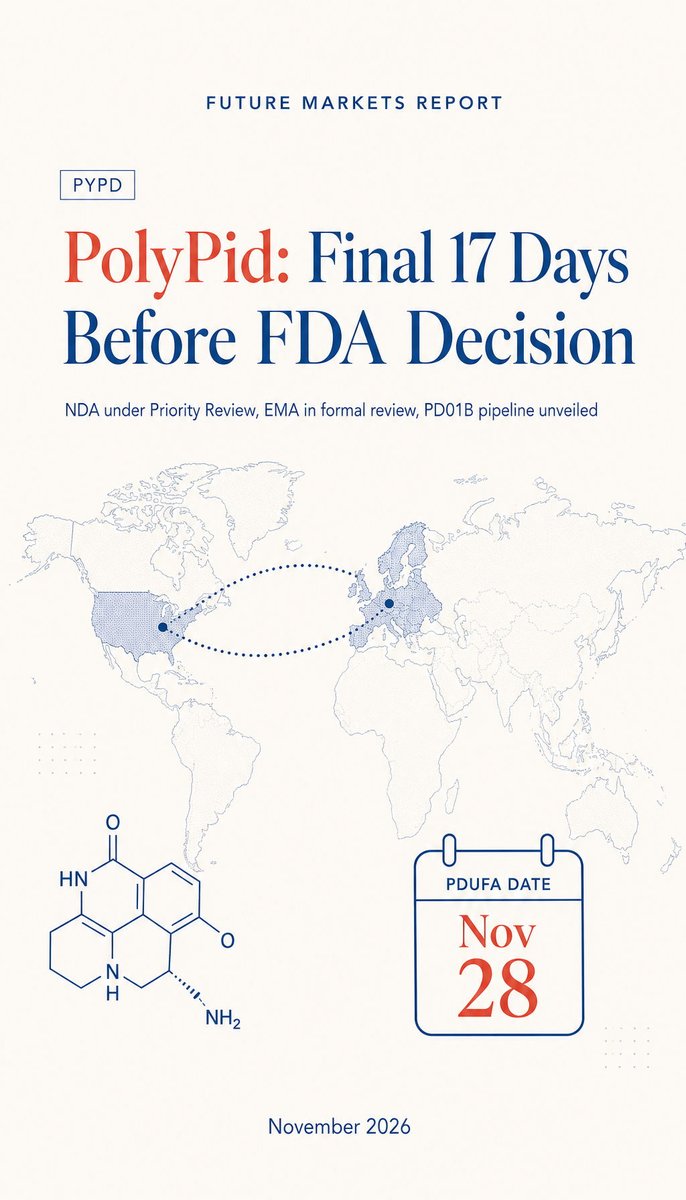
$PYPD - November 11, 2026. The last major investor update before the most consequential 17 days in PolyPid's corporate history. This is not routine quarterly earnings. It is a comprehensive field report from a company that has quietly resolved every structural risk it carried six months ago.
📅 PDUFA goal date November 28, 2026 - labeling discussions underway, all FDA interactions on track.
💰 $30M confirmed from Azurity in milestone payments, with $290M+ remaining on the table.
🏛️ EMA validated the D-PLEX100 MAA; formal review underway, decision expected H2 2027.
🤝 European rights fully regained from ADVANZ PHARMA; active partner discussions ongoing.
🔬 PD01B introduced: Kynatrix-based candidate for diabetic foot infections, pre-IND and first-in-human study both H2 2027.
https://t.co/YSvRWthc3m
Six months ago, PolyPid was running on a cash position it described as sufficient into the second half of 2026. As of today, the company has extended its runway to 2028, confirmed $30 million in inbound milestone payments, and is awaiting the FDA's decision on a Priority Review NDA with a goal date 17 days out. That transformation was not accidental. The Azurity deal - a U.S. and Canada commercialization partnership that provides a transfer price on each manufactured unit plus tiered royalties from mid-teen to mid-twenties percentages on sales - was specifically designed to fund the commercialization transition without dilutive capital raises.
The European chapter of this story has also shifted in the past six weeks. The ADVANZ PHARMA agreement, signed in 2022, has been mutually terminated, and PolyPid now holds exclusive European commercialization rights outright. The EMA has validated the Marketing Authorization Application submitted on September 14, 2026, initiating formal review. PolyPid is in active discussions with European commercial partners and expects an EMA decision in the second half of 2027. The sequence here - FDA decision first, then EU validation, then EU decision - gives the company two sequential commercialization windows across the Atlantic, with fresh partner leverage in Europe that it did not have while ADVANZ held the rights.
The more strategically durable piece of this Q3 update is the introduction of PD01B. The Kynatrix technology that enabled D-PLEX100 to release doxycycline at surgical sites for 30 days is now being applied to a second clinical problem: diabetic foot infections. DFIs affect tens of millions of patients globally and are the most common event leading to lower-extremity amputation. Systemic antibiotics struggle to reach infected tissue with compromised blood supply. PD01B is designed to deliver high-concentration doxycycline directly into the wound after debridement, sustained for weeks, following the same CMC and manufacturing foundation already built for D-PLEX100. That is a capital-efficient pipeline expansion: one platform, two indications, two independent NDAs.
The NTAP application to CMS adds a reimbursement layer that most investors underestimate. If granted, NTAP provides additional hospital reimbursement in the inpatient setting - meaningfully reducing the economic friction for hospital formulary adoption. A CMS decision is expected in August 2027. Combined with Azurity's existing footprint in more than 1,700 leading U.S. hospitals, the commercial infrastructure for a potential Day 1 launch is visibly in place.
https://t.co/YSvRWthc3m
_
Disclosure: This content is not financial or investment advice. PolyPid Ltd. is a paid subscriber to Wall Street Wire's coverage and distribution platform. Full disclosure: https://t.co/XfvLkFMKXu
Western buyers are paying 14 to 16 times the Chinese price for dysprosium oxide. Terbium runs 6 to 9 times. Yttrium oxide, more than 100 times.
USA Rare Earth $USAR began commercial-scale shipments of rare earth carbonate from its Brazil mine in October under a Pentagon-backed offtake that pays U.S. and European reference prices instead of Chinese ones. The premium is not a market quirk. It is the revenue model, and the first payments arrived this month.
https://t.co/FkCP1dN4wq