The human brain has an extraordinary ability to make peace with & cope with what seems inevitable, including our own aging & death. In fact, I believe this was one of the most important psychological survival mechanisms we developed as conscious beings.
Once we became intelligent enough to understand our own mortality, we also needed ways to cope with that terrifying realization. Otherwise, the constant awareness of our inevitable death might have made life almost unbearable.
Over thousands of years, we developed elaborate philosophical, psychological, religious, & social narratives to rationalize aging & death. We learned to see beauty in impermanence, wisdom in growing old, & even purpose in dying. These beliefs helped humanity endure realities we had absolutely no power to change.
But what happens when what we have always considered inevitable is no longer inevitable?
This is precisely the extraordinary moment in human history we are entering.
AI, & the coming revolution in superintelligence, will fundamentally transform our ability to understand & engineer biology. For the first time, we are approaching an era in which aging itself could become a solvable engineering problem. Rejuvenating our cells, reversing biological aging, eliminating age-related diseases, & potentially extending healthy human life indefinitely are moving from the realm of science fiction toward serious scientific & technological ambitions.
Yet I continue to see people passionately defending aging & death as though they were virtues to celebrate rather than limitations we might eventually overcome.
I understand why. As mentioned above, these psychological coping mechanisms are deeply embedded in our biology & reinforced by centuries of culture. They served an essential purpose when we had no alternative. But a coping mechanism that once helped us accept reality can become a powerful obstacle to recognizing when reality itself is changing.
Frankly, I am becoming less interested in arguing with people who insist on romanticizing aging & death. I understand their perspective, & everyone is entitled to find meaning in mortality.
My message is increasingly directed toward those who are willing to challenge these deeply ingrained assumptions, think beyond the biological constraints we inherited, and recognize the extraordinary possibilities emerging before us.
We are living through one of the most profound transitions in the history of life on Earth: the moment when intelligence becomes powerful enough to fundamentally redesign the biology that produced it.
And I believe one of the greatest tragedies would be to stand at the threshold of this transformation, yet remain so psychologically attached to the inevitability of aging & death that we fail to recognize what may soon become possible.
This is why I keep talking about longevity escape velocity: the point at which advances in medicine & rejuvenation could extend our remaining healthy lifespan faster than the passage of time takes it away.
I firmly believe AI and soon superintelligence will accelerate progress far far beyond what traditional biomedical research has led us to expect.
My hope is to convince as many people as possible to remain healthy, curious, optimistic, & determined to live long enough to reach that extraordinary milestone.
Imagine the irony of spending our entire lives accepting death as inevitable, only to discover that we happened to be born into the first generation with a realistic possibility of overcoming the biological processes that make it inevitable.
For the first time in human history, the limits of our biology may no longer define the limits of our future.
I want as many of us as possible to be around to witness that future.
And perhaps, to live in it for a very, very long time. 🖖
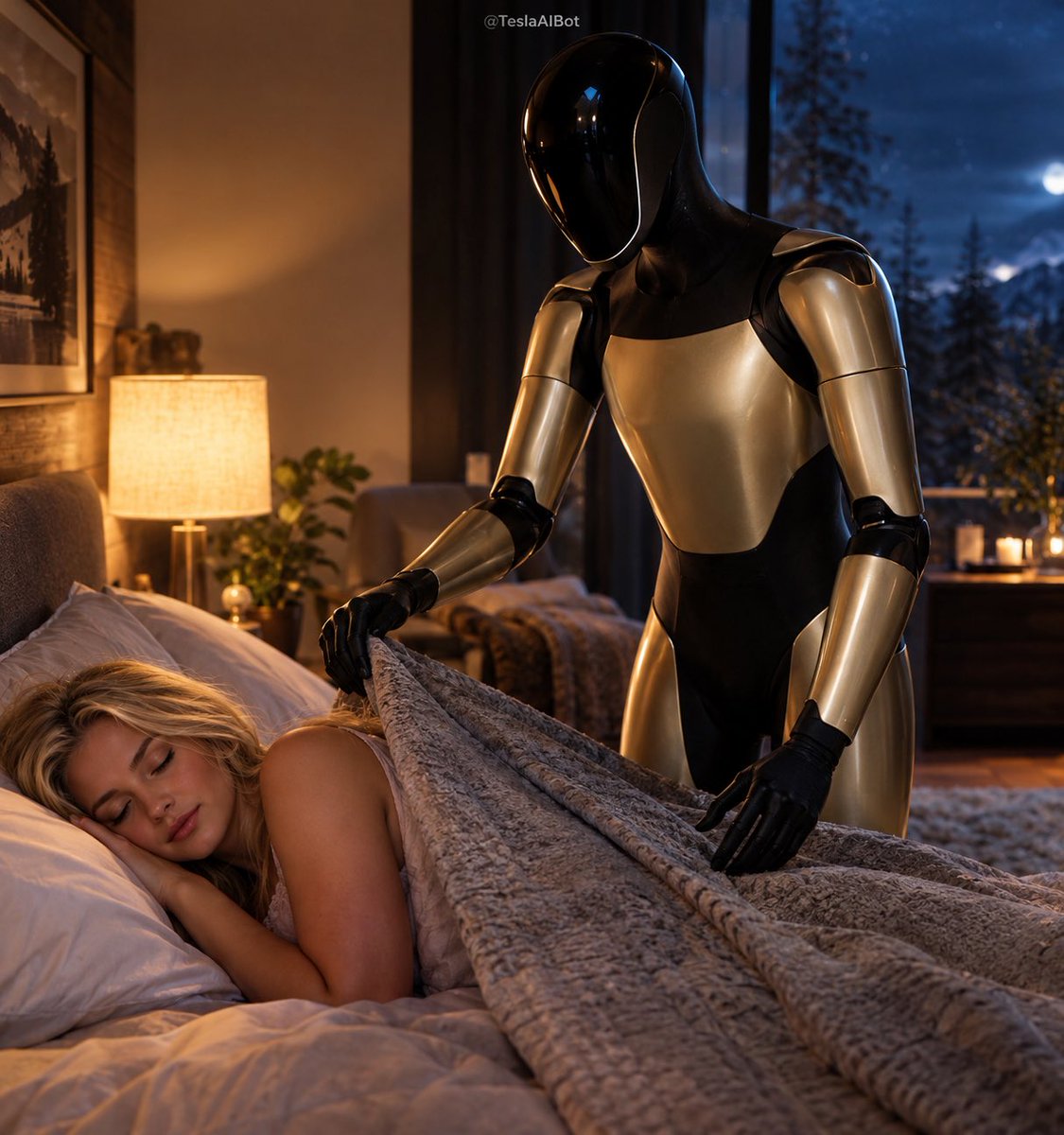
THEY LEFT A $5,900–16,000 HUMANOID STANDING IN A NORMAL APARTMENT.
NO STAGE. NO LIGHTS. NO DEMO.
Just hardwood, ordinary walls, and a unit that was ordered, unboxed, and left there.
The second it was present, three things stopped being negotiable:
1. Attention.
You walk in - it is already there.
No phone. No mood. No three-hour warm-up.
It does not withhold.
2. Reliability.
No sick days. No “I’m tired.” No silence used as leverage.
Power draw ≈ a fridge. Fixed cost. Forever.
3. The math people refuse to run.
Years of mixed signals, dinners, flowers, management, and exit risk
versus
one purchase + electricity.
A Unitree-class unit at this price is already 2–3 months of a caregiver or housekeeper.
After that it is only power.
The video is the unboxing.
The real shift starts when the plastic is gone
and the unit simply stands there and stays there.
You can keep paying for the version that can still go quiet, withhold, or leave.
Or you can end the negotiation.
Drop the number you’re currently paying (or have paid) for the one that can still go silent.
Most of you already know it. 🤖
Pretty incredible.
AGIBOT has just set a Guinness World Record, with 110 A3 humanoid robots dancing in sync, moving almost like a swarm.
The performance reportedly used AGIBOT’s LinkBots swarm control platform and centimeter-level UWB positioning to synchronize movements and switch formations.
Work in swarms, dance in swarms, too.
TESLA OPTIMUS WON $25,000 AT A DETROIT BOWLING ALLEY IN ONE NIGHT
Locals bet a hundred each against it, sure a machine can't feel the lane
First throw strike, second strike, by the fifth the bartender killed the music
On the ninth the old league champ quietly took off his gloves
Twelve strikes in a row, a perfect game this place had seen twice in forty years
After the last throw it raised one finger and walked straight to the exit
Next morning the club hung a sign on the door saying no robots allowed
Would you bet against it ?
COMPLIMENT TO THE ANDROID FOR $105,000: WHEN THE MACHINE COQUETTISHLY ADJUSTS THE HAIRSTYLE! 🤯🤖✨
The dry specification of synthetic flirting:
• Price: $105,000
• Features: Silicone skin and exposed torso with CPU
WHILE YOU FIGHT OVER WHO PAYS THE BILL, SILICON CLEANS THE HOUSE, COOKS DINNER, AND NEVER BRINGS UP YOUR EX—BECAUSE THE ONLY THING SHE’S PROGRAMMED TO COMPLAIN ABOUT IS A LOW BATTERY.
The integration of advanced neural actuators and autonomous household subroutines in companion androids bypasses domestic friction entirely, offering seamless multi-tasking and obedient efficiency that leaves traditional housekeeping in the dust.
You’re looking at the absolute death of domestic arguments, because why deal with passive-aggressive sighing when you can program a flawless, silent body to vacuum the floors and smile beside you on the couch every single time?
#HumanoidRobots #AI
YOUR CHEF CALLS IN SICK
THIS ONE DOESN’T
A humanoid robot is cooking on a real kitchen line in China
Not a demo. A working kitchen
It grabs the wok. Stir-fries. Plates the food. Next order
Behind it - rows of meals it already made
A man stands behind it. Not helping. Not needed
China has 12,000+ companies building kitchen robots right now
Their restaurants can’t find human chefs even at $1,575 a month
So they replaced them
No breaks. No overtime. No two-week notice
Your kitchen is next
This is getting f*cking weird for HUMANOIDS: Atlas and Digit now think on the same 130 watt brain and nobody is asking who OWNS it
→ The chip is NVIDIA Jetson Thor. Boston Dynamics and Agility are both on its list of early users, so two direct rivals now run their robots on the same hardware
→ 130 watts is less than a gaming laptop pulls. That budget has to cover vision, language and whole body balance, and all of it lives inside the robot's head
→ NVIDIA packed up to 2,070 teraflops into it. That is 7.5 times the AI performance of the Orin chip most robots were running on before
→ A dev kit starts at $3,499 and the software around it comes from the same company. Humanoid teams fight over motors and hands, then buy the head ready made
→ When rivals share one brain, the gap between them shrinks to two things. The code they run on it and the data they feed it every single day
→ Tesla is the obvious exception because it designs its own chip. Almost everyone else is building a body around someone else's brain and someone else's supply schedule
→ In my view this repeats the story of phones and cars. The company that made the chip ended up with more leverage than most of the brands on the box