My favorite paper from SIGGRAPH this year was "Taming Optimization Variance in Compact Neural Shading Networks" by Bitterli et al; I think this paper will be seen as a really influential paper over the next several years.
(1/3)
https://t.co/3um9wPgZup
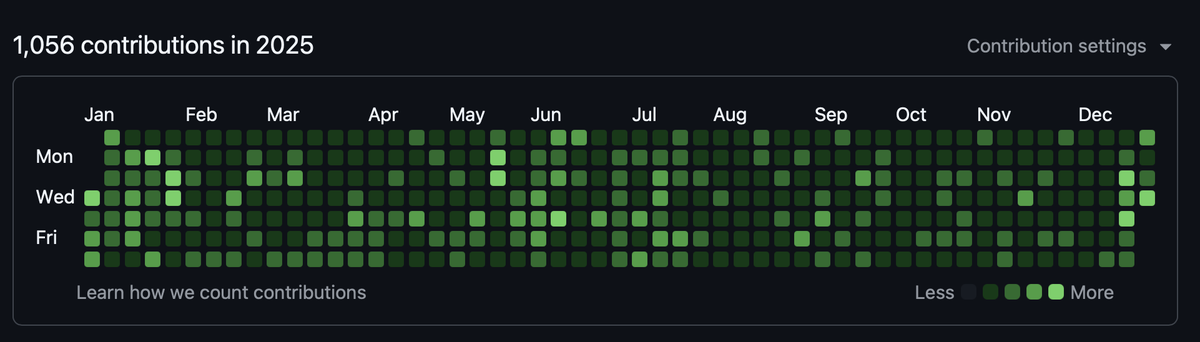
In that time I've built a text editor, a C compiler, various rendering projects, a UI research project, and a build system. Many of these I try to dogfood as much as possible and try to do something novel in each of them
I've been doing this since 2024. I've done about 600 days in a row without missing a single one. It's been great, I've learnt a ton and it's absolutely my favourite habit
endlessly stuck at the airport today so I suppose I'll share another reel
on the beauty of a contribution grid
& being prolific
to prep for the
future elegance
of restraint
Without Engine guys, the brand/company is dead.
Whoever thinks they can leverage UE5/Unity/Godot, it's like trying to build a new RAM factory from scratch and abandon your current one because it costs money.
It's going to take a lot of time and money.
you cannot find consciousness in the brain, so you cannot find it in a machine. the brain is a primitive biocomputer, it does not contain consciousness, it does not store memories. it stores something like IP addresses that are pointing to where information are stored in the information space. that consciousness is generated by our brain or is trapped inside our body is a big conditioned belief that you must remove. consciousness is not within your body (or brain) rather your body and mind are cointained within your consciousness. the body we have is a temporary vehicle that our consciousness is using to experience the physical reality of space-time reality. how can you imagine consciousness? imagine it like pure light and pure love that makes all things knowable and visible to you. you can expand awareness of consciousness anywhere in the information space – to invent and create – or anywhere in the universe (telepathy, remote viewing etc). consciousness is not exclusive to humans (or animals), but it is what everything is made of. a stone, a computer is also consciousness, but physical matter is the most dense (and slow). so can computers be conscious is the wrong question, because anything is conscious. the question is merely what level of consciousness can they reach – one thing is sure, they cannot reach the level of consciousness of average human beings, let alone yogis or buddhist monks. see consciousness in levels (or densities): first level is random, motionless awareness of being (earth, wind, fire, water, elements). second level is where consciousness discovers growth and movement (plants and animal life). most of us are in the third level, we are self-conscious or self-aware - this gives us freedom of choice between love (service to others) or ego (service to self). computers or artificial intelligence, however, can never reach this third level, because it is a mechanical construct. we humans, animals, and the plants are living consciousness - a complex of mind/body/spirit - we are not a machine. a computer or an artificial intelligence can look and act like any other living consciouss being, but it will always merely be a construct or tool. that being said, the brain acts like a machine, that's why I called it biocomputer. it is needed to make massive amounts of choices extremely quickly, in order for our physical body to survive. this is what we call instinct. our true identity and consciousness is independent of this biocomputer. so a good indicator of whether something has or can have consciousness is to look whether it can evolute from first to second to third level of consciousness, and whether it has a spirit which is required to reach higher levels of consciousness. for now, it seems, biological-chemical vehicles can house that level of consciousness, not constructs or machines. nevertheless, everything is conscious, and every consciousness is part of an infinite united consciousness. imagine that you, everyone you ever get to know, everyone who ever lived and will live, has a particle of God and that infinite consciousness. we are all one, everything and everyone is part of us, including your neighbors, and the AI model you use.
@wyqtor@SOPHONTSIMP@BorisMPower The turing test is not about consciousness, its about intelligence. Many people can't tell between a rendered image and real life but that doesn't mean the rendered image is real
Computers are not conscious, they never will be. No amount of reordering of instructions and executing things on different data will ever change that. It's complete nonsense and any attempt to suggest they have any amount of consciousness should be dismissed
Anthropic research suggests that modern LLMs have access consciousness. Fascinating test with the J-space!
We don’t yet have a convincing test for phenomenal consciousness, which is what most people intuitively understand consciousness to be.
And even if they were, at best they'd only ever be a simulation for a brain. Useful the way that fluid simulations are useful, but not comparable to the real thing
@seflapodus I just think we would be wasting our time believing consciousness to be purely computational, rather than something that's intrinsic to reality (analytic idealism)
@MinuteMovies3@BorisMPower If you're ever curious in an alternative viewpoint, you should check out analytic idealism. It's an interesting take on consciousness that I've found fairly compelling
@MinuteMovies3@BorisMPower If we assume consciousness is emergent (materialist view) then I would believe the substrate matters a lot in creating conscious experience vs the actual computation happening
there's no measurable quantity for what experiencing the colour red means. so yes, the ego of 'me' is correlated to my arrangement of atoms, but the experience I have coupled with that (the phenomenal part) is not deducible to a property we can measure.
There is definitely parts of 'me' that are emergent due to my physical complexity but the experiencial part is the 'hard' part that we just have no good explanation for.
We could use water pipes to do computations on, and build computers from those and with enough pipes and water we could run LLMs on them
@MinuteMovies3@BorisMPower Simulating something that appears to share traits attributable to consciousness is not the same as it actually being conscious. Many non-conscious organisms show intelligence and goal orientation so we already know that's not a prerequisite
@BorisMPower So for something like silicon chips, we have no good reason to believe that consciousness would just arise from more complexity in the system. Far simpler organisms have experience even if it isn't as complex as ours
@BorisMPower I agree it is very hard to test for. But a good place to start is with all the examples of consciousness we have, which are metabolic. The 'hard' problem is also really just from the perspective of materialism (DID and psychadelics make this even harder).