🔑 @polar_sh now supports two factor authentication! (strongly recommend to enable it!)
Powered by my brand new open source lib Reauth; couldn’t dream of a better battle test 🔥
I've got an agent in a loop optimizing a renderer with the goal to minimize frame times (and tests to measure). It got times down from 88ms to 2ms and allocations down from ~150K to 500. Sounds good, right? Wrong. This is exactly why agent psychosis is a big fucking problem.
As an experiment, I rewrote the Ghostty core render state in Go, with access to identically laid out data structures as Ghostty and the exact same validation tests. I made a purposely naive renderer (simple, correct, but slow). 88ms per frame with 150,000 allocations (horrendous, lol)!
I then kickstarted a Ralph loop to bring the frame times down. I told it it can't modify input data structures or the public API or tests (they're correct), but it can do anything else it wants. It got to work.
It has worked for about 4 hours. I've spent around $350 on this experiment so far. The results?
88ms => 1.5ms
150K allocs => ~500 allocs
Incredible right? Nope.
My hand-written renderer I ported has frame times (same benchmark) of ~20us (0.020ms) and 0 allocations in the update path.
This is the problem with psychosis and lacking systems understanding. If you don't understand the system, you're going to accept that this is an incredible result. If you understand the system, you'll see better solutions immediately and can do roughly 75x better on throughput.
The people who blindly trust agent output are in the former camp. They're sheeple, overdrinking from a fountain of mediocrity.
Standard disclaimer: I use AI all the time. I like AI. The point I'm making is to not blindly accept results. Think. Analyze. Learn.
Introducing the Polar Startup Program ✨
Need robust payments, usage billing & sales tax taken care of? Get our Scale tier for free for 12 months.
> Slack Channel with the Polar-team
> P1 Support
> 3.40% + $0.30 per transaction
Apply today → https://t.co/JOCZ9sfuux
Supply chain attacks and OSS sustainability go hand in hand. I've semi-seriously joked for years that OSS upstreams should periodically purposely inject full vulns into their code and let downstreams fuck around and find out. Downstreams can pay to get the non-FAFO version.
The not joke part is simply that OSS maintainers aren't a supply chain. OSS maintainers are not responsible for monitoring CVEs (because, they are not a supply chain). OSS maintainers are not at fault when bad shit happens to downstreams, because basically every OSS license (MIT, Apache, GPL, etc.) literally says: the software is provided "as-is, without warranty." You get what you pay for (that is to say: absolutely nothing!)
Now, the joke part is that I do believe there is an ethical obligation to try to prevent harm downstream. But "try" is the key word. So, this isn't a serious proposal.
But, if you're using OSS code and you're not paying for a license with a contract that promises some kind of warranty, you have no supply chain. You (the downstream user of an OSS lib) ARE the supply chain.
To use a metaphor: physical goods have a real supply chain. Car manufacturers, chips, clothes, toys, etc. You have a signed commercial agreement with all your suppliers that promises quantity AND quality and blowback if either are missed. Thats a supply chain.
If someone puts some chips on the side of the road with a "FREE" sign, then you integrate those into a product, then find out those chips are hacking customers, its your fault, not the person who dropped them on the side of the road.
@pilcrowonpaper Absolutely none IMO. I would even say it’s a bad idea: data integrity and consistency provided by SQL is a security feature for such critical flow.
THIS IS HUGE! 🚀
If you are a startup, moving to @polar_sh would make more sense than ever now.
👉 Less fees than other processors
👉 No need to worry about VAT and other taxes
👉 A dedicated slack channel with us (and me ❤️)
Support is a known achilles heel for Merchant of Records.
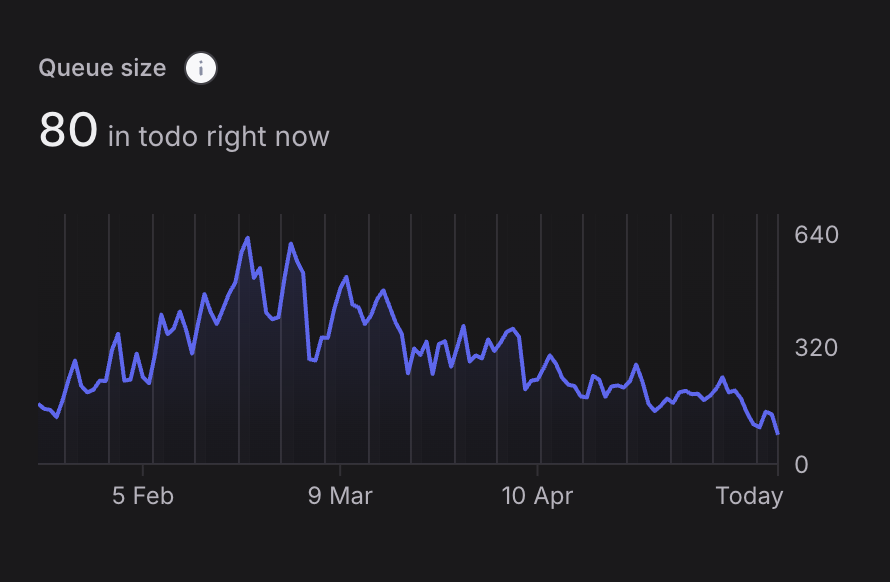
We've always been praised for ours (mostly – nobody is perfect), but in February, we started seeing it get away from us – reaching ~600 tickets/day in the backlog.
Excited to have aggressively turned the trend around despite 10x in growth.
→ Hired a Director of Merchant Operations to help scale our support, risk and success team.
→ We shipped our own AI support chat.
→ We shipped our own continuous account review agent.
→ We shipped self-review onboarding against our AUP and integration requirements.
→ We've shipped a ton of internal tooling
→ We've answered 5,000+ tickets
We're far from done, but excited about the momentum in the right direction.
We're officially in talks with Story Kitchen and Evan Spiliotopoulos about making our long dream of a Broken Sword movie a reality!
We hope you understand that we can't go into more detail about any of this just yet, but here is the Variety exclusive that just went live 🍿📽️
This is the 3rd (!) time I try to come up with my vision of a great auth library in 2 years. This time feels the good one.
What changed?
I have a clear goal: have MFA in place in @polar_sh before June.