Meta published a paper that might end the current LLM era.
They proved that we can kill the "tokenizer" forever and it actually makes the models stronger.
Every AI you use today (ChatGPT, Claude, Gemini) reads text the exact same way. It chops your words into arbitrary chunks called tokens.
It relies on a massive, bloated vocabulary of around 100,000 specific chunks just to understand a sentence.
We assumed this was the only way to build AI. We treated it as the fundamental speed limit of language models.
Meta proved we were completely wrong.
Their new paper, "Breaking the Token Ceiling," ditches tokens entirely.
Instead, they forced the AI to process raw bytes. A vocabulary of just 256 values.
The results rewrite the rules of model efficiency.
By training on pure bytes and distilling the knowledge, these tiny models didn't just survive. They dominated.
Meta's distilled 1B-parameter byte models asymptotically surpassed state-of-the-art token models like Llama 3.2-1B and Gemma-3-1B across downstream tasks.
They use a fraction of the vocabulary. They require less data. They take up less storage.
It forces the model to actually learn the fundamental relationships between raw data instead of relying on pre-packaged text chunks.
This is a massive shift for anyone building, training, or deploying AI.
We’ve spent the last five years obsessively optimizing how we chop up text to feed these models.
It turns out, the bottleneck wasn't the intelligence of the model.
It was the tokenizer.
🚀 Are you a PhD student pushing the boundaries of AI, robotics, graphics, or accelerated computing?
NVIDIA's Graduate Fellowship offers up to $60K in funding, mentorship from NVIDIA researchers, and a summer research internship!
⏳ Apply by October 30!
https://t.co/HkNUpQQL0e
@cerebras too expensive the pure SRAM architecture...wish cs5 has the proposed stacked DRAM to solve the memory bottleneck. and release the compiler, i/o runtime to public access so we can develop software for you
Thrilled to announce the @SpAItial_AI PhD Intern program.
Work with a team of exceptional researchers. Build foundation models with lots of GPUs and publish the results at a top-tier conference.
Incredibly happy to strengthen the connection between academia and frontier AI🤝
💥 Introducing Warp Sciences, a new company applying AI and robotics to help the world develop new medicines faster.
We’ve raised a $215M Series A led by @lightspeedvp to bring frontier AI out of the browser and into the lab, and build scientific capacity here in America.
I co-founded Warp with my long-time friend @dpatil, FAIR co-founder @manohar_paluri, and drug hunter Sol Reisberg. The early team is full of incredible people like @bkspears9, who helped achieve Q>1 fusion at LLNL.
I wrote a blog to introduce SGLang HiCache (Hierarchical Cache)
HiCache started with CPU offloading in February 2025. It now preserves reusable history across GPU, CPU, and external storage, including hybrid-model state.
The blog will walk through mechanism under HiCache, and how it achieves 15.5× effective input throughput and ~98% cache hit rate in mass production serving.
Read the visualized deep dive 👇
https://t.co/gCL72ELCa9
🔬 Google Student Researcher Program 2027: Paid Research Opportunities in AI, Computer Science & Data Science!
Are you a bachelor's, master's, or PhD student passionate about artificial intelligence, machine learning, data science, or scientific research? Google is inviting eligible students to apply for its 2027 Student Researcher Program, offering opportunities to work on innovative research projects addressing real-world challenges. 🌍💻 Successful candidates may be matched with research teams across Google, including Google Research, DeepMind, and Google Cloud.
🎯 What Are the Benefits?
✅ Gain practical experience in advanced research and technology.
✅ Work on real-world scientific and computing challenges.
✅ Explore areas such as AI, machine learning, computer vision, data science, and software engineering.
✅ Collaborate with researchers, engineers, and scientists.
✅ Develop technical, analytical, and research skills.
✅ Explore opportunities across multiple international locations.
📅 Application Deadline: 13 December 2026
🔗 Read the full opportunity and application guide: https://t.co/aqI6yrAdtM
Qwen3.8-27B reportedly jumped from 82 to 381 tokens/sec on a single RTX 3090 with 24GB VRAM.
That’s a 4.6× increase without changing the GPU or the model.
The developer, TeksEdge, achieved this by optimizing the inference stack rather than upgrading the hardware.
Here’s how the reported performance improved:
Baseline: 82 tokens/sec
Optimized MTP: 114 tokens/sec
DFlash2 + context lookup: 138 tokens/sec
Optimized lookup verification: 381 tokens/sec
Three techniques explain the improvements.
1. Speculative decoding
Normally, a language model generates tokens sequentially, with each new token depending on the previous ones.
Speculative decoding introduces a faster drafting process that proposes multiple tokens for the main model to verify. When several proposals are accepted, the system can generate more output per verification cycle.
In this experiment, optimized MTP increased throughput from 82 to 114 tokens/sec. Adding DFlash2 and context lookup pushed it to 138 tokens/sec.
2. Context lookup
Why generate text from scratch when the same text already exists in the input?
Context lookup identifies sequences that can be reused and proposes them for verification instead of generating every token individually.
The reported implementation processed blocks of up to 16 tokens, accepting roughly 15 per block.
On a 25,000-token document reproduction task, throughput reportedly climbed from around 260 to 382 tokens/sec.
There’s a catch: this technique works particularly well when the output resembles existing text. Open-ended conversations generally offer fewer opportunities for reuse.
3. Prefix caching
Coding agents frequently resend identical system instructions, repository context, and code snippets across multiple requests.
Prefix caching stores reusable computations from previously processed prompts, reducing the work required when those same prefixes appear again.
In TeksEdge’s reported test, time to first token fell from 22.4 seconds to just 0.56 seconds.
That’s approximately a 40× reduction in initial waiting time.
For agents working with large codebases, this can make repeated interactions substantially more responsive.
One important distinction: 381 tokens/sec isn’t ordinary chat performance.
The developer reports around 133 tokens/sec for regular chat. The higher figure comes from a workload that benefits heavily from context reuse and optimized verification.
Those numbers measure different conditions, so they shouldn’t be treated as interchangeable.
The interesting part is that the RTX 3090 didn’t change. The model didn’t change either.
The improvement came from making the inference stack do less redundant work and verify proposed tokens more efficiently.
Local AI performance isn’t determined by GPU specifications alone. The software running on that hardware can make a substantial difference.
Project: TeksEdge’s Qwen3.8-27B RTX 3090 implementation.
Jensen closed his GTC Berlin 2026 keynote with this Hermes Agent demo as the finale.
He introduced it by saying the way to build an agent is to ask an agent to build it for you, so he installed and set up a customized Hermes in one prompt.
Then he used Hermes, running on @nvidia RTX Spark, to create a simulated training environment for the @huggingface Microduck. Hermes planned an obstacle course with Nemotron and had GPT-6 Astra build it using FreeCAD, Omniverse libraries, Blender, Newton, and Isaac Lab. Hermes trained thousands of simulated ducks on that course until the validated policy was ready to run on the real robot in the physical world.
At Nous, we believe open source is a practical tool as much as a philosophical ideal. It gives users the ability to build powerful, complex workflows chaining numerous local+cloud models, devices, and tools themselves instead of waiting for a company to enable them.
Interested in Internship at NVIDIA? Apply for a 2027 internship at LPR https://t.co/2nYVnR2KGC! 🤖
We’re looking for interns to help shape the future of intelligent systems that interact with the physical world.
Apply: https://t.co/stKrVFetDk
#EmbodiedAI#NVIDIA#Internship
High throughput on the grill. Zero latency on the drinks.
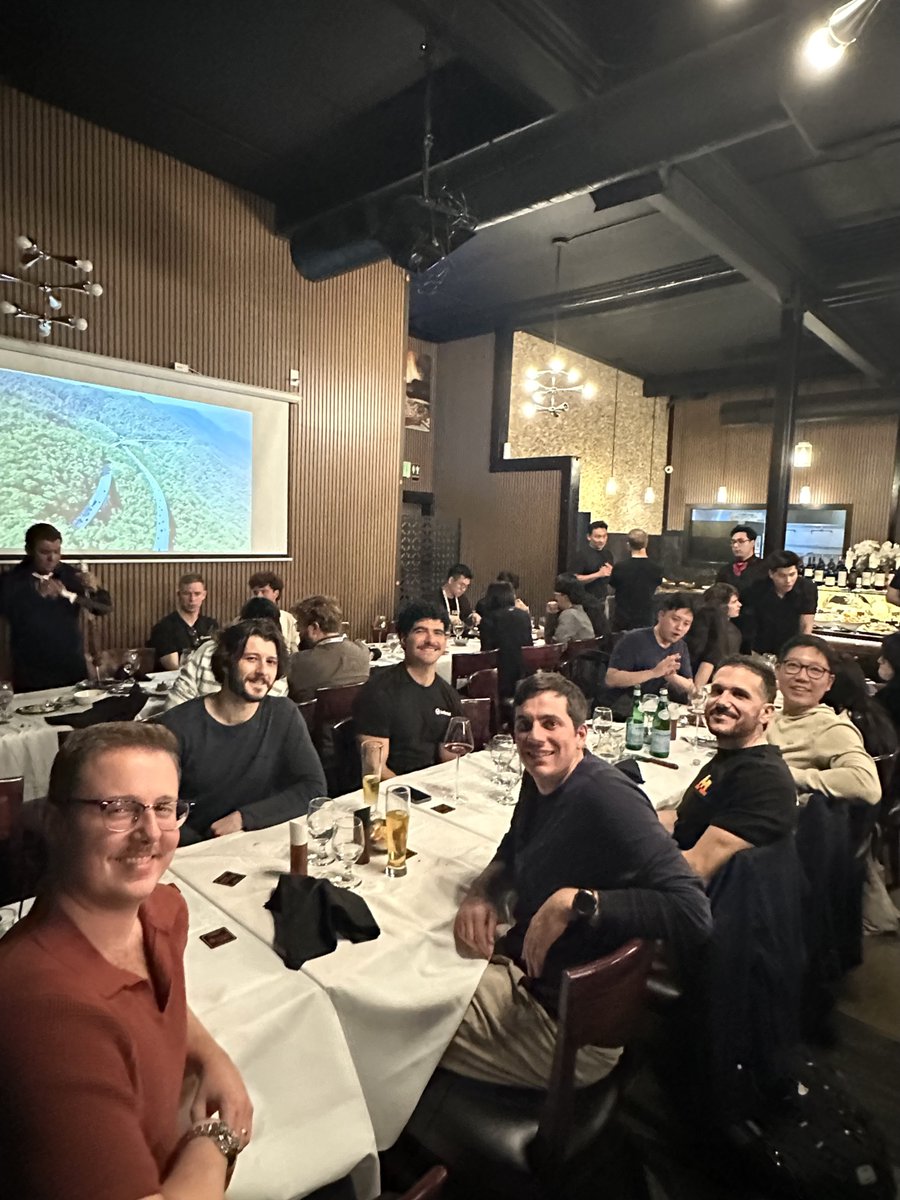
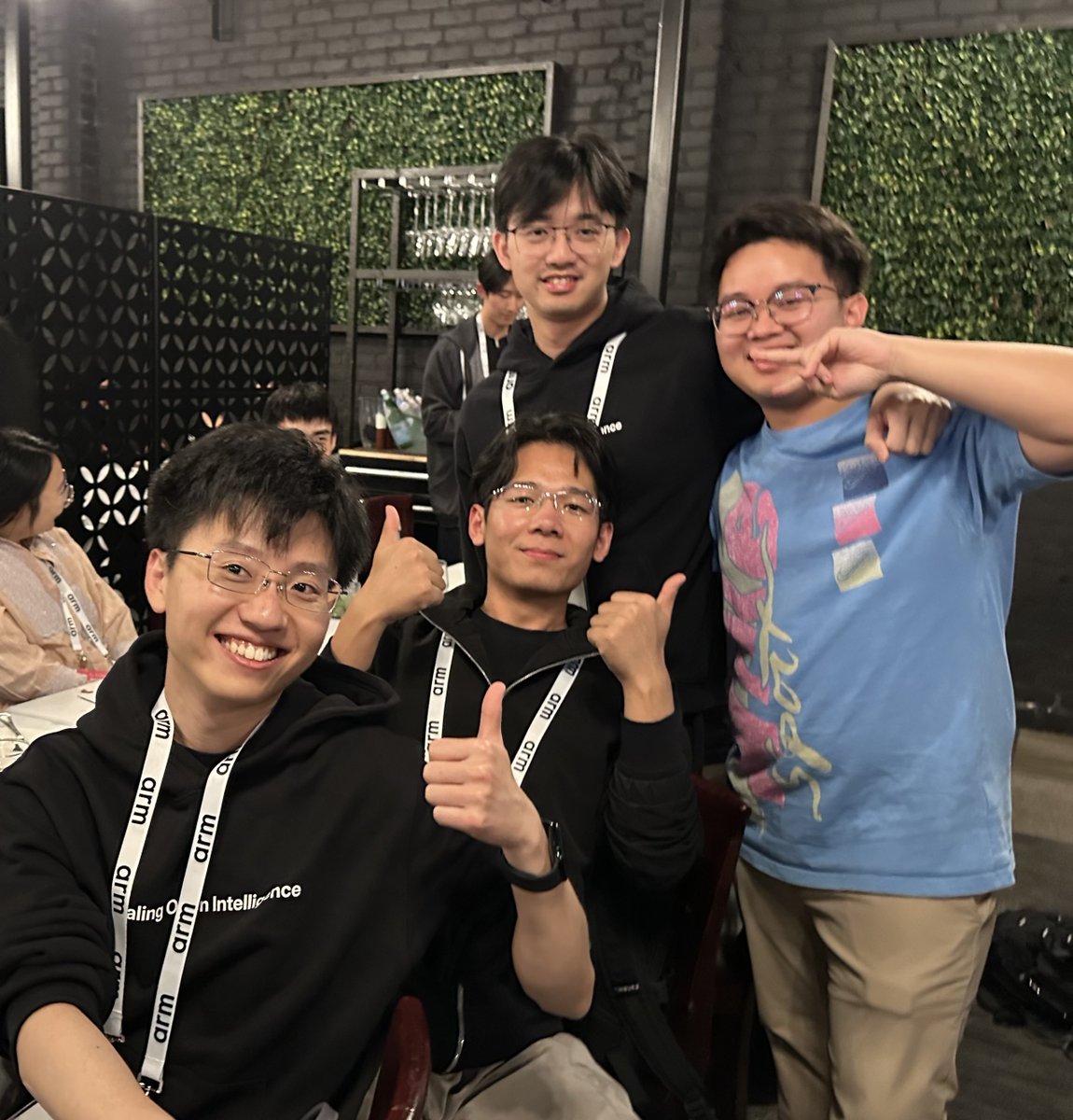
vLLM maintainers and friends gathered during the PyTorch Conference for an evening of Brazilian steak, drinks, and great conversation! 🥩🥂
Grateful for this community and everyone who keeps vLLM moving forward. 🚀