5 Things That Caught My Attention This Weekend...
1. The Pentagon Pizza Index is back. Social media users noticed Google “popular times” activity spike at a Domino's near the Pentagon around 5pm Saturday, while another well-known nearby bar was unusually quiet. Then Trump unexpectedly cut short his Camp David weekend and returned to the White House as tensions across the Middle East escalated. For anyone unfamiliar with the theory, people have tracked late-night pizza activity around the Pentagon for decades as an unofficial sign that something serious might be happening.
2. The reason people were watching is more serious. Saudi Arabia sounded air-raid alerts after another wave of Houthi missile and drone attacks, including an attempted strike on Riyadh, while US embassies across the Middle East issued heightened security warnings. Trump also returned early from Camp David, although the White House hasn't publicly tied that decision directly to an imminent military operation.
3. Nvidia just spent $12.9 BILLION buying Hugging Face. If you don't know Hugging Face, think of it as one of the most important hubs for open AI models: more than 18 million developers, 3 million models and 200,000 companies use the platform. Nvidia says Hugging Face will remain open and developers won't be required to use Nvidia hardware.
4. Remember when streaming was supposed to save us from cable? Disney+ has updated its terms so that even plans marketed as ad-free can contain certain advertising, sponsorship and promotional content, particularly around live programming, sports and before or after content. Disney still describes its Standard and Premium movies and series as ad-free, so this isn't the same as suddenly inserting traditional commercial breaks halfway through every movie.
5. Underneath all the geopolitical uncertainty, the US economy is still running surprisingly hot. The Atlanta Fed's GDPNow estimate for Q3 has jumped to 5.1% annualised, up from 4.4% only a week earlier, driven partly by stronger estimates for consumer spending and government expenditure. Remember, GDPNow isn't an official Fed forecast, it's a model-based nowcast that changes as new data arrives.
Patience. React, don't predict.
The Pentagon Pizza Index is back… and the timing couldn't be stranger.
In today’s video, we break down the stories, Price Action, Data and Flows that could actually matter to markets this week.
If you're watching markets this week, this is one you’ll want to catch.
Patience. React, don’t predict.
$SPY - The 2nd largest cluster since inception (51 trades, $16.19B and growing) has printed at $762.70. Included in that cluster is an individual $3B trade that ranks #14.
Other notable clusters from the last year shown on image 2.
For comparison purposes, #1 was $16.34B, which means today's has the potential to overtake it if more late-reported trades arrive at this level between now and close.
Happy Triple Witch! 🧙♀️🧹
https://t.co/i5V7d5Evfk
Something interesting is happening in US housing.
Lennar has taken its average selling price on new orders from $511K in 2022 to $359K today.
At the same time, ITB, the home construction ETF, reportedly just saw the largest dark-pool transaction in its history.
Important distinction: a dark-pool print doesn't tell us "smart money is buying or selling at that price until markets start to move."
But it does tell us somebody was willing to transact at serious size.
Combine that with what builders are telling us about prices, incentives and demand, and housing is becoming a very interesting market to watch.
$1.45 TRILLION.
That’s how much US margin debt has now climbed to, up another $228 billion this year as leverage continues to build underneath the market.
Meanwhile, CoreWeave is raising another $3B in debt, Steve Eisman is questioning the real reason AI leaders want to slow development, Blackstone is dealing with liquidity demands in private real estate, and the Dow Transports continue to weaken.
In today’s video, we connect the Price Action, Data and Flows and look at what they could be telling us about the market right now.
Patience. React, don’t predict.
7 Things That Caught My Attention Today...
1. This is one of the leverage charts I keep coming back to. FINRA margin debt reportedly reached $1.45 TRILLION in August, up $37B in a month and $228B since the start of the year. Relative to the economy, margin debt is now around 4.5% of GDP, above the peaks around 2021 and the dot-com era. The more leverage builds, the more important volatility becomes because falling prices can eventually create forced sellers.
2. Another interesting development in the AI financing story. CoreWeave announced a $3 BILLION convertible debt offering alongside a program allowing it to sell up to 35 million shares. This comes as the company spends extraordinary amounts building AI infrastructure: $14.1B in infrastructure investment during the first half of 2026, against a $104B revenue backlog. But here's the number I'm watching, interest expense was around $640M last quarter and is expected to reach $860–940M next quarter.
3. Steve Eisman had an interesting take on the sudden calls from AI leaders to slow development. His argument is that this may be about more than safety. As cheaper and increasingly capable models emerge, regulation and slower frontier development could potentially strengthen the competitive moats around established players. Eisman also pushed back strongly on claims that AGI is imminent, essentially asking: if the risks are really as immediate as we're being told, why are these companies simultaneously raising enormous amounts of capital and preparing for potential IPOs? I don't know which side ultimately proves correct, but “who benefits from slowing down?” is an interesting question to add to the AI debate.
4. Here's a chart that completely changes depending on what you use as the denominator. The median new US home reportedly cost around 91 ounces of gold in Q2, roughly 82% below its 1960s peak when measured in gold, even though homes look extraordinarily expensive when measured in dollars. But here's where it gets even more interesting: measure the average annual wage in ounces of gold and you get a very different picture again. The unit you choose can completely change the story an asset appears to tell. I'm writing this one up properly for the newsletter soon, so make sure you're subscribed.
5. Diamonds have quietly experienced an extraordinary bear market. Prices are reportedly around their lowest levels this century and roughly 70% below the 2011 peak. Lab-grown diamonds, changing consumer preferences and weak demand have completely changed the economics of an asset once marketed around scarcity. It's a useful reminder that something being scarce, expensive or considered a “store of value” doesn't automatically mean the price has to keep rising.
6. Blackstone is reportedly arranging a secondary transaction allowing institutional investors to sell positions in its $57.7B Blackstone Property Partners fund, while also cutting management fees by around 30% for investors that agree to limit redemption requests. Commercial real-estate values remain well below their previous highs, and what's particularly interesting is that the fund's largest exposure is now data centres.
7. And one chart underneath the equity indices continues to bother me: the Dow Jones Transportation Average. While the major indices remain relatively strong, transports have continued to weaken. I don't treat Dow Theory as some magical market-timing system, but transports give us a useful look at economically sensitive businesses moving goods around the economy. When the companies transporting those goods start behaving differently from the headline indices, I think the divergence is worth watching rather than ignoring.
As always,
Patience. React, don't predict.
This might be one of the most important charts people aren't watching.
US margin debt has reached $1.45 trillion.
Up $37B in August.
Up $228B YTD.
Around 4.5% of GDP.
Leverage has been growing faster than the market itself.
But the more leverage sitting in the system, the more interesting things can become when volatility eventually shows up.
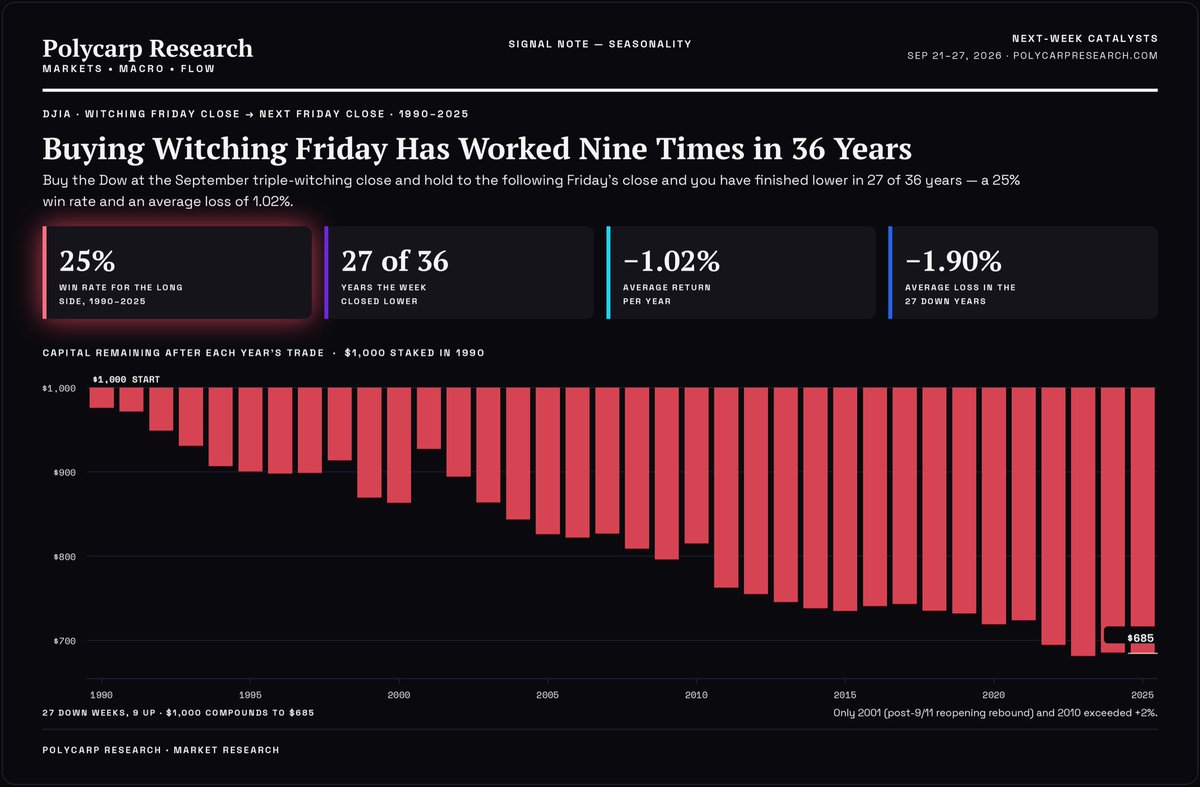
The week after September triple witching has closed lower in 27 of the last 36 years.
$1,000 run through that trade every year since 1990 is worth $685 today.
The long side only wins 25% of the time. $SPY
@Bluekurtic@fxevolution@thesetupfactory
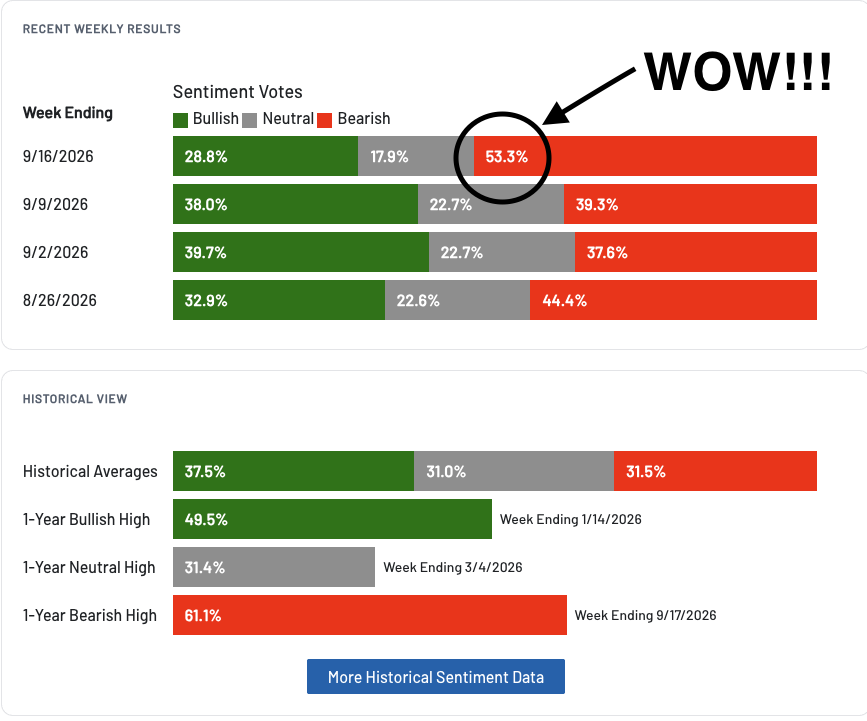
32 straight weeks.
That's how long AAII bearish sentiment has now been above its historical average.
This week it jumped to 53.3%, compared with just 28.8% bullish.
The crowd remains deeply uncomfortable.
The wall of worry is still very much alive.
The Fed just raised rates… but I think what Kevin Warsh said afterwards matters even more.
In today’s video, we connect the Price Action, Data and Flows and look at what these very different signals could be telling us about where the market stands right now.
Patience. React, don’t predict.