NEW: your YouTube channel now has its own AI agent working 24/7.
it can ideate videos, create thumbnails & titles, automatically find & repackage underperformers & so much more.
reply "AGENT" to try for free.
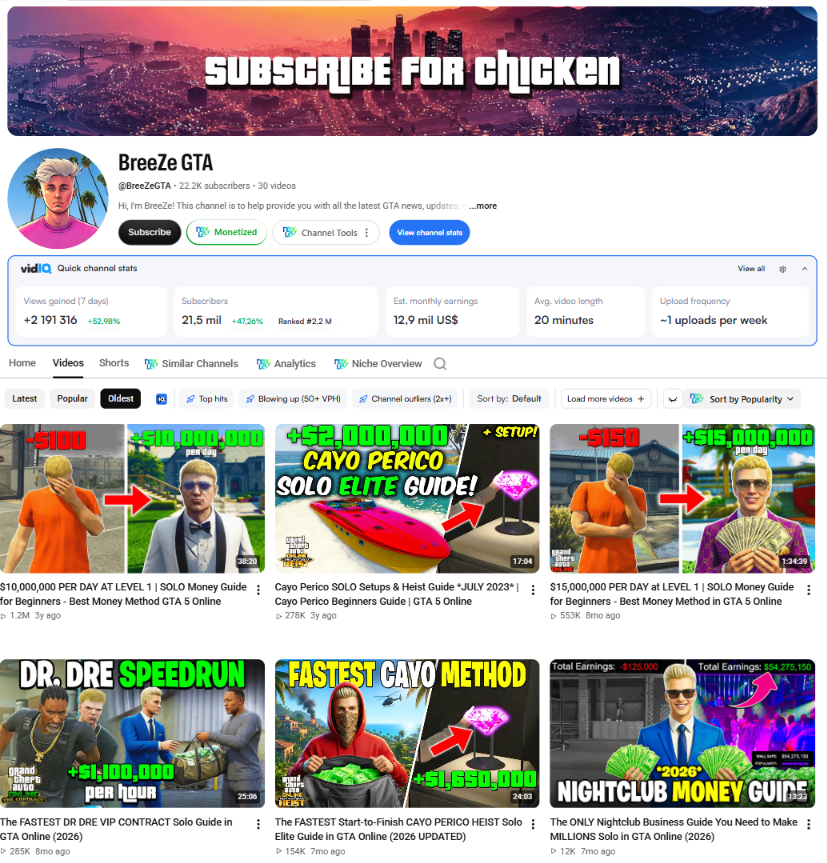
this ~$12.9k/mo channel has been cooking since gta 5 released…
now he's using the SAME audience's curiosity to milk gta 6 comparisons.
here's why this angle is so cracked and how you leverage it NOW:
the channel is BreeZe GTA.
22.2K subscribers. 30 videos. vidIQ estimates about $12.9K a month from adsense, and 2.19M views in the last 7 days.
the popular tab:
"15 CRAZY features in GTA 6 that were NOT in GTA 5": 2.7M in 8 days
"15 THINGS from GTA 5 you WON'T be able to do in GTA 6": 2.4M
"12 THINGS you NEED to do on DAY 1 in GTA 6": 1.3M
and a GTA 5 online money guide from 3 years ago still sits at 1.2M.
that's the unfair advantage. the audience was built on GTA 5, so every GTA 6 video lands on people who already trust him.
why it works:
comparison is the cheapest curiosity on youtube. the viewer knows GTA 5 inside out, so every "this changed" lands instantly
FOMO. "you NEED to do," "you WON'T be able to." miss it and you're behind your friends
in-game footage, with map overlays and comparison graphics on top
steady uploads, about 1 a week, around 20 minutes each
recognisable thumbnails: lucia or jason, the V and VI logos side by side, the same pink and purple every time
how you run this play:
1. find 1 comparison that matters.
something players did every day in GTA 5 that works differently now. cops, money, the phone, the map.
2. source it.
rockstar's official material or your own gameplay. never a leak presented as fact.
3. package it.
1 character + both logos + 2 to 3 words. "GONE IN GTA 6" does the job.
4. open on the promise.
if the title says 15 features, feature 1 starts inside 8 seconds.
5. let fable 5.2 outline the pacing:
"outline a 20-minute GTA 5 vs GTA 6 comparison video with 15 items. every item opens with how it worked in GTA 5, then what changed. label each claim confirmed, reported or rumour. put the strongest item between 40% and 60%, and tease the next item before closing each one."
and the content cycles keep coming.
the PC release, the online updates, the money meta. each 1 restarts the comparison game.
if you want the skill files that write 20-minute comparison scripts that hold, DM me "VERSUS" and i'll send the details
(200M+ views generated through AI scriptwriting skill files trained on 10,000+ scripts, one-time payment)
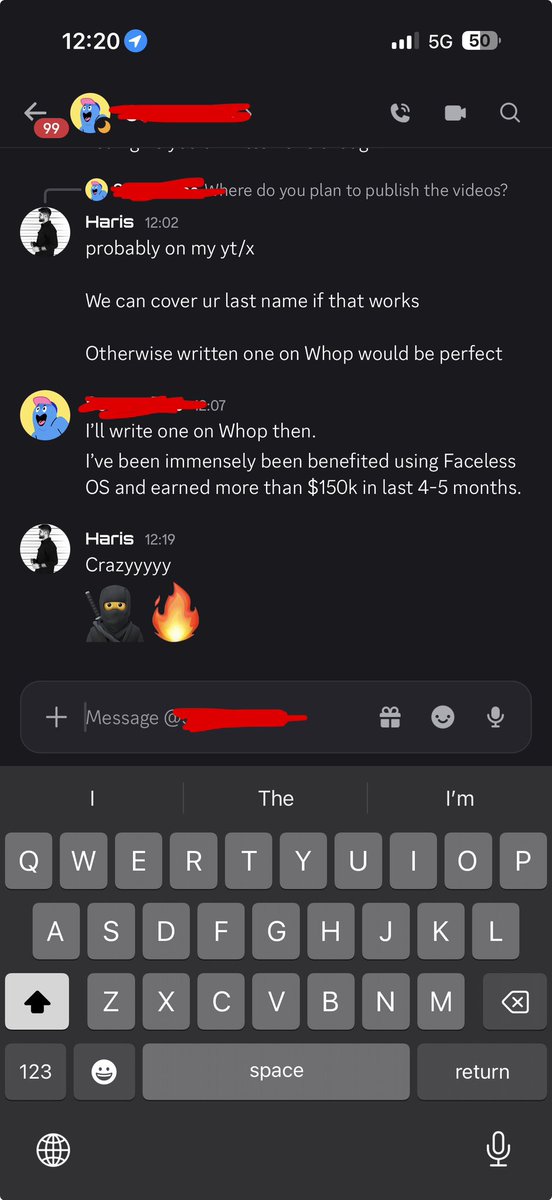
He made $150k+ in the last 5 months.
All im gonna say is if you’re not using FacelessOS, you’re NGMI
Get FacelessOS: https://t.co/cJeMwMufSJ
EVERY killer YT creator uses FacelessOS 🥷🔥
a faceless channel with 800,000 views/month was making $2,400 in adsense.
$3 RPM in a niche averaging $12. the views were real. the revenue was phantom. 1 structural fix in the script changed the RPM to $14.50 without changing a single word of content. let me show you exactly where the leak was sitting...
youtube's mid-roll ads fire at the 30-40% mark of your video. for a 10-minute script, the first mid-roll lands at minute 3-4.
and in 70% of the scripts i audit, something TERRIBLE happens at that exact timestamp.
the creator delivered a useful insight. a solid data point. a mini payoff the viewer genuinely valued.
then the script moved to the next section.
0 new curiosity gap opened. 0 unresolved question pulling the viewer forward.
for 30-60 seconds, the viewer is in a state of completion. they received value. walking away feels cost-free.
the first mid-roll ad fires DIRECTLY inside this window.
the viewer leaves before the ad plays. they counted as a view. they generated $0.
i call this the payoff void. and it's the reason high-view channels have terrible RPMs.
the fix is 1 sentence.
within 10 seconds of every mini payoff in your script, open a new curiosity gap. "but this leads to something even more disturbing" or "and the data from the next section contradicts everything i showed you above."
1 sentence. the viewer's brain registers something unresolved. leaving before resolution feels wasteful. they stay past the ad placement.
the 800K view channel added curiosity bridges after every mini payoff. the view count dropped from 800K to 400K. the revenue went from $2,400 to $5,800.
the 400,000 views that disappeared were phantom views. they counted on the dashboard and generated $0. the 400,000 who stayed were the viewers watching past the ads.
check your scripts right now. find the point where you deliver value and then move on without creating tension. that's the payoff void. and the first mid-roll ad is firing directly inside it.
DM me "RETAIN" if you want FacelessOS to flag these voids automatically before upload
haris
the entire scriptwriting system behind any faceless channel doing 1M+ views comes apart in about 20 minutes.
the process replaces roughly 3 hours of manual browsing and delivers something manual research never produces: a cross-referenced structural blueprint of what's working RIGHT NOW.
the full chain is below. copy the prompts.
(i do this before writing in a niche i've never written in btw...)
step 1: find the outliers.
connect the nexlev MCP to claude and run this:
"using nexlev, search for channels in [NICHE] with 10,000 to 200,000 subscribers. for each channel, pull their last 30 videos. identify videos where the view count is at least 5x the channel average. return the top 15 outliers sorted by view-to-average multiple, with video title, URL, view count, channel average, and publish date."
you want the 5x+ multiple specifically, because a video beating its OWN channel holds audience size, editor, and production constant for free.
four things are left: the topic, the packaging, the timing, the script. the first 3 take 10 seconds to rule out. was the topic trending across the whole niche that week? did the thumbnail break the channel's usual pattern? was the upload riding a news cycle?
rule out all 3 and the script is what remains. rule out none and you're copying a thumbnail.
step 2: pull the transcripts.
connect the transcript MCP and feed claude the top 5 outlier URLs at once. all 5 in the same session. that's the entire point, because the value comes from cross-referencing rather than from any single teardown.
step 3: the structural analysis prompt.
"analyse these 5 outlier transcripts together. for each one: what hook type was used (in media res, contradiction, impossible result, or prediction bomb), where did the entry point land relative to the story's timeline, what pacing pattern did the body follow, where does each curiosity gap open and close, how many times is the grand payoff foreshadowed before delivery, and what editorial decision made this different from a generic take on the same topic. then identify the patterns all 5 share that underperforming videos in this niche are missing."
step 4: the vocabulary extraction.
"pull the recurring vocabulary, phrasings, and transition language across all 5 transcripts. i want the words this specific audience responds to, not general scriptwriting language."
this one is underrated. matching audience vocabulary is half of why an outlier feels native to its niche.
step 5: the transferable framework.
"compress the analysis into a reusable template: the hook formula, the pacing map with timestamps, and the payoff structure. write it so it applies to any topic in this niche, not only to these 5 videos."
step 6: generate against it.
"using that template, write a script on [MY TOPIC]. match the psychological pattern of the outliers with completely original content. annotate visual direction notes for my editor."
6 prompts + 20 minutes and you're writing against real pattern data instead of a vague shit claude or chatgpt gives you.
DM me "REVERSE" if you want the full version with the audit layer attached
haris
95% of faceless youtube creators are using the WRONG hook framework and they have 0 idea.
educational content and faceless content operate on completely different psychological systems. mixing them up is costing creators millions of views across the space. and nearly every channel i audit is making this exact mistake. let me show you why...
educational hooks use what i call the target-transformation-stakes framework. who is this for, what will they get, why should they care.
"if you're at 100 subscribers and want to reach 100K, i'm going to show you the 3-step system that took my client from 0 to 100K in 6 months."
that works for personal brand channels. the viewer is promised a transformation. they need to trust the creator. the hook builds credibility and maps to a specific outcome.
faceless hooks use the character-concept-stakes framework. who is the story about, what is the situation, why does it matter.
"at 3:47 a.m., mark zuckerberg sent an email that would destroy his best friend forever."
that works for faceless. the viewer is promised an engaging experience about someone else. 0 teaching. 0 transformation promises. pure curiosity about what happened.
the destruction happens when creators cross the frameworks.
a faceless channel opening with "if you want to understand criminal psychology, i'm going to teach you..." is using educational framing for entertainment content. the viewer came for a story. they got a pitch. they leave.
a personal brand opening with "this entrepreneur discovered a secret that changed everything" is using entertainment framing for educational content. the viewer came for expertise. they got a teaser. it feels like clickbait.
wrong framework = confused audience = destroyed retention. regardless of how well-written the hook is.
the fix is matching the framework to the format BEFORE writing a single word.
faceless? character-concept-stakes. drop the viewer into a character, present a situation, imply the stakes.
personal brand? target-transformation-stakes. name the audience, promise a specific outcome, establish the cost of inaction.
DM me "HOOKS" if you want FacelessOS to apply the right framework to your niche automatically
haris
there's a 30-60 second window inside your faceless youtube scripts that's making you fail MISERABLY
not your hook though
let me show you EXACTLY where it sits and why it costs more than any other structural mistake:
youtube's mid-roll ads fire at the 30-40% mark of your video.
for a 10-minute script, the first mid-roll lives at minute 3-4.
now look at what happens in most scripts at EXACTLY that timestamp.
the creator delivered a useful insight. a solid data point. a mini payoff the viewer genuinely valued.
then the script moves to the next section.
no new curiosity gap opened.
no unresolved question pulling the viewer forward.
for 30-60 seconds, the viewer is in a state of completion. they received something valuable. nothing is keeping them from leaving. walking away feels cost-free.
this is what i call the payoff void.
and the first mid-roll ad fires DIRECTLY inside it.
the viewer leaves before the ad plays. they counted as a view on your dashboard. they generated $0 in revenue.
i've audited 200+ faceless scripts in the last year. the payoff void shows up in over 70% of them. the creators with strong view counts and TERRIBLE RPM all share this pattern.
the fix takes one sentence.
within 10 seconds of every mini payoff, open a new curiosity gap. "but this leads to something most creators NEVER consider" or "and the data from the next section contradicts everything i showed you above."
one sentence. the viewer's brain registers something unresolved. leaving before resolution feels wasteful. they stay past the ad placement.
a creator in my network had 800,000 views per month and $2,400 in revenue. $3 RPM in a niche averaging $12.
the retention graph showed the payoff void hitting at minute 3 on EVERY upload. the viewers were leaving right before the first mid-roll fired. every single time.
we added curiosity bridges after every mini payoff. nothing else changed.
RPM went from $3 to $14.50.
the view count dropped from 800K to 400K. the revenue went from $2,400 to $5,800.
the 400K views that disappeared were phantom views. they counted on the dashboard and generated nothing. the 400K who stayed were the viewers watching past the ads.
check your scripts right now. find the point where you deliver value and then move on without creating tension. the payoff void lives there.
the math is simple. if 70% of your scripts have a payoff void at the exact timestamp where the first mid-roll fires, 70% of your ad revenue is PHANTOM revenue that never materialised.
your view count says you should be making $8,000 a month. your adsense says $2,400. the gap is the payoff void. every single time.
one structural fix. one sentence after every payoff. the retention graph responds within the next 3 uploads.
DM me "FACELESSOS” if you wanna access an AI scriptwriting system that does this for you
if your research process is typing "give me 50 viral video ideas" into chatgpt, you're getting the worst ideas in your niche, and i'll explain exactly why.
every idea it gives you is an average of stuff it already saw during training. you're asking a machine to predict what worked in the past and calling it the future.
so here's the research stack i'd run instead, built on 2 models that came out in the last few weeks. every prompt is in here, so bookmark this one:
first you need to understand what each model does, because they do completely different jobs.
jev came out on september 15 from typesafe AI, and it doesn't write anything. you send it text plus a list of typed questions, and it sends back typed decisions with a probability attached to each one.
it answers in 70 to 500 milliseconds and costs around $0.042 per million input tokens. so you run thousands of yes or no checks every week for pennies.
think of jev as the judge.
opus 5.5 came out on september 22 from anthropic, and it's the analyst. on anthropic's fact-checked research report test it passed 16 times out of 18, while fable 5.1 and opus 5 passed 0 times.
so jev looks at everything, and opus only gets called when something's worth digging into. that split is how the whole thing stays cheap.
before any prompts, there are 3 rules i give both models, and honestly they matter more than the prompts themselves.
rule 1 is that views never prove a niche is profitable, or that a format caused them. rule 2 is that every claim gets a label: observed, baseline, pattern, inference or hypothesis. and rule 3 is that 1 viral video is never a market pattern.
without these, AI will happily tell you a niche is a goldmine because of 1 lucky upload.
then there's 1 formula that replaces hours of scrolling:
relative performance = video views ÷ channel median recent views
500K views on a channel that averages 20K is a 25x outlier. 2M views on a channel that averages 5M is underperforming. you want to study the first one, every time.
now the prompts. paste these into opus 5.5 in this order:
1. "research this youtube market: [NICHE]. analyse audience, subtopics, creator density, formats, recurring questions, monetisation and faceless suitability. separate observed evidence, inference and hypothesis."
2. "map the channels around [MARKET]. don't rank by subscribers. find format leaders, challengers, and channels with outliers 5x or more above their own median."
3. "analyse these outliers. for each one: views, channel baseline, relative performance, title formula, thumbnail concept, hook and structure. never describe performance as causation."
4. "from this dataset, find content gaps: unanswered questions, weak explanations, stale angles, missing audiences and missing formats. never claim nobody has covered something."
5. "topic: [TOPIC]. generate 10 distinct angles. for each: the viewer's question, hook, title, thumbnail concept, payoff and the evidence needed. no synonyms of the same angle."
6. "build the script architecture: cold open, promise, stakes, context, first reveal, escalation, counterpoint, payoff, implication, cta. give every section a retention job."
7. "for every section give me: timestamp, narration, visual, source and on-screen text. no random stock footage."
and between prompt 5 and prompt 6 is where jev comes in.
every idea goes to jev before it reaches opus. you send it the idea, the market evidence, the performance signals and the angles. it sends back a decision, a probability, a confidence score, the evidence for, the evidence against, what's still unknown, and the next action.
anything under your confidence bar dies right there. only the survivors reach opus, so you never pay opus to write a script for a bad idea.
then once a week you run the loop. refresh your channel list, snapshot the views, flag the new outliers, update your gaps, run jev, send the survivors to opus, publish, and feed your own retention data back in.
do this for 8 weeks and you'll have a memory of your market nobody else has, because it's built from your own data. nobody copies that by scrolling the homepage.
if you want the full protocol with the 3 skill files ready to paste, DM me "INTEL" and i'll send it over
(200M+ views generated through AI scriptwriting skill files trained on 8,000+ scripts, one-time payment)
i’ve posted EVERY technique i used to generate $5M+ across 10,000+ scripts on YouTube.
but NOBODY watches it in the RIGHT order...
so i turned the main 6 into 1 sequenced masterclass, about 3 hours, with an action item after every module so you walk away with a better script instead of a notepad full of notes.
here's what's inside:
> module 1: the opus 5.5 setup
the 3-way DB cooper test, what the new model fixed and what it still gets wrong, plus 5 prompts you paste into claude today
> module 2: the million view teardown
4 small channels that cleared 1M views (1 of them with 4,000 subs at 1.78M), and the hook, payoff and ending decisions behind each 1
> module 3: the 7 levels of content
why great writers get 0 traction, and the level where 1 video with 300 views made six figures
> module 4: the first 50 words formula
the value stack that took first minute retention from 42% to 78%, the curiosity ladder, and the ending that sells your next video
> module 5: the positioning fix
the 3 traps that get you likes and 0 inquiries, with a before and after rewrite for each
> module 6: the operator's room
me and vexi on 1 channel vs 20, why over-optimising kills a channel's identity, and how to reverse engineer any outlier 1 lego block at a time
want it?
1. Comment “COURSE”
2. Follow @fyreinteractive so i can DM
p.s. won’t be sending it after 72 hours