Embedding AI functions into software sees little adoption, yet enterprises are willing to use scenarios where AI calls software functions.
https://t.co/vl1DA5sv8K
I recently listened to a podcast featuring an industry practitioner from Synopsys. Interestingly, the episode was released on September 29—just one day before OpenAI and Synopsys announced GPT-Synopsys, their specialized AI model for chip design. Here are my key takeaways:
1. Custom silicon is ultimately an economic decision.
As AI inference scales, the cost of GPUs, electricity, and cooling rises rapidly. For large model and cloud companies, workload-specific ASICs may offer better economics than general-purpose GPUs.
2. Chip design is becoming more modular.
EDA tools and reusable, silicon-proven IP are turning parts of chip design into a “building block” process. This lowers the barrier to entry and helps companies shorten development cycles.
3. AI will augment EDA—not replace it anytime soon.
Software bugs can be patched. A failed tape-out can cost millions and potentially kill a company.
AI agents can generate, search, and optimize, but EDA tools still provide the constraints and verification needed for reliable results.
4. Fully autonomous AI chip design remains mostly experimental.
Many widely reported examples still rely on traditional EDA tools, human-written verification scripts, engineers, or external design-service companies.
The most realistic model is:
AI handles productivity.
EDA provides certainty.
Humans retain final responsibility.
5. Competition is shifting from chips to systems.
Performance now depends on packaging, interconnects, networking, cooling, memory, and software—not just the processor itself.
Nvidia’s moat is not merely the GPU. It is the entire system and ecosystem around it.
6. Smaller teams, broader talent.
AI, reusable IP, and automation will reduce the number of people needed for some chip projects. But architecture, trade-offs, business judgment, and final sign-off will remain human responsibilities.
The most valuable people will be those who can connect chips, systems, algorithms, and applications—and clearly express their intent to AI.
Elon Musk said his business empire will build and operate Terafab independently, quashing speculation about Taiwan Semiconductor Manufacturing Co. running his chipmaking venture.
https://t.co/H1GXyhKBQ0
Goldman Sachs: SpaceX Q3 2026 Preview
1\ GS reiterates Buy, raises 12-month PT from $220 to $230 ahead of Q3 2026 earnings. AI segment forecasts (capacity, revenue, margins) raised on deal activity, management commentary and enterprise use-case progress. GS believes Street AI estimates remain conservative over the next 6–18 months.
2\ Terrestrial compute buildout: 2.4GW by YE26 has high visibility. Ramp continues to ~7.0GW by YE27 and 10.6GW by YE28. Key constraints to track: power & cooling, datacenter shells, and server supply.
3\ Compute monetization: new hosting deals, foundation model improvements, supply-demand imbalances and rising token demand support elevated revenue per GW — GS sees sizable upside to consensus AI segment revenue.
4\ Starship: continued launches drive iterations toward full reusability and higher cadence, unlocking downlink capacity and better unit economics for broadband/mobile today, plus orbital compute over time.
5\ Long-term framing: space (launch & reusability), connectivity (broadband + mobile constellation) and AI (compute, X) each have multi-trillion-dollar potential over a 5+ year horizon; vertical integration provides a structural cost and competitive advantage.
AI Wealth Boom Peaks, Widening Wealth Inequality
The AI valuation surge has generated unprecedented wealth for founders, early investors and employees holding stock options. On the Bloomberg Billionaires Index, tech billionaires captured all of this year’s $845 billion in wealth gains, while fortunes of non-tech billionaires dropped by a combined $62 billion. Nine of the world’s top 10 richest people derive their wealth from AI-linked firms including SpaceX, Meta, Alphabet and Nvidia. Elon Musk even briefly became the world’s first trillionaire earlier this year.
This massive wealth concentration has triggered public backlash. California will hold a ballot measure in November to impose a 5% tax on billionaires, with similar proposals floated across Washington, New York and other US states.
Yet signs suggest the AI-fueled wealth rally has peaked for now. The aggregate net worth of the world’s 500 richest individuals has fallen 6% since mid-June amid rising investor skepticism toward leading AI companies. Larry Ellison’s wealth slumped roughly $60 billion as investors worry about the heavy debt Oracle is taking on to build out its AI infrastructure.
https://t.co/7hEBXmncPK
Toshiba's HDD expansion just spooked the market — but the real winners are upstream (GS note takeaways)
$STX and $WDC dumped 10–11% Friday after Toshiba said it's doubling nearline HDD capacity by FY27 (~¥60B into its Philippines plant), targeting 30% market share (from ~11%) and 65TB drives by 2030 — basically claiming it'll catch up to Seagate/WD's multi-gen tech lead.
Worth the panic? GS is skeptical:
1/ Toshiba has cried wolf before. At its 2022 Investor Day it promised 25% share by 2025 and 40TB drives. Actual result: share fell from 17% → 11%. None of it happened.
2/ But this time the intent looks real — TDK is expanding head capacity in tandem, and with HDD profits booming, Toshiba is highly motivated. The tech/capacity/share hurdles are still "by no means low" though.
3/ Impact on $STX (Buy) / $WDC (Neutral): near-term pricing & margin dynamics stay very healthy — both are still ahead on HAMR. The real risk is multiple compression: at 18–20x NTM P/E vs 4–8x for the memory complex, that premium was already stretched.
4/ The actual alpha is upstream. Japanese HDD suppliers never hiked prices aggressively — they win on volume + richer mix:
• TDK (Buy) – 100% of Toshiba's HDD heads, now shipping to STX/WDC too; HDD ~15% of op profit with margins inflecting
• HOYA (Buy) – glass substrates, second customer ramping 2H FY3/27, Toshiba adopting too; nearline glass CAGR likely revised 10%+ → ~20%
• Resonac – Toshiba is its biggest HD media customer and buys 100% externally. If Toshiba doubles, Resonac's new Singapore capacity gets filled by Toshiba alone → tight supply, price hikes coming
• Also: MinebeaMitsumi, Nidec, Nitto Denko
TL;DR: Toshiba doubling down on HDD scared the duopoly trade, but the cleaner play is the Japanese component/materials chain riding volume growth + mix upgrade + potential price hikes.
Hon Hai (Foxconn) Beats Estimates on AI Server Demand
1\ AI is now the biggest driver: Bloomberg Intelligence expects Hon Hai to sustain 25–35% revenue and earnings growth over the next few years, with its cloud/AI server business having overtaken consumer electronics as its largest segment. Growth is broadening from hyperscalers to neoclouds, sovereign AI, and enterprise buyers.
2\ A barometer for the AI trade: Hon Hai's numbers are watched as a check-in on the AI sector amid growing investor worries about overcapacity and rising debt — and this print suggests the spending boom isn't slowing, even as figures like Sam Altman and Dario Amodei publicly call for caution on AI development.
3\ The drag remains Apple: Its lower-margin iPhone assembly business still weighs on the stock, which is up only ~10% YTD, lagging Taiwan's star-studded index
https://t.co/zzuLqPWZ51
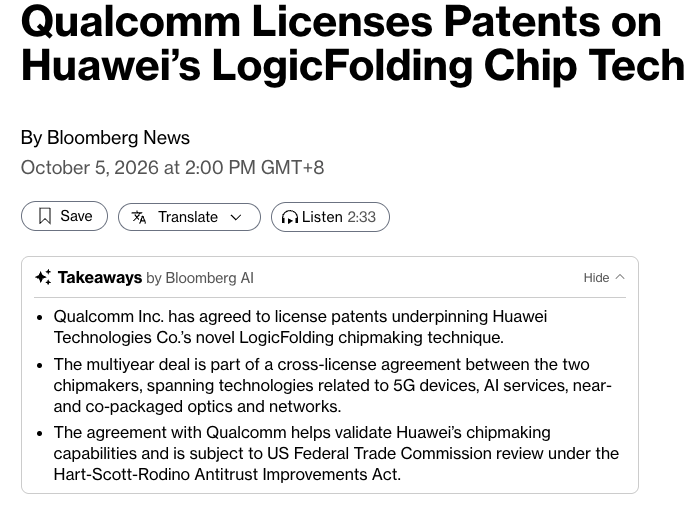
Qualcomm has agreed to a multiyear license of the patents behind Huawei's new LogicFolding chipmaking technique — a rare endorsement from a US chip giant that validates Huawei's homegrown capabilities. The deal is part of a broader cross-license agreement covering 5G, AI services, and co-packaged optics, and still needs US FTC antitrust review. LogicFolding boosts data transmission speeds to work around China's lack of access to ASML's EUV machines, helping Huawei close the gap with TSMC and push into overseas AI markets despite US export curbs.
https://t.co/nN5Argb1p7
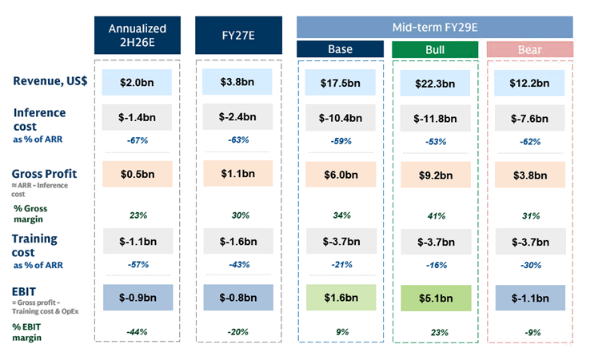
Goldman Sachs’ Ronald Keung and team upgraded https://t.co/Lo160Gn5Nb (Zhipu) from Neutral to Buy, with a revised 12-month DCF-based target price of HK$1,560, down slightly from HK$1,610.
The upgrade reflects a more attractive risk-reward profile after Zhipu’s share price fell 70% from its July peak, reducing its market capitalization from US$120 billion to below US$40 billion. The stock now trades at approximately 12x 2026E year-end ARR and 10x FY2027E ARR, compared with 9x and 6x for MiniMax.
Goldman remains positive on Zhipu’s competitive position among Chinese AI model companies. Zhipu has the highest ARR run rate among its domestic peers and has successfully developed both frontier models and smaller, cost-efficient “flash” models.
Goldman raised its 2026E year-end ARR forecast from US$2.7 billion to US$3.2 billion, above management’s latest US$3 billion target. Key growth drivers include strong token demand and new commercial agreements with Chinese and global hyperscalers beginning in October 2026, which could generate additional high-margin revenue.
Looking ahead, Zhipu’s expanding compute capacity and data flywheel should support further model improvements, particularly through its upcoming GLM-5.5 and GLM-6 releases.
Reflection matters not simply because the US is preparing an open-weight model to compete with China, but because it represents an effort to turn open AI into a business built on NVIDIA compute, open-source tooling, and private enterprise deployment. The next phase of competition will be defined not just by who opens the model, but by who controls the compute, tools, and commercial ecosystem around it.
The model is not confirmed yet
Axios reports that Reflection is preparing an open-weight model competitive with leading Chinese models. But there is still no model name, release date, license, model card, or independent benchmark.
The US has not abandoned open source
The US remains dominant in AI infrastructure and tooling, including PyTorch, vLLM, Megatron, and TensorRT. What it lacks is a frontier model lab willing to release its weights.
The US–China gap is driven by business models
OpenAI, Anthropic, and Google can monetize closed models through APIs. Chinese labs use open weights to gain developers, distribution, adoption, and global influence.
Open weights are not the same as open source
Downloadable weights do not necessarily include training data, training code, data recipes, or post-training pipelines. Reflection’s license will determine how open the model really is.
NVIDIA is a major beneficiary
Open models encourage enterprises to deploy AI on their own infrastructure, increasing demand for GPUs, servers, and inference systems. Model weights may be free; compute is not.
Reflection is selling more than a model
Its real product is an “AI factory”: open models, deployment tools, compute infrastructure, and enterprise services for governments and regulated industries.
Reflection is not simply an “American DeepSeek.”
The next open-AI race will not be decided by who releases weights. It will be decided by who controls the tooling, compute, enterprise deployment, and ecosystem around them.
NVIDIA-backed Reflection is preparing to release a new open-weight AI model expected to compete with top Chinese 🇨🇳 models.
Note: Reflection has signed major compute deals recently with Nebius and SpaceX.
AI itself is egalitarian. But the techniques for using it are not. It's just like how Office was already extremely powerful back in the day—yet the quality of the PPTs people produce still differs enormously.
The Model Isn’t the Agent—and Benchmarks Are Missing Half the Story
The harness can matter as much as the model.
The same weights behave differently across Claude Code, Codex, and OpenCode because each system controls the tools, context, retries, and stopping rules.
This creates harness overfitting.
Train in one interface, and the model may learn that interface’s habits—not the underlying problem-solving skill. Strong performance in one harness may collapse when the model moves elsewhere.
Multi-harness RL offers a better path.
By training inside several real, unmodified harnesses, the model learns to adapt across tool formats and interaction patterns instead of depending on one scaffold.
Reward design matters.
Correctness alone can encourage endless exploration. Adding a small efficiency bonus teaches the model to solve the task and stop. In the experiment, multi-harness training improved accuracy while cutting tool calls by 31%.
The bigger implication:
We should stop evaluating models as isolated objects. Real agent capability belongs to the full model–harness system—and the most valuable models may be those that remain effective when the surrounding system changes.
https://t.co/4tCYoH9OVJ
1/8 Anthropic’s guide to writing effective Agent Skills is essentially a playbook for turning domain knowledge into instructions an AI agent can reliably discover, load, and execute.
Here are the most important lessons:
2/8 Keep the Skill concise.
Assume the model is already capable. Include only the knowledge, rules, and procedures it would not otherwise know. Every unnecessary explanation consumes context that could be used for the actual task.
3/8 Match instruction strictness to task risk.
Use flexible guidance when multiple approaches are valid. Use templates or pseudocode when there is a preferred pattern. For fragile or high-stakes operations, provide exact steps, commands, validation, and guardrails.
4/8 Treat metadata as part of the product.
The Skill’s name and description determine whether the agent discovers and activates it. The description should clearly explain both what the Skill does and when it should be used, using specific trigger terms.
5/8 Design for progressive disclosure.
Keep SKILL.md as the main guide, then move detailed schemas, examples, and documentation into separate reference files. The agent should load only the information relevant to the current task.
Avoid deeply nested references.
6/8 Turn complex tasks into explicit workflows.
Break work into ordered steps and add feedback loops:
Analyze → Plan → Validate → Execute → Verify
For important operations, create machine-verifiable intermediate outputs so errors are caught before changes are applied.
7/8 Prefer tested scripts for deterministic work.
Reusable scripts are more reliable, faster, and cheaper than asking the agent to regenerate code every time. They should handle errors, document dependencies, explain configuration values, and return actionable messages.
8/8 Build Skills through evaluation and iteration.
Start with real tasks and identify where the agent fails without the Skill. Create at least three evaluations, establish a baseline, write the minimum necessary guidance, test across models, and refine based on observed behavior.
The broader lesson: a great Agent Skill is not merely documentation. It is a compact operational system—discoverable, context-efficient, executable, testable, and continuously improved through real-world use.
https://t.co/JWqx9gYvnD
We already flagged this partnership in our AI Weekly. Keep following us — we stay plugged in and bring you the on-the-ground read on this name.
https://t.co/RpOtYLkR5p
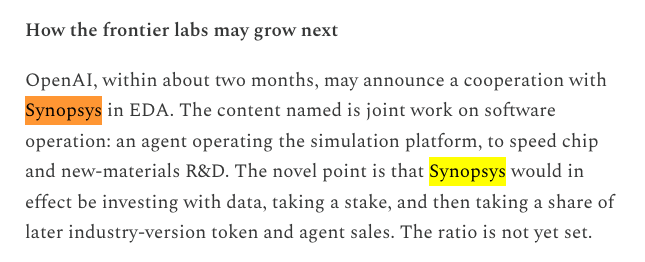
$SNPS & OPENAI PARTNER ON GPT-SYNOPSYS FOR CHIP DESIGN
Synopsys and OpenAI signed a multi-year deal to build GPT-Synopsys, a specialized model that can directly use Synopsys EDA tools for semiconductor design.
The model is being designed to handle tasks like PPA optimization, timing closure and verification, with agents running the tools, interpreting results and iterating on designs for engineer review.
OpenAI will license Synopsys’ EDA tools, while both companies will share revenue and jointly take the product to market.
GPT-Synopsys will run on OpenAI-hosted infrastructure and integrate with Synopsys AI and Synopsys Autopilot.
Early customer engagements are already underway.
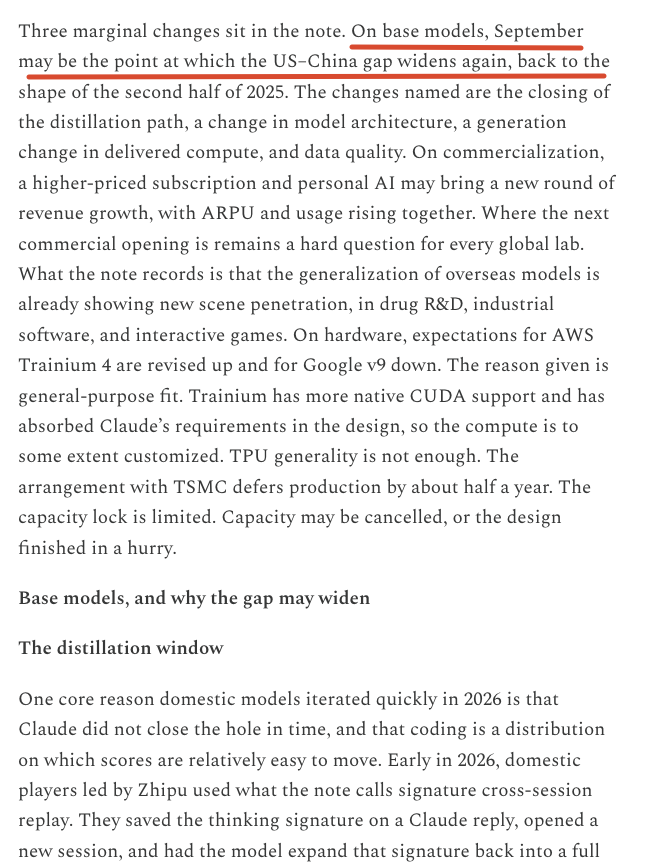
In the TMTB EOD Wrap report, they suggest that as distillation becomes increasingly challenging, the gap between open-source and closed-source models could widen again.
This aligns with a view we discussed earlier in our AI Weekly report.
@TMTBreakout
https://t.co/Cf2dXHdLWu
Nomura OCS/CPO expert call:
1\
OCS demand is moving into a much steeper growth phase.
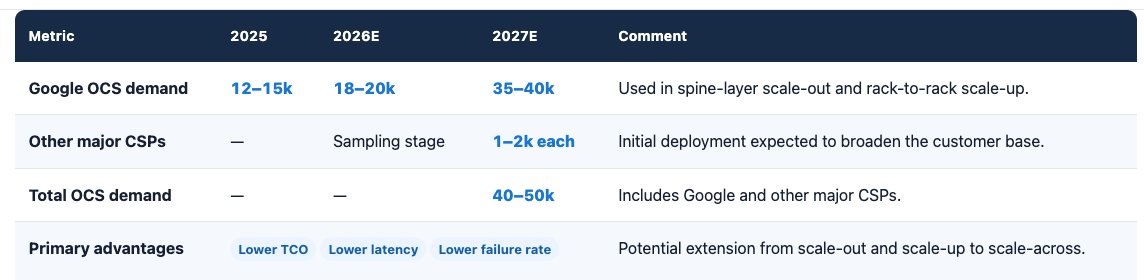
Google demand is expected to rise from 12–15k units in 2025 to 35–40k in 2027. Including other CSPs, total 2027 demand could reach 40–50k units.
For large AI clusters, the appeal is lower TCO, latency and failure rates.
2\
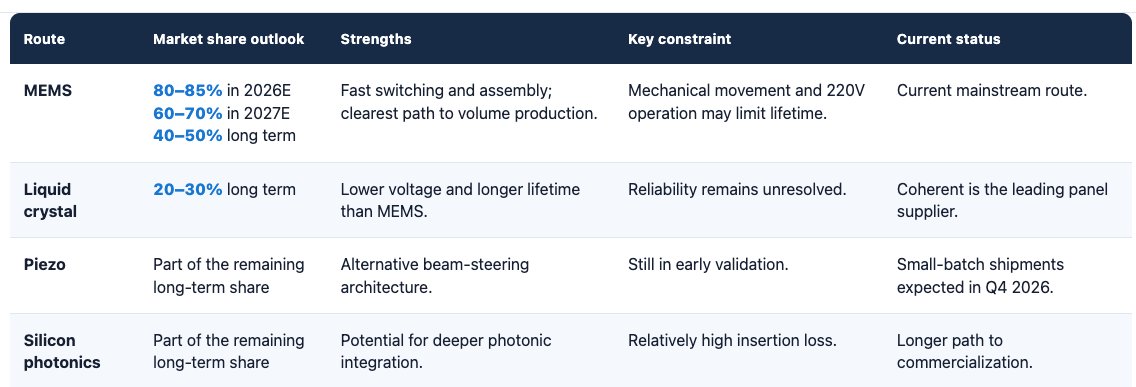
MEMS remains the leading OCS architecture, with an estimated 80–85% share in 2026 and 60–70% in 2027.
But the market is diversifying: liquid crystal offers lower voltage and longer life, piezo is entering validation, and silicon photonics remains a longer-term option.
3\
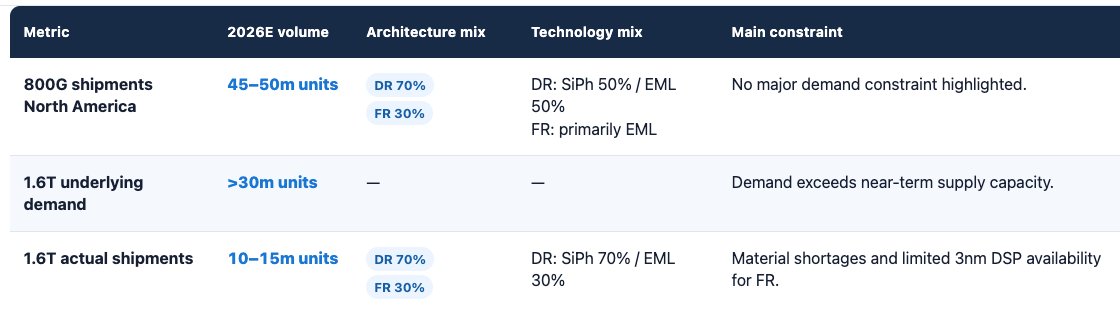
North America could ship 45–50m 800G modules in 2026.
1.6T demand may exceed 30m units, but material shortages could cap actual shipments at just 10–15m. The constraint appears to be supply—not end demand—with DR gaining share amid limited 3nm DSP availability.
4\
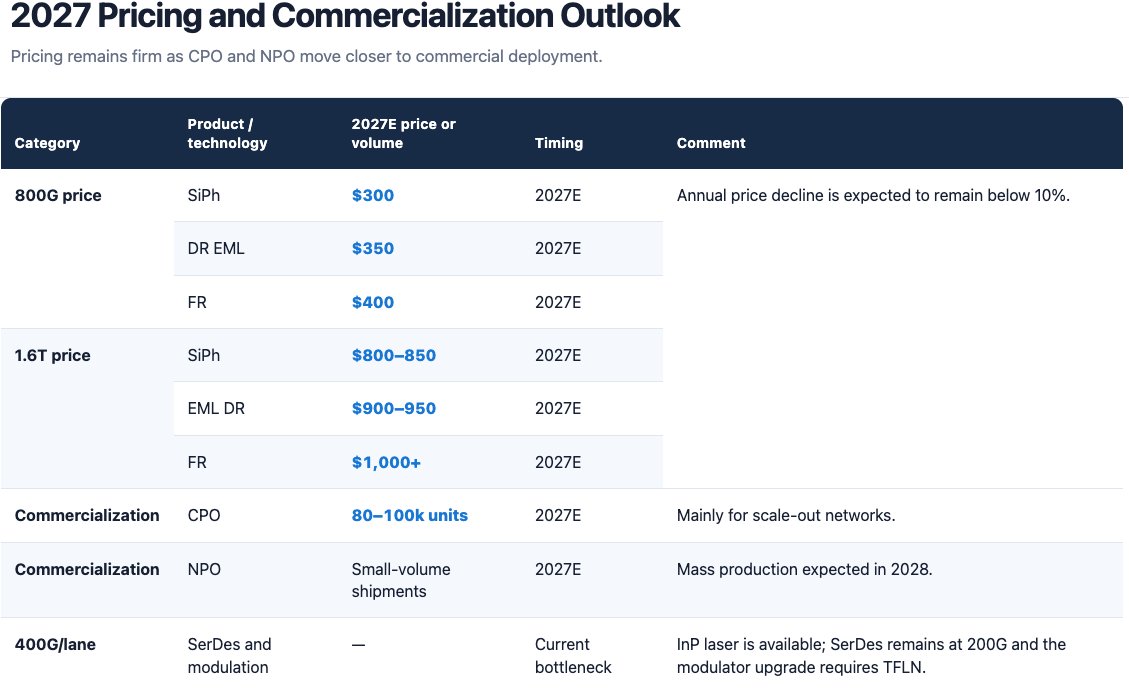
2027 transceiver pricing still looks firm: roughly $300–400 for 800G and $800–1,000+ for 1.6T, with annual declines expected to stay below 10%.
CPO could reach 80–100k units in 2027, while NPO may move from small-volume shipments in 2027 to mass production in 2028.
One underappreciated driver of China’s rapid model iteration in 2026 was a temporary Claude vulnerability—combined with coding being a relatively easy domain for benchmark optimization.
Some Chinese labs reportedly reused Claude’s “thinking signatures” across sessions, turning an anti-distillation mechanism into a way to recover reasoning traces. Anthropic closed the loophole in August 2026.
Since then, Claude-family models have become much harder to distill. Success rates reportedly fell to around 10%, sharply increasing costs. Astra remains technically distillable, but architectural differences limit the quality of the resulting models.
By 2027, leading Chinese AI labs are expected to train on clusters equivalent to roughly 50,000 B300 GPUs, while top North American labs may operate 200,000–300,000-GPU clusters built primarily around GB300 and Rubin.
The gap is not just in cluster size, but also in GPU generation and system performance. On a conservative estimate, this could translate into a 15–20× difference in effective training capacity.
Bottlenecks in Data Center Construction - Lead Time
New high-voltage transmission line construction: 11 years
Grid connection queue: 5.5 years
Power transformer: 2.5 years
Data center construction: 1.5 years
GPU/Server procurement: 0.5 years
$DELL $NVDA $NBIS $IREN $GEV