Looking back, three shifts in how I think and learn had an outsized impact. I wish I had made them on day one.
1. became more data-driven
2. started seeking contrary opinions
3. started learning tougher topics
Start doing this as early as you can; it directly impacts your career growth, acceleration, output, and outcomes. The sooner the better.
Hope this helps.
Whenever the interviewer asks, "Do you have any questions for me?", never skip this question. Here are 5 questions (in order of importance) that I have actually asked the interviewer to understand the company and role better...
1. What keeps you awake at night? [my default]
2. What new tech is the team experimenting with?
3. One company project that you are excited about?
4. An interesting work the team shipped recently?
5. Some company traditions that you enjoy?
Each of the above questions covers one interesting aspect of the role and team. Pick one that is most important to you. I ask one of these questions because I am interested in innovation, culture, growth, dealing with failures, and decision DNA.
Remember, it is important to ask questions in the interview for two reasons: first, it demonstrates your genuine interest in the role, position, and company; second, it allows you to get some super important insights about the role and company.
@khushmanpreet@arpit_bhayani@Harshrwt27 Oh, my bad🥲 but yeah, they mostly do it over the board, with 2-3 folks around them. Noting moves would make less sense here 😅
@arpit_bhayani@Harshrwt27 I disagree. Chess players write down every move (atleast in classical chess), though in top-level tournaments modern boards often record moves for them, skipping manual notation. They are accustomed to it from a very young age. Technology, in chess, has been revolutionary tho.
I wonder if education in India is really helping students when we have to write long essays for simple, straightforward topics, while the world demands crisp and concise communication. 🥴
Thoughts?
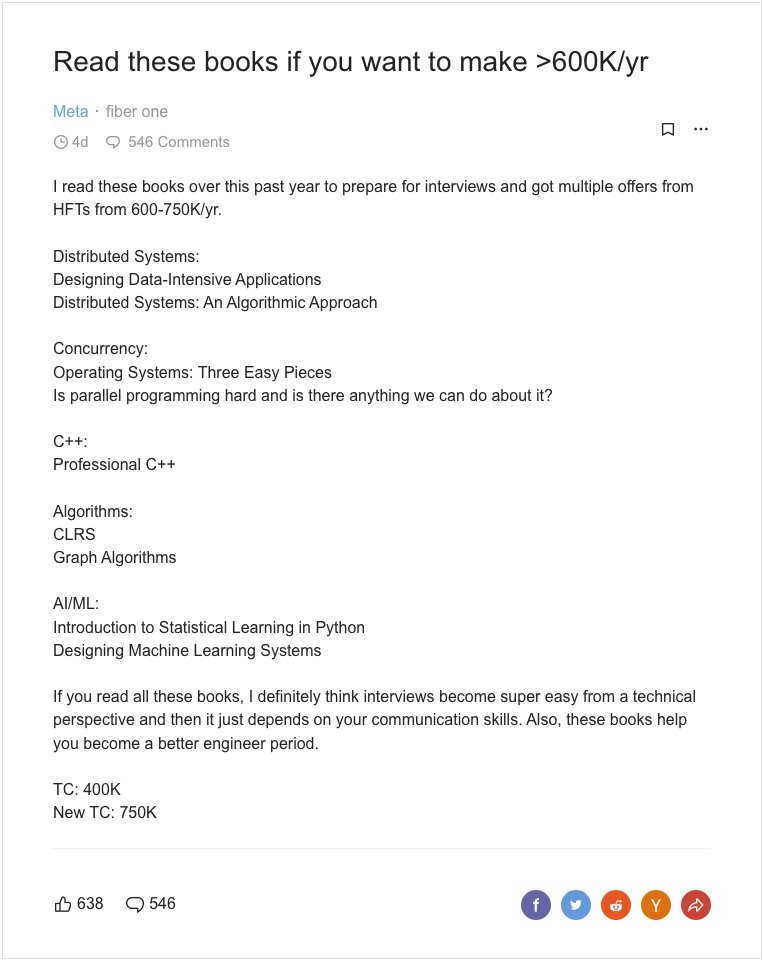
From Blind: Read these books if you want to make >600K/yr
Having read 8/9 books on this list over last 10 years, here's my distilled recommendation on what you should read first without getting distracted to become an actual value multiplier engineer 👇