A Norwegian neuroscientist spent 20 years proving that the act of writing by hand changes the human brain in ways typing physically cannot, and almost nobody outside her field has read the paper.
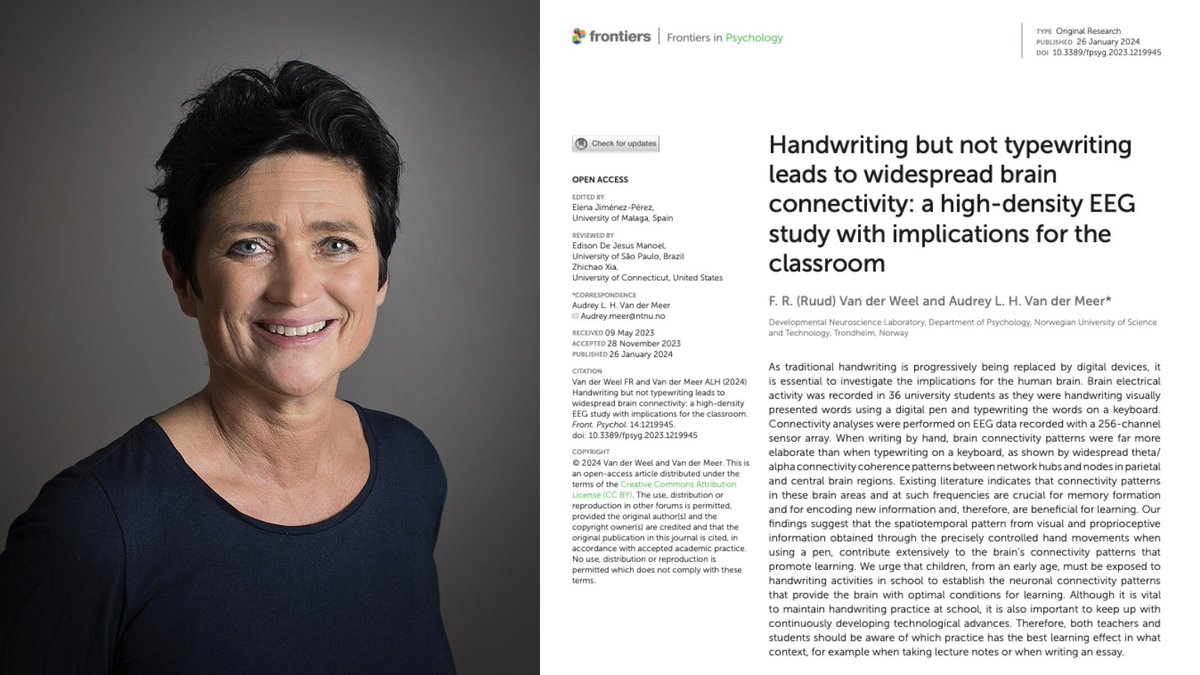
Her name is Audrey van der Meer.
She runs a brain research lab in Trondheim, and the paper that closed the argument was published in 2024 in a journal called Frontiers in Psychology. The finding is brutal enough that it should have changed every classroom on Earth.
The experiment was simple. She recruited 36 university students and put each one in a cap with 256 sensors pressed against their scalp to record brain activity. Words flashed on a screen one at a time.
Sometimes the students wrote the word by hand on a touchscreen using a digital pen, and sometimes they typed the same word on a keyboard. Every neural response was recorded for the full five seconds the word stayed on screen.
Then her team looked at the part of the data most researchers had ignored for years, which is how different parts of the brain were communicating with each other during the task.
When the students wrote by hand, the brain lit up everywhere at once.
The regions responsible for memory, sensory integration, and the encoding of new information were all firing together in a coordinated pattern that spread across the entire cortex. The whole network was awake and connected.
When the same students typed the same word, that pattern collapsed almost completely.
Most of the brain went quiet, and the connections between regions that had been alive seconds earlier were nowhere to be found on the EEG.
Same word, same brain, same person, and two completely different neurological events.
The reason turned out to be something nobody had really paid attention to before her work. Writing by hand is not one motion but a sequence of thousands of tiny micro-movements coordinated with your eyes in real time, where each letter is a different shape that requires the brain to solve a slightly different spatial problem.
Your fingers, wrist, vision, and the parts of your brain that track position in space are all working together to produce one letter, then the next, then the next.
Typing throws all of that away. Every key on a keyboard requires the exact same finger motion regardless of which letter you are pressing, which means the brain has almost nothing to integrate and almost no problem to solve.
Van der Meer said it plainly in her interviews.
Pressing the same key with the same finger over and over does not stimulate the brain in any meaningful way, and she pointed out something that should scare every parent who handed their kid an iPad.
Children who learn to read and write on tablets often cannot tell letters like b and d apart, because they have never physically felt with their bodies what it takes to actually produce those letters on a page.
A decade before her, two researchers at Princeton ran the same fight using a completely different method and ended up at the same answer. Pam Mueller and Daniel Oppenheimer tested 327 students across three experiments, where half took notes on laptops with the internet disabled and half took notes by hand, before testing everyone on what they actually understood from the lectures they had watched.
The handwriting group won by a wide margin on every question that required real understanding rather than surface recall.
The reason was hiding in the transcripts of what the two groups had actually written down.
The laptop students typed almost word for word, capturing more total content but processing almost none of it as they went, while the handwriting students physically could not write fast enough to transcribe a lecture in real time, which forced them to listen carefully, decide what actually mattered, and put it in their own words on the page.
That single act of choosing what to keep was the learning itself, and the keyboard had quietly skipped the choosing and skipped the learning along with it.
Two studies. Two countries. Same answer.
Handwriting makes the brain work. Typing lets it coast.
Every note you have ever typed instead of written went into your brain through a thinner pipe. Every meeting, every book highlight, every idea you captured on your phone instead of on paper was processed at half depth.
You did not forget those things because your memory is bad. You forgot them because typing never woke the part of the brain that would have made them stick.
The fix is the thing your grandmother already knew.
Pick up a pen. Write the thing down. The slower road is the faster one.
LOOK: The US FBI offers a $25,000 (P1.5 million) leading to the arrest and conviction of Filipino Austin Yatco, who uses the username “Hairy Lips" on YouTube and Discord platforms.
The US District Court for the Eastern District of New York in Brooklyn issued a warrant of arrest against Yatco in January after he was charged with conspiracy to produce child pornography, and conspiracy to receive and distribute child pornography.
Yatco and his group, “Greggy’s Cult,” are accused of coercing minor victims into creating child pornography of themselves and then distributing it among the group and to others. | @dexcabalzaINQ
READ MORE: https://t.co/VV6qWclW5F
She was supposed to attend a Daniel Craig film premiere in London that weekend. Instead, she was in a Belfast hospital with 39 separate injuries. She was 29 years old.
Winnie M Li was a Harvard graduate and a George Mitchell Scholar who had co-produced a short film shortlisted for an Oscar. She flew to Belfast for a conference. The day before she was supposed to fly home, she decided to squeeze in a solo hike through a forest park on the western edge of the city. A 15-year-old boy followed her in and raped her in broad daylight.
She later said she went from being a confident woman to a ghost, with PTSD and depression so severe she had to give up her film career. Her attacker was sentenced to 8 years. He was out in 4.
Hiking had been one of her great joys before the attack. It took years before she could do it alone again. In 2009, she forced herself to backpack through Southeast Asia for three months, trying to find the person she used to be. Five and a half years after the assault, she sat down and started writing about what happened to her. Her novel Dark Chapter, built from her own experience, won a major literary prize. Her second novel was fought over by five US publishers and picked by The New York Times for their book club. She co-founded a festival in London dedicated to conversations about sexual violence, and earned a PhD from the London School of Economics studying how survivors use their voices to reclaim their stories.
And every year, on the exact anniversary of the worst day of her life, she goes on a solo hike. In her own words: to remind herself that beauty still exists, and she can enjoy it.
This year was year 18. She walked the Southwest Coast Path along England's coastline, and the photos show her smiling on a cliff in Cornwall. After 17 years of doing this, she said the nausea and anxiety on the anniversary are finally gone. That took 17 years, but she got there.
I have nothing to add to her story except this. If you are in the middle of your own recovery and it feels like it will never end, her 18 years of annual walks say otherwise.
Let me explain what just happened, because most people have NO idea how INSANE this is.
> The WHO officially classified combined oral contraceptive pills (birth control) as a Group 1 carcinogen
> Meaning it's cancer-causing in humans, same category as asbestos & tobacco.
> 13-15% of US women aged 15-49 are on the pill right now
> Up to 80% of sexually active women have used it at some point
> Linked to higher breast + cervical cancer risk (while lowering ovarian/endometrial)
> Millions of young women (teens-30s) flooding their bodies with synthetic hormones daily
> Long-term effects still unfolding: mood, libido, fertility crashes people ignore
> Big Pharma pushed it for decades despite red flags
The industry purposely messed with women’s natural hormones to make a profit
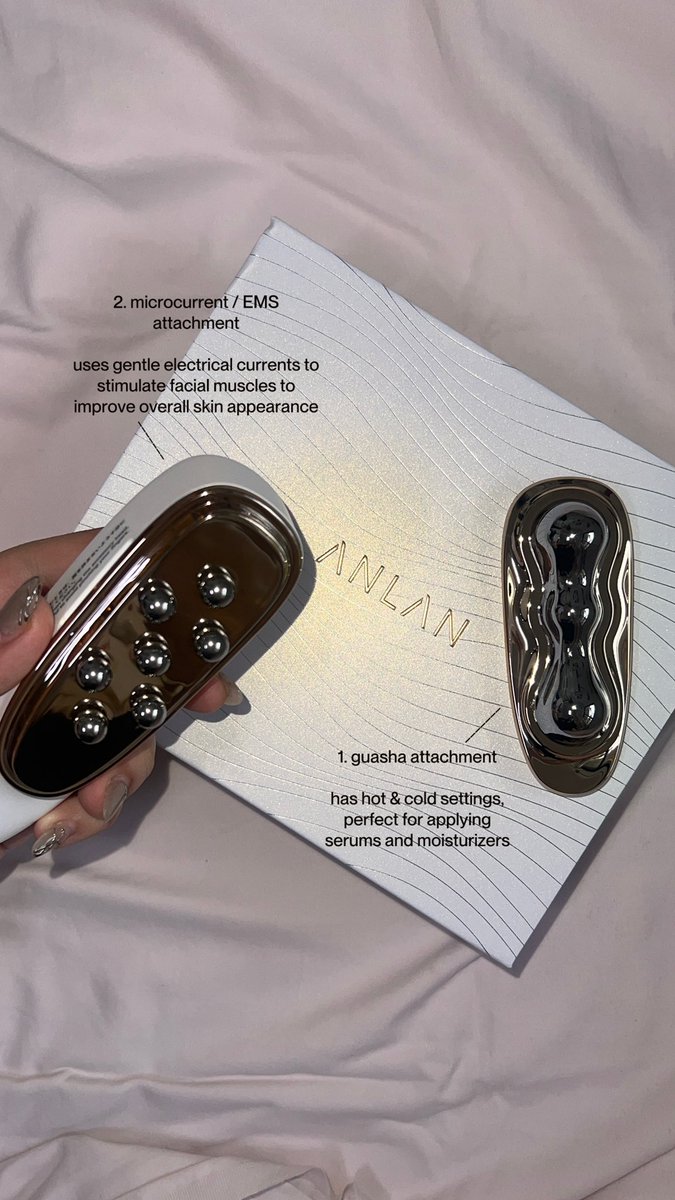
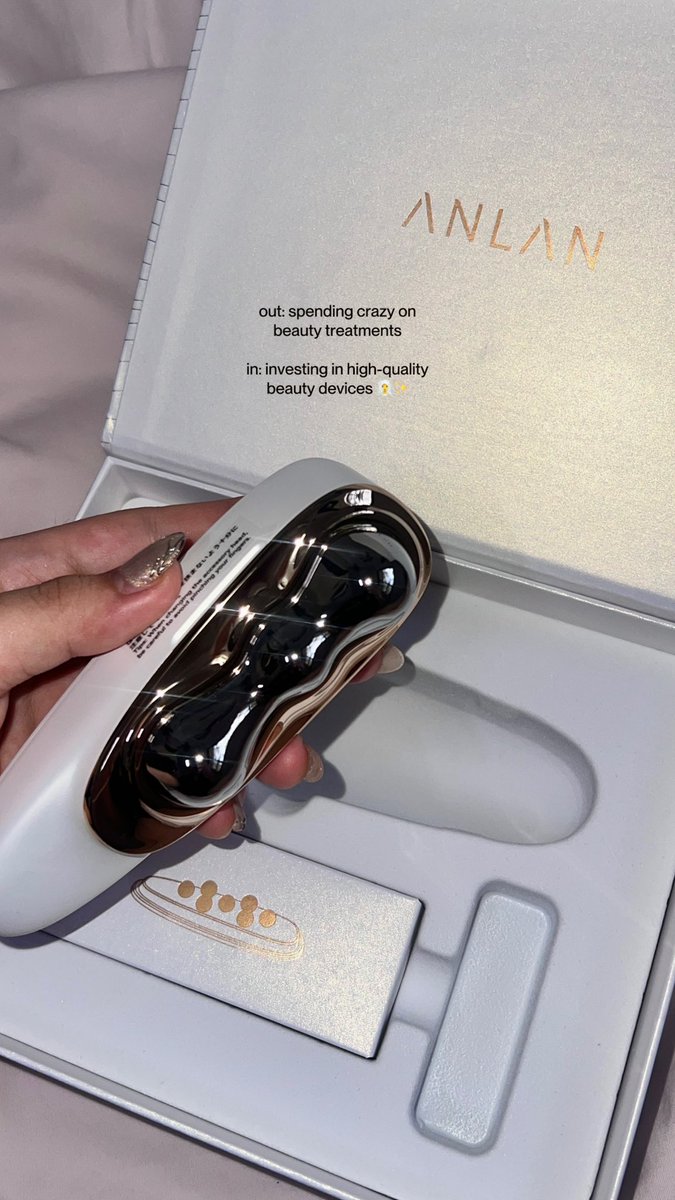
got my first beauty device from ANLAN Philippines — a multi-use guasha tool 🤩 (and it comes with an EMS attachment for this small device that’s literally the same as what they use at clinics)
if you’re in the PH, you can get yours here: https://t.co/t2x1pEw71X