Super disappointing to see this from such a well respected podcast.
1. No one charges 1% in perpetuity.
2. The average investor earns a fraction of what broad markets provide due to a host of behavioral and tactical issues.
Given both of those factors, the chart is meaningless.
I understand why he’s doing it… but wow is the system broken. Add him to the list of standout players Sather has brought to Grand Forks, helped develop, and gotten them paid.
I don’t know how mid-major coaches keep doing it.
March 3, 2020: Things were looking bright for the Northern State Wolves men’s basketball team. They had just claimed their third straight conference tournament championship with an 80-59 win over Mankato behind a combined 67 points from Parker Fox, Mason Stark and Gabe King. The 26-6 Wolves seemed to be hitting their stride, with nine straight wins and were about to play in their third straight Division II national tournament. However, NCAA officials cancelled its tournaments due to spiking Covid-19 numbers. @WolvesAthletics@nsuwolves_mbb Photo
I started my career as financial advisor at the age of 22, in September 1998.
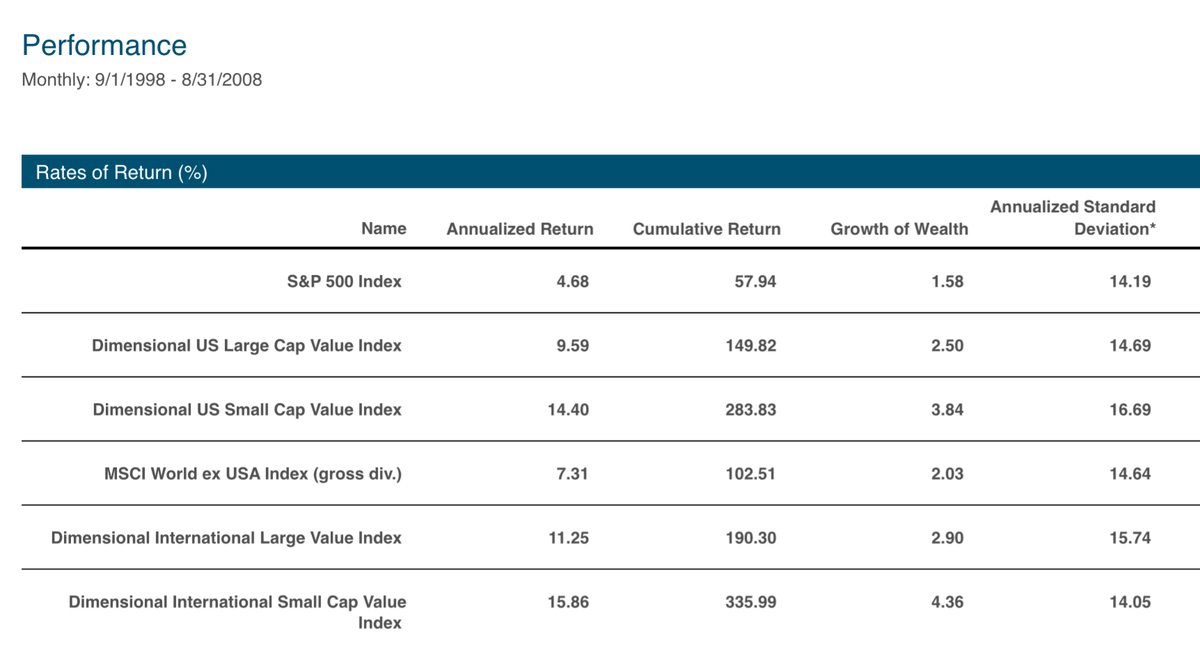
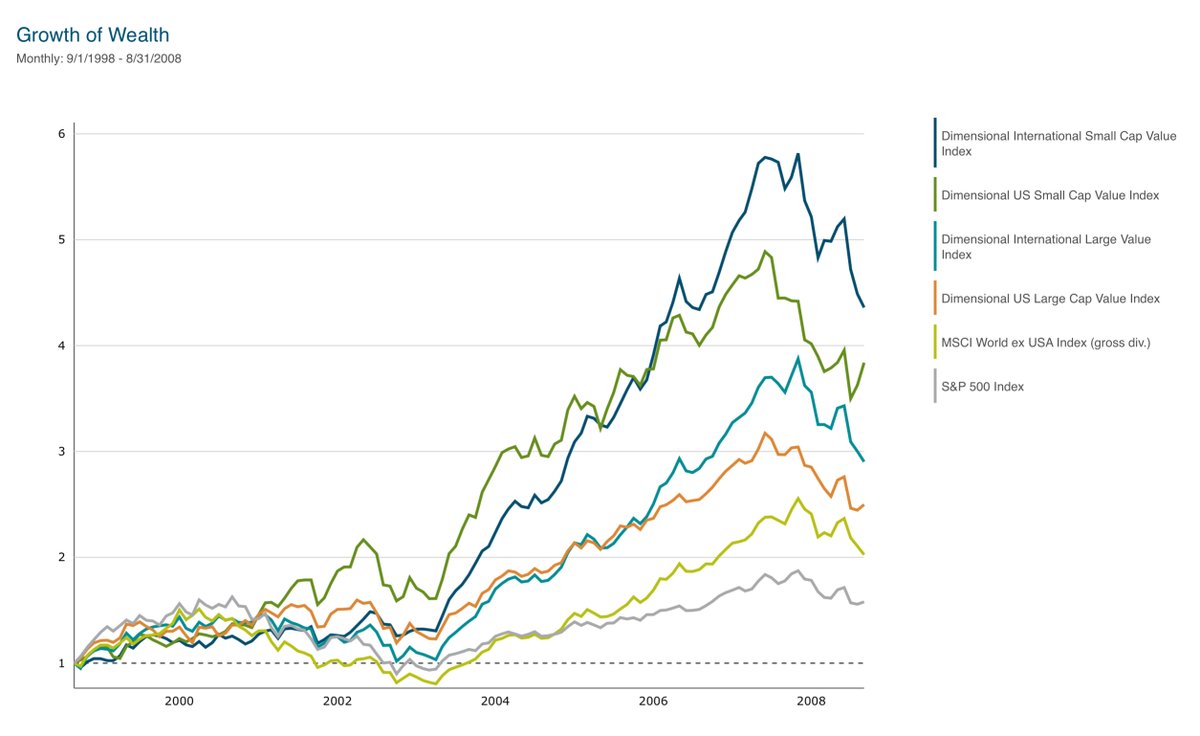
Core stock asset class returns for the first 10 years of my career looked like this.
No wonder I’m always telling people not to put 100% of your $ in the S&P 500 or just US stocks.
Live through a decade like this and you’ll either be a hardened asset class investor for life, or just a glutton for punishment.
When College Football Feels Lost, the FCS Leads the Way. NIL done right, pure, and true, just like FCS.
This weekend is something special. @FCSNationRadio1
https://t.co/mKQNvjJRFN
Capitalism doesn’t assume humans aren’t greedy. It assumes they are and refuses to give them power over others.
That’s the point.
Greed under capitalism is constrained by consent. You only get richer by offering something others voluntarily choose to pay for. If you stop providing value, the money stops.
Greed under collectivism is unconstrained. It’s backed by force. You get resources whether you create value or not, so long as you can moralize need or capture political power.
Also, capitalism doesn’t pit competition against cooperation. Competition is how we discover who can cooperate best. Every successful business is a massive act of cooperation with customers, workers, suppliers, and investors. It just isn’t coerced cooperation.
And the claim that capitalists never give back is empirically false. Private charity, philanthropy, reinvestment, and voluntary aid explode under capitalist systems and collapse under socialist ones.
What you’re really saying is this:
You don’t trust individuals to choose generosity. You trust the state to enforce it.
That isn’t moral. It’s just replacing voluntary cooperation with compulsory obedience.
The insurance carrier controls all of the cards, including the cap rate (maximum index crediting rate) and the interest rate charged on policy loans, which these strategies often rely on in an attempt to achieve the overly optimistic results depicted in policy illustrations.
The policyholder is at the mercy of the insurance company’s positions on these critical factors for *DECADES*, often while extensively leveraged. Another huge unknown is the cost of insurance as you age, which the policy must fund.
Many strategies being marketed rely on “hyper-funding” the policies (using policy loans to overfund the policy with additional premiums). Policy illustrations demonstrate these strategies succeeding on paper with very optimistic assumptions under conditions of high leverage and *zero volatility*.
But that’s not how the world works. In real life, markets don’t achieve “average” performance consistently each year, and interest rates and other costs change over time. By using unrealistic and optimistic assumptions to sell products, insurance companies are *intentionally* hiding the sensitivity of these strategies to market volatility or minor changes in other critical assumptions. The result, in practice, is often disaster to the policyholder in the form of terrible performance, higher than expected costs, costly tax consequences, or policy lapse.
I had the great pleasure of being a part of the @bigten and playing @B1GMBBall for the past four years.
I am just as grateful, if not more, to announce that I am now a College Basketball Analyst for the @BigTenNetwork … Tonight starts my career as a color commentator!
so while we’re dismantling the government can we go ahead and make paper checks obsolete
and maybe simplify employee stock option & crypto tax
and maybe fix the 401(k) rollover system
and maybe increase the $3K capital loss offset that hasn’t been changed since the 70s