@RafaPaez_ No todos tus fans están en Twitter. Di esto en YouTube y verás. Jajaj, un abrazo. Ojalá vuelvas. Nadie hace contenido como el tuyo en Español.
@antoniosarosi Quitar la parte "artística" no es en cierta forma hacer trampa? 🤔 Pues ya los deberes del full stack serían menos, y el gran debate es incluyendo todo.
Y si el frontend es móvil ? Aplica lo del Fullstack? No he visto un Android/iOS dev que sepa backend o viceversa.
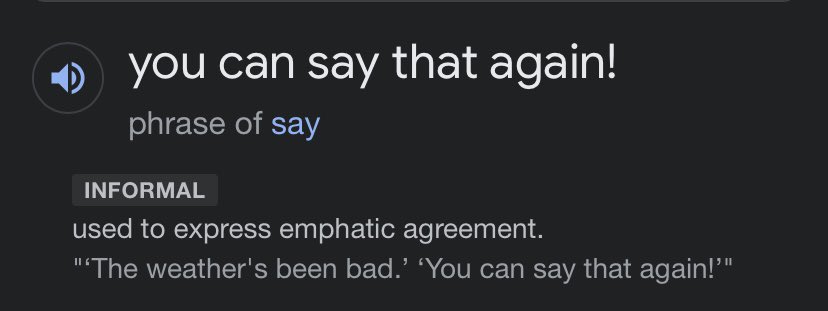
Idiom: You can say that again!
Definition: Used to show that you completely agree with what someone has said.
Example:
+ That’s a wonderful movie.
- You can say that again!
Idiom: The devil is in the details.
Definition: It’s used for saying that something may seem simple, but in fact the details are complicated and likely to cause problems.
Example: See the clip below in the replies👇
@ruchi_twt As an ex-Spotify user, let me answer your question: It depends on what benefits you’re looking for! I was paying $10/month for Spotify and then realized that with $2 more I’d get both YT Music and YT. I consume a lot of YT videos so the ad-less experience is worth that $2 extra!
Idiom: To lose (one’s) train of thought.
Spanish equivalent: Se me fue la paloma / Se me fue la idea.
Example: And then... uhmm... sorry, I lost my train of thought, what was I saying ?
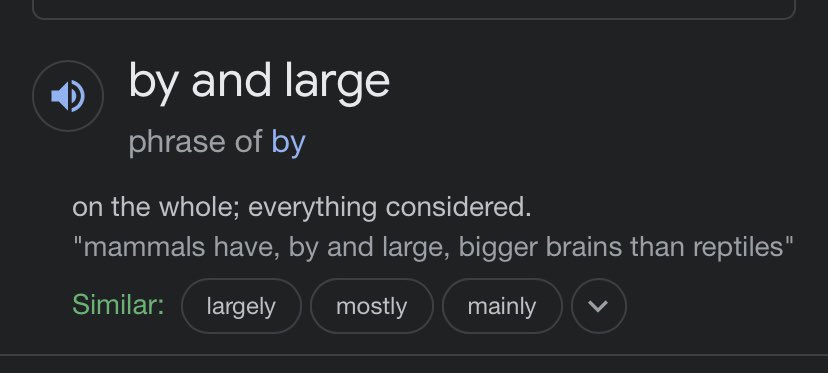
Phrase: by and large.
Definition: In general / On the whole.
Spanish equivalent: En términos generales / En general.
Example: People who work in the tech industry have, by and large, a pretty good salary.
You may already know the phrase “silver lining”, but did you know this...
Proverb: Every cloud has a silver lining.
Meaning: An advantage that comes from a difficult or unpleasant situation.
Spanish (potential) equivalent: No hay mal que por bien no venga.
Have you ever wanted to express “por así decirlo/por decirlo así” in English ? Well, look no further! “So to speak” is here for you!
Example: This arrangement will allow us to eliminate our debt and get back to solid ground, so to speak.
¿Sabías que..
“Stranger things” NO significa “cosas raras” ? De hecho, significa “cosas más raras”, el sufijo -er en el adjetivo “strange” denota el comparativo “más”.
“stranger” por sí solo NO es un adjetivo, es un sustantivo (example: Don’t talk to strangers).