2022: Shraddha Walkar butchered by her boyfriend Aftab Poonawala, pieces scattered.
2025-26: Court permits him to skip hearings due to dental appointment, mental health check & now to take MA Sociology exam.
Gems of our judiciary 🙏🏽
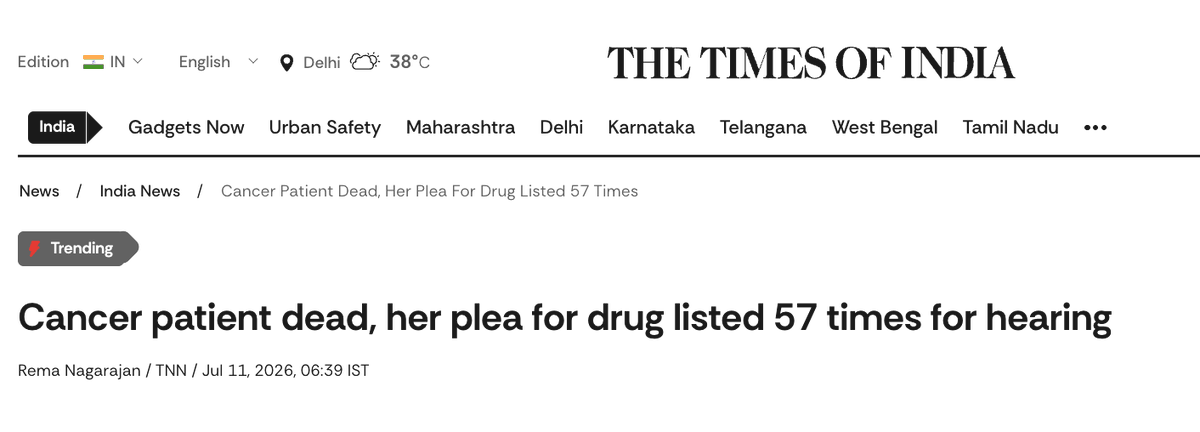
Cancer patient was about to die. She pleaded. Her plea has been listed 57 times. The court has still not heard it. Teesta Setalvad was about to be jailed. She pleaded. Her plea was listed out of turn. The court heard it at midnight.
Cancer patient is dead. Teesta is alive.
Full-scale VIP protection for Shinde Sena thug Corporator Ramesh Mhatre in hospital, even as the 2 Doctors he slapped & punched tell me they are receiving threat calls from his goons and are too scared to return to work.
“I will **** your mother outside.”
With audio, here’s the FULL transcript of the language used by Shinde Sena Corporator Ramesh Mhatre and his goons at the KDMC Hospital on Monday.
True worth of ‘laadki bahin’ to Shinde Sena.
Dear @police_haryana team,
Can we please educate this Thar owner in the next 24 hours in such a way that he mends his ways 🥹 ?? He could have stopped to help.
Car number - HR 98 X 5101
How to avoid such behaviour friends?
#FI
BREAKING ⚠️
Shinde Sena thug Corporator Ramesh Mhatra deemed ‘too ill’ to appear in court in person. Clear VVIP long rope for this shameless coward. Fit to thrash doctors, but ‘too sick’ to appear in court.
62% of Indian resident doctors work more than 36 hours at a stretch. 86% report severe sleep deprivation. 97% earn less than an entry level civil servant. 76% are assaulted while on duty.
We can call ourselves civilised only when we learn to treat our doctors like they treat us.
WHEN A RULING PARTY BECOMES DRUNK ON THE INTOXICANT OF POWER AND ENTITLEMENT.
Shiv Sena (Shinde faction) corporator Ramesh Mhatre allegedly assaulted a female doctor, a gynecologist, and multiple nursing staff members at the Kalyan-Dombivli Municipal Corporation (KDMC)-run Shastrinagar Hospital in Dombivli, Maharashtra, following a dispute over the unavailability of Neonatal Intensive Care Unit (NICU) beds.
THROW THIS CORPORATOR OUT OF THE PARTY AND JAIL HIM.
Ethanol will hurt the BJP electorally, not because of car owners, the are just 8% of the population, but because of bike owners, who make up 60%.
Every issue with a bike, irrespective of whether it's due to ethanol or not, is being blamed on ethanol. Remember that the overwhelming majority of car and bike mechanics are not your voters and, in fact, they hate you and you know why. They are actively telling anyone with any bike issue that it is due to ethanol. Not only does it serve a political purpose, but it is also easy and convincing.
Car and bike dealers are equally happy to lean into this excuse because it completely deflects blame away from the manufacturers and their own service centers. If a part fails prematurely or a vehicle suffers from a chronic engineering defect, blaming ethanol allows dealers to shift the responsibility onto government policy rather than admitting to poor build quality or honoring warranty claims. It gives them a convenient, politically charged scapegoat that customers readily accept, shielding the automotive brands from reputational damage.
It's up to the BJP to smell the coffee. The issue is no longer on Twitter and no longer raised just by English-speaking metro car owners. It has gone to the ground. There is still time to wake up and make corrections.
P.S. I'm not defending ethanol here. It does damage engines and parts. I've been strongly opposing it and will keep doing so. I'm only saying what's happening on the ground. The BJP should do a course correction on ethanol solely because its implementation was wrong and correcting it is only logical. However, since politicians see every controversy from the standpoint of electoral gains and losses, I'm telling them that it will hurt them electorally too.
Vipin Kumar is an Indian construction worker in Romania.
One day, while he was walking near Nicolae Romanescu Park in Craiova, he saw a girl slip through a thin layer of ice and start struggling in the sub-zero water. Her father tried to reach her but became trapped in the broken ice.
Without any hesitation, Vipin used a nearby sledge to slide toward her. When the ice broke beneath him as well, he plunged into the freezing water, managed to grab the child, and held her above the surface for nearly 30 minutes until emergency crews arrived.
Both Vipin and the girl suffered severe hypothermia and were rushed to the hospital, where they received treatment.
Romania granted honorary citizenship to Vipin Kumar for his bravery and for risking his own life to save the girl.
Nowadays, social media is filled with hate against India, and Indians are increasingly being targeted. But when stories like this emerge, they rarely receive the same attention. They are not shared as widely, and somewhere along the way, these stories get buried and forgotten.
People get fined for overspeeding, wrong parking, no seatbelt and many other violations.
But no government official is ever punished for robbing citizens of their basic dignity on the road.
I'm a cardiologist. Something just happened today that I genuinely did not see coming — and it could change the future of preventive medicine more than anything I've written about on this platform.
Midjourney — the AI company that became famous for generating images from text prompts — just announced a medical hardware division and unveiled a working prototype of a full-body scanner unlike anything that's ever existed.
It's called the Midjourney Scanner. And it works like this.
You step into a shallow pool of water. You stand on a platform that slowly descends — about two inches per second — through a ring containing roughly half a million tiny ultrasonic transducers, each the size of a grain of sand. Every one of them acts as both a speaker and a microphone, sending ultrasonic waves through your body from every angle and recording what comes back.
60 seconds later, you step out. The scan is done.
No radiation. No magnets. No claustrophobia. No IV contrast. Just sound, water, and an almost incomprehensible amount of computing power — roughly 2 petaflops processing 17 gigabytes per second of raw acoustic data — reconstructing a 3D map of your entire internal anatomy down to half a millimeter resolution.
Organs. Tissues. Blood vessels. Bones. Muscle. Fat distribution. All segmented by AI in real time.
As a cardiologist who has spent months writing about how the standard screening playbook misses the majority of future heart attacks — this is the technology I've been waiting for without knowing it existed.
Here's why this matters for the future of your heart.
Right now, getting a detailed look inside your cardiovascular system requires either a CT scan (radiation), an MRI (magnets, claustrophobia, 45-60 minutes, $1,000+), or a coronary CT angiogram (radiation, IV contrast, limited availability). These are powerful tools. I order them regularly and they save lives.
But they're reactive. You get them when something is already suspected. They're expensive. They're uncomfortable. And for most people, they happen once — maybe twice — in a lifetime.
Imagine instead: a 60-second scan with no radiation that you could repeat monthly or quarterly. Tracking cardiac structure over time. Watching body composition shift. Detecting changes in organ size, fluid distribution, or vascular architecture before symptoms ever develop. Building a longitudinal dataset of YOUR body that AI can analyze for patterns no single snapshot would reveal.
That's what Midjourney is building toward.
The company plans 50,000 scanners worldwide over six years, with capacity for a billion scans per month. The first location — the "Midjourney Spa" in San Francisco — opens at the end of 2027 with 10 scanners alongside saunas, cold plunges, and a gym. The scan costs a few dollars. The experience is designed to feel like wellness, not medicine.
The technology is built on Butterfly Network's ultrasound-on-chip platform — 40 modules per scanner — combined with Midjourney's own AI segmentation and reconstruction stack. David Holz, the founder, claims the system aims for image quality comparable to MRI in many aspects but at nearly 100x the speed with zero radiation.
Now the caveats — because I'm a physician and the caveats matter enormously.
This is a Gen 1 prototype. About a dozen people have been scanned so far. Current scan time is actually closer to 20 minutes, not 60 seconds — the system is bottlenecked by bandwidth and reconstruction algorithms. The 60-second target is aspirational for future hardware generations.
It is not FDA-cleared for diagnostic use. Midjourney is starting with body composition maps — a category below diagnostic imaging in the regulatory hierarchy. The path from "beautiful 3D body scans" to "clinically validated diagnostic tool that your cardiologist can act on" runs through years of clinical trials, comparative studies against MRI and CT gold standards, and FDA review.
No independent clinical validation has been published. The imaging claims come from Midjourney's own demonstrations. Comparative data against established modalities does not yet exist.
And the privacy implications of full-body internal scans at planetary scale — a billion scans per month — is a conversation that hasn't even started yet.
So I want to be precise. This is not ready for clinical medicine today. It may not be ready for years. Many ambitious medical hardware projects have failed in the gap between prototype and product.
But.
The fact that a working prototype exists — producing real segmented 3D anatomy from sound waves and compute alone — means the physics works. The engineering works. The question is no longer "is this possible" but "how fast can it be validated and scaled."
And if it is validated — if the resolution holds up against MRI, if the AI segmentation proves reliable, if the regulatory path clears — then what we're looking at is the most significant new imaging modality in 50 years.
For my entire career, preventive cardiology has been limited by the fact that seeing inside the body is expensive, slow, uncomfortable, and infrequent. We catch disease late because we image rarely. We image rarely because imaging is hard.
A 60-second, no-radiation, spa-based full-body scan that costs a few dollars would demolish every one of those barriers.
I've written about AI detecting inflamed arteries. About gene editing curing cholesterol. About GLP-1 drugs rewriting metabolic medicine. About cellular reprogramming reversing aging.
This is the missing piece: the ability to see inside every human body, routinely, safely, and affordably — so all of those interventions can be deployed before the disease arrives instead of after.
The company that taught AI to generate images from imagination just built a machine that generates images from the human body.
The future of medicine showed up today from the last place anyone expected.
What an insensitive thing to say. Pathetic attacks in the name of politics, forgetting he's not a politician and has worked his whole life for securing India under many governments.
The man is 81 years old, his job is to use his brains and strategy to keep India secure from multiple threats and project power, in which he has done a commendable job. Like one comment said, it's like attacking Stephen Hawking as incompetent.
@imadimaurya@VaibhavSisinty There is a difference between becoming better at solving problems and independently deciding which problems are worth solving.