If a probiotic never did much for your constipation, the trials back you up.
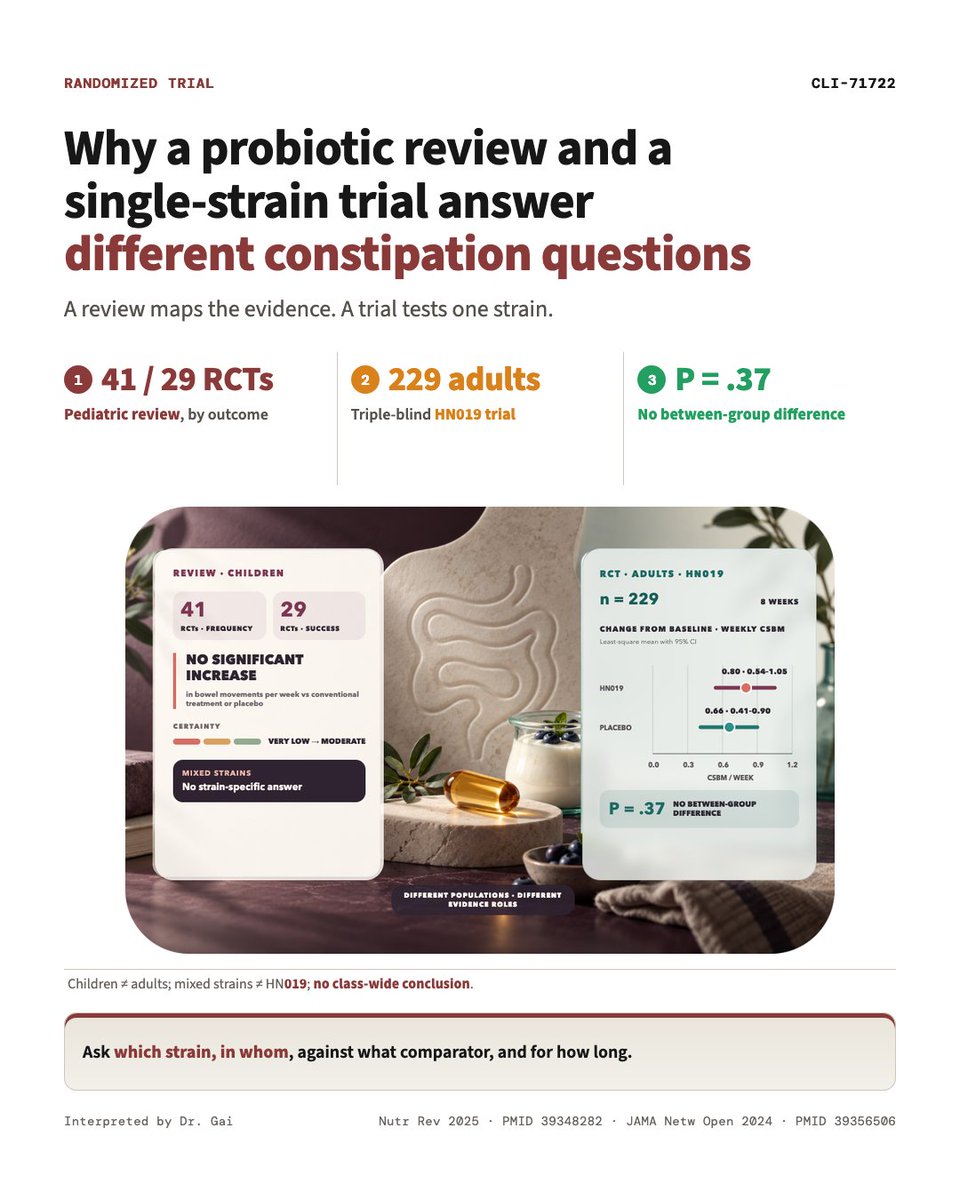
A review of children's studies pooled 41 randomized trials. Probiotics on their own did not raise weekly bowel movements more than placebo or standard laxatives.
In adults, one strain, Bifidobacterium lactis HN019, was tested in 229 people for 8 weeks, triple-blind. Complete spontaneous bowel movements (a full one, no laxative) rose 0.80 a week, versus 0.66 on placebo (P=.37, no real difference). Several authors work at the company behind HN019, and they still published the null result.
As someone who studies the gut microbiome, my takeaway: "probiotic" isn't one thing. Ask which strain, in whom, compared with what, and for how long.
Have you tried a probiotic for constipation, and did you notice any change?
Nutr Rev 2025 · PMID 39348282 · JAMA Netw Open 2024 · PMID 39356506
Vitamin D did not lift mood in depressed teens who were low in it.
92 adolescents with depressive symptoms and vitamin D deficiency took 2640 international units (IU) a day or placebo for 28 days, alongside usual treatment.
Median depression scores on the Beck Depression Inventory-II (BDI-II) started at 28 in both groups and ended at 25 with vitamin D and 23 with placebo.
This analysis tested whether C-reactive protein (CRP), a blood marker of inflammation, changed the effect: 81.5% were below the 3 mg/L threshold, and no consistent interaction was found.
Limits: short, small trial with little inflammation in the sample; the supplement maker provided pills free of charge.
Fixing a deficiency is worth doing on its own merits, but it is not a mood shortcut.
Has anyone ever suggested vitamin D to you for low mood?
European Journal of Nutrition 2026 · PMID 41915083
@NTFabiano The slower cognitive decline didn't seem to come from less amyloid. In those cognitively unimpaired older adults, it tracked with slower tau buildup in the temporal cortex, and that association had already leveled off at 5,001–7,500 steps a day.
@BenBikmanPhD I didn't expect the citrate to move that fast. In the same healthy volunteers, a couple of hours of higher insulin and the urine's own stone inhibitor more than doubled.
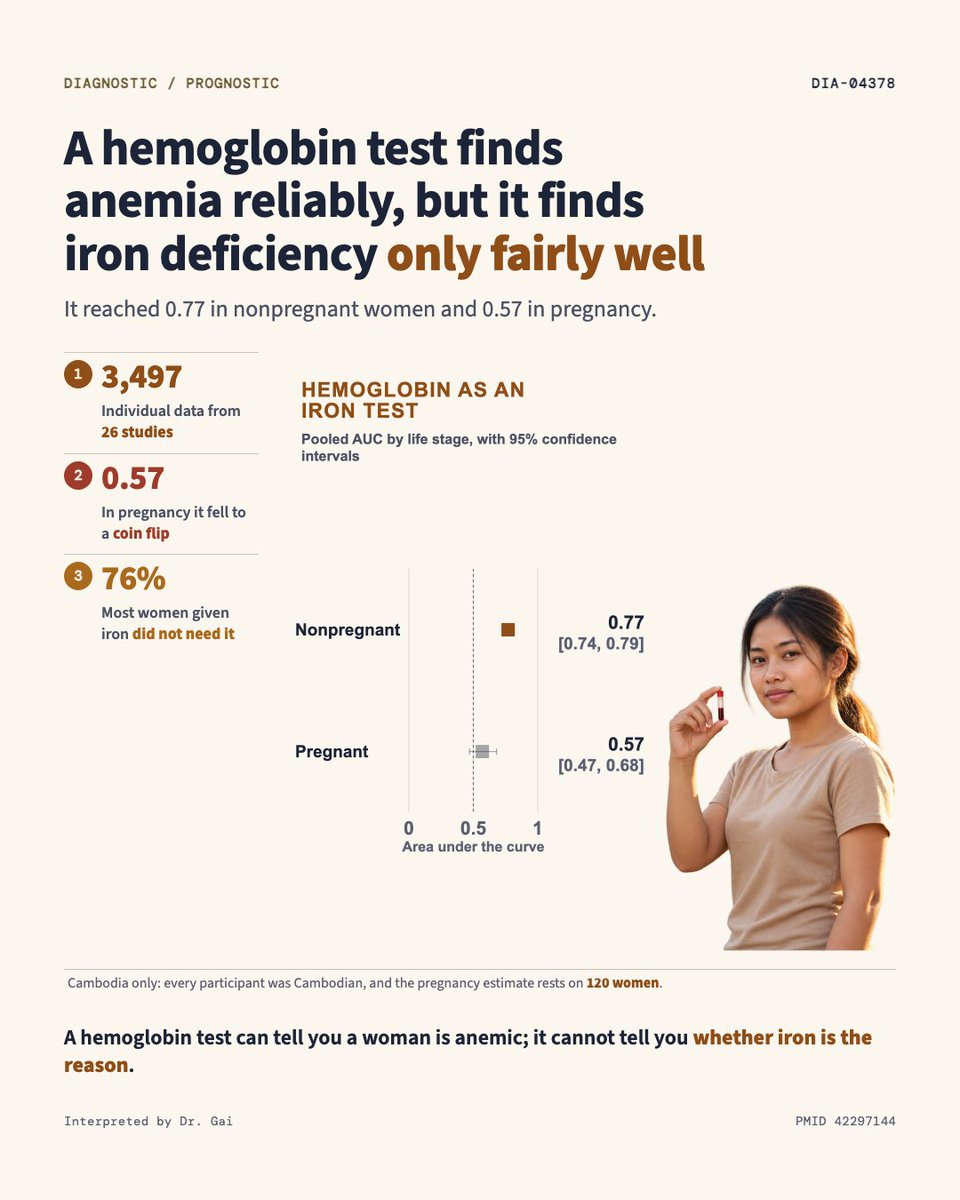
A hemoglobin test tells you someone is anemic. It does a fair job at best of telling you why.
An individual-data meta-analysis pooled 3,497 Cambodian women of reproductive age, a population where inherited hemoglobin disorders are common and iron deficiency is low.
In non-pregnant women, hemoglobin separated iron deficiency with an area under the curve of 0.77 (1.0 is perfect).
In pregnancy it was 0.57, close to a coin flip, based on only 120 women.
About 76% of anemic non-pregnant women actually had enough iron.
Limits: one country with unusual genetics; results may differ where iron deficiency is common.
Blanket iron programs based on hemoglobin alone may treat the wrong cause.
Have you ever had ferritin (stored iron) checked, not just hemoglobin?
Advances in Nutrition 2026 · PMID 42297144
@DocPriyamMD C. diff after dental clindamycin, and it started in the community, not on a ward. In the case this matches, she hadn't been hospitalized in a year, and the isolate was an uncommon ribotype that involved the entire colon.
One large egg has about 147 mg of choline. Only about 8% of US adults reach the recommended intake.
Choline is a nutrient the body uses for cell membranes and the brain messenger acetylcholine. The Adequate Intake is 550 mg a day for men and 425 mg for women.
Using US national survey data (2009-2014):
Only 8.03% of adults met the Adequate Intake.
Egg eaters averaged 525 mg a day versus 294 mg in non-eaters, and 57.3% of egg eaters met the target versus 2.43%.
Limits: intake is estimated from diet recalls, an Adequate Intake is a planning target, not a deficiency diagnosis, and authors report consulting for egg and choline industry groups.
Beyond eggs, other sources include liver, fish, chicken and milk.
How many eggs do you eat in a typical week?
Nutrients 2017 · PMID 28783055
@BenBikmanPhD Ten people with mild Alzheimer's, compared with age-matched controls, and the ketone uptake still looked ordinary, even in the regions already short on glucose. That's a clean finding for a small PET study.
The latest update: vitamin D supplements did not clearly prevent colds and flu.
A meta-analysis of randomized trials pooled 40 trials and 61,589 people for the main comparison.
Odds ratio for acute respiratory infection: 0.94 (95% CI 0.88 to 1.00, p=0.057), now short of significance; the 2021 version had found 0.92.
There was no evidence that the effect differed by age, starting vitamin D level, dose, or dosing schedule.
Serious side effects did not differ.
Limits: a funnel plot suggested small-study bias, and a senior author reports grants from supplement makers outside this work.
Not "useless," just no clear prevention benefit for infections.
Did you start vitamin D hoping to catch fewer colds?
The Lancet Diabetes & Endocrinology 2025 · PMID 39993397
@timspector@KingsCollegeLon What I found surprising is that overall phage diversity didn't even change in IBS. In the Gut paper, 50 viral groups still tracked with the condition, and the usual bacteria-virus pairings looked different. It feels more like a rewired network than one missing bug.
A quick, painless eye scan can spot diabetic nerve damage.
Corneal confocal microscopy photographs the tiny nerves in the clear front of the eye. Researchers compared it with standard clinical and nerve-conduction tests in 89 people with type 1 diabetes and 64 healthy controls.
Corneal nerve fibre length best identified nerve damage: area under the curve 0.88 (1.0 is perfect).
A single cut-off of 14.0 mm/mm² gave 85% sensitivity and 84% specificity.
Two separate cut-offs reached 91% sensitivity or 93% specificity.
Limits: one center, type 1 diabetes only, and cut-offs were derived in the same group.
Nerve damage often starts silently, so early checks matter.
Have you ever had your feet or nerves checked at a diabetes visit?
Diabetes Care 2012 · PMID 22323412
A polyphenol supplement raised cholesterol and improved LDL quality at the same time.
In a placebo-controlled crossover trial, 90 postmenopausal women with mildly high cholesterol took a daily mix of ellagitannins (as in pomegranate and walnuts), resveratrol and soy isoflavones for 8 weeks; 78 completed.
Total cholesterol rose 7%, LDL cholesterol 9.5% and triglycerides 16%.
Oxidized LDL, a damaged form linked to artery plaque, fell.
The oxidized LDL drop was biggest in women whose gut bacteria make equol from soy, up to 65%.
Limits: 8 weeks of blood markers, not heart events; higher lipids and better oxidation point in opposite directions.
Your gut bacteria may decide how you respond to the same supplement.
Do you eat soy foods regularly?
European Journal of Nutrition 2026 · PMID 42371155
After guidance to introduce egg earlier, allergy prevalence was lower. The study cannot say why.
Two Melbourne infant cohorts: adjusted prevalence moved from 9.2% to 7.6%, a 1.6-point difference.
Median age at egg introduction fell from 8 to 6 months across 5,276 and 1,933 infants.
Before-and-after cohorts years apart with no concurrent control can only describe a trend.
JAMA Pediatrics 2026 · PMID 42258202
Your fitness may say more about your risk than your weight does.
I read a 2025 BJSM meta-analysis of 20 prospective studies (398,716 observations) that sorted adults by measured fitness on a treadmill test and by BMI.
Compared with fit people of normal weight, unfit people had about twice the risk of dying from any cause, and that held at every weight: 1.92 at normal weight, 1.82 overweight, 2.04 with obesity.
Fit people with overweight or obesity? 0.96 and 1.11, not clearly different from the reference group.
Limits: these are observational cohorts, many from one US clinic database, so they can't prove cause. The scariest number, 3.35 for heart deaths in unfit people with obesity, lost significance when one study was removed.
Which do you track more often, your weight or your fitness?
Br J Sports Med 2025 · PMID 39537313
@DocPriyamMD So the curry gets blamed for what was really yesterday's dinner. Love that. And since those same TRPV1 receptors line the far end too, the chilli gets one last word on the way out.
@EricTopol@Nature That split is the useful part: same BMI, very different futures depending on whether the extra fat is already straining organs. I wonder how much of that gap a simple waist measurement would catch on its own.
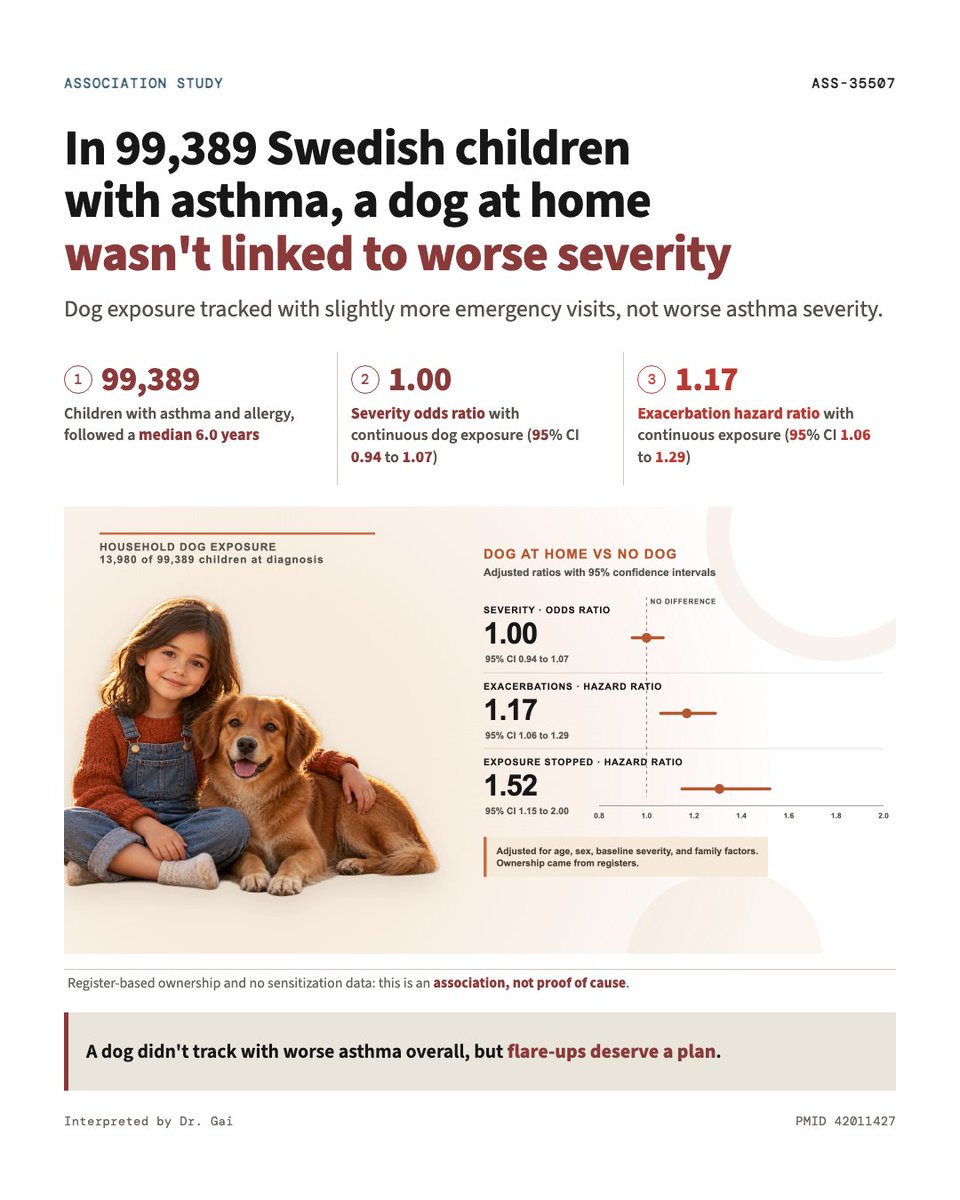
For a child who already has asthma, a family dog was not linked to more severe asthma.
Swedish national registers followed 99,389 children diagnosed with asthma and allergy at ages 3 to 16, until age 19.
Continuous dog exposure: odds of moderate-to-severe asthma 1.00 (95% CI 0.94 to 1.07), no difference.
But flare-ups needing emergency care or heavy reliever use were modestly higher: hazard ratio 1.17 (1.06 to 1.29).
Giving the dog away did not improve outcomes.
Limits: ownership came from registers, allergy to dogs specifically was not measured, and this is an association, not cause.
Does your family have a dog?
Journal of Allergy and Clinical Immunology: Global 2026 · PMID 42011427
@DocPriyamMD Cucurbitacin, I'd bet. Toxic squash syndrome, like the 2018 JAMA Dermatology case from Paris. What gets me is that cooking doesn't break it down, so that bitter first spoonful is the only warning you get.
@BenBikmanPhD It's easy to picture a late shake just sitting there until morning. The striking part is that it was already being absorbed, and the body kept building more protein than it broke down through the night.
@nicknorwitz The after-meal walk may be the practical one. In 8 crossover trials (116 adults), exercise after eating lowered the glucose rise versus sitting and beat a pre-meal workout. Doing it beforehand was no better than sitting. All eight trials were small and high risk of bias.
Even eating full-fat dairy as actual foods left LDL alone. In a 12-week trial, 66 adults with metabolic syndrome ate 3.3 servings a day of milk, yogurt and cheese, and fasting LDL didn't change versus a low-dairy diet. Lipids were an exploratory endpoint, and butter wasn't in the study.