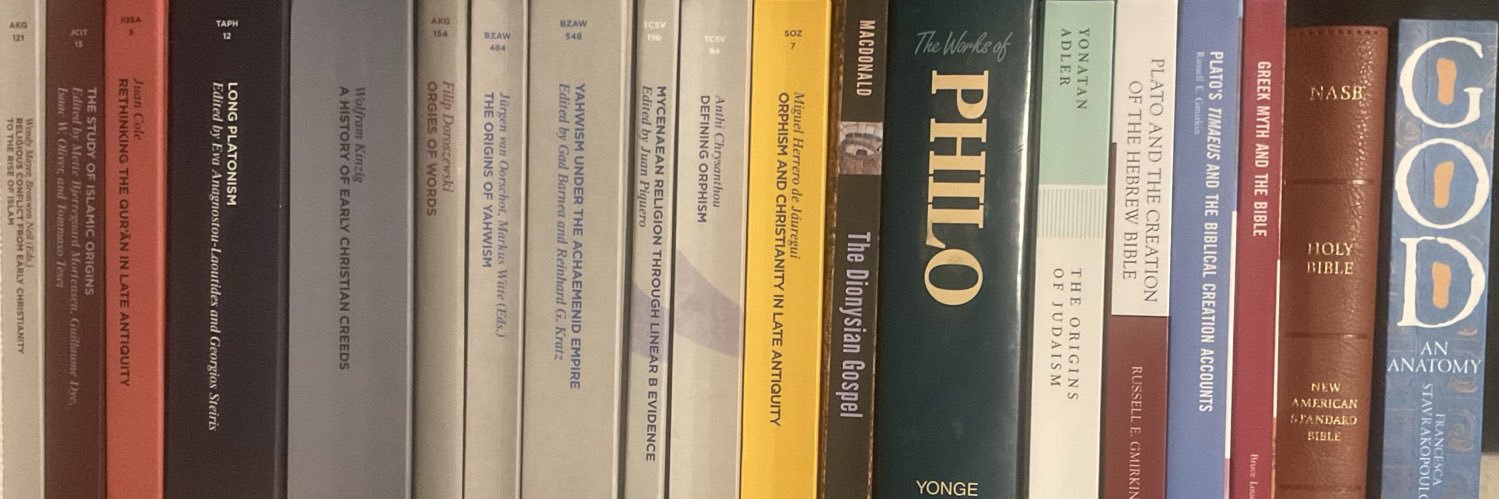
Russell E. Gmirkin dates Genesis.
According to the model first proposed in Gmirkin 2006: 240-56, ruling class elites who created the Pentateuch in ca. 270 BCE drew on Greek historiographical, legal and literary writings found at the Great Library of Alexandria, including the writings of Plato. These educated Jewish and Samaritan educated elites both authored the Pentateuch in its Hebrew original and translated it into Greek (the Septuagint).
I can list scholars
Russell Gmirkin
Gad Barnea
Yonatan Adler
Oded Lipschits
Francesca Stavrakopoulou
Not a Wikipedia page, a historical evidence that dismantles the Bible. These elephantine Jews went down to the Nile after the destruction of Jerusalem. They are continuing their tradition. A tradition with no Abraham, no Moses, no exodus, no Torah. Straight out of Jerusalem. They are not some “distant group of Jews”. The Yahwism they bring to elephantine is the same one in Jerusalem. A Yahwism with No torah, no Abraham, no Moses.
Cooked
“The book of Genesis, like Plato's Timaeus, promoted two complementary visions of the divine realm of the gods: a transcendent philosophical monotheism manifested in the creation of the perfect kosmos at the dawn of time, and a conventional terrestrial polytheism that accommodated the popular beliefs and cults of tradition. Both of these carefully balanced Platonic theological elements were highly innovative..”
“The transition from the original polytheistic cultural matrix of Iron I Judah and Samaria to the reimagining of Yahweh in monotheistic terms in the late Hellenistic and Roman Eras can be traced through six stages, two of which can be documented from evidence in the Pentateuch itself.
1.First Temple Yahwistic Polytheism
Yahweh was the national god of Bit-Humri (Samaria/Israel) from at least the Omride dynasty (884–842 BCE), with satellite temples at Kuntillet ‘Ajrud, Nebo in Moab, and Jerusalem. Early evidence shows a local Yahweh cult that was compatible with worship of other regional gods (El, Baal, Asherah). Remains at Kuntillet ‘Ajrud attest worship of Yahweh and his consort Asherah in a polytheistic environment; Jerusalem’s temple also accommodated Baal and other deities.
2.Between the First and Second Temples
After Judah became independent (730s BCE) and Samaria fell (720s BCE), Jerusalem became a more important center of Yahweh worship. The Iron II temple of “Yahweh of Samaria and his Asherah” was likely destroyed with Samaria; Jerusalem’s temple was destroyed by Nebuchadnezzar. Neither Samaria nor Jerusalem had a Yahweh temple in the Neo-Babylonian period. Archaeological continuity and exilic Judean communities in Babylonia show prosaic polytheism that accommodated other gods without hostility.
3.The Persian Period
A modest Yahweh temple was built at Jerusalem ca. 516 BCE and a larger one on Mount Gerizim ca. 450 BCE. These may have been dedicated exclusively to Yahweh, but there is no evidence they displaced worship of other gods. Yahweh continued to be worshipped alongside other gods in a polytheistic setting in Babylonia, Egypt, Idumea, Samaria, and Judah (including the Elephantine papyri). The idea that monotheism arose from Persian influence lacks contemporary evidence.
4.Hellenistic Era Cosmic Monotheism
No archaeological or epigraphic evidence supports monotheism in Judah or Samaria before the Hellenistic period. The earliest evidence appears in the Pentateuch and related texts best dated to the early Hellenistic era (ca. 270 BCE at Alexandria). Genesis 1–11 adapts Plato’s Timaeus and Critias (eternal creator of the kosmos plus terrestrial offspring). Genesis 1 introduces cosmic monotheism; the rest of Genesis presents a novel benevolent terrestrial polytheism.
5.Combative Yahwistic Monolatry
Exodus–Joshua rejects the benevolent terrestrial polytheism of Genesis in favor of equating the local patron god Yahweh with the creator of the universe and opposing the gods of the nations. These books were written around the same time as Genesis (ca. 270 BCE) but from a radically different perspective, indicating a clash of agendas among the authors of the Hexateuch.
6.Yahwistic Terrestrial Monotheism
True monotheism that denies the existence of other gods first appears in Second Isaiah (ca. 270–185 BCE) and then in Apocrypha and Pseudepigrapha from ca. 175–150 BCE onward. This became the monotheism for which Jews were known (Tacitus). It sometimes tried to align with Greek philosophical monotheism (e.g., Letter of Aristeas) but more often rejected other gods as fallen angels or demons (Enoch literature, Dead Sea Scrolls). This was a combative, nationalistic monotheism, not Plato’s philosophical model that still recognized a pantheon of lesser benevolent gods.
- Russell E. Gmirkin, Plato’s Timaeus and the Biblical Creation Accounts
Jews were worshipping Yahweh and his consort Asherah. They have a temple of Yahweh in Elephantine. No abraham, no Moses, no Torah.
The Bible created an anachronistic narrative, with the Pentateuch invented in the 3rd century bce, Yahweh’s theological framework is made up by people. He is not real.
Who said “widespread”? Well you did sir.
And then you had no idea that the current consensus was that Torah was not enforced as law in Judea-Israel until the 2nd century BCE.
And now you’re whining about me being direct with after you gaslit me in this thread and tried to tell me you “read the scholarship” and that you have PhD and specialize in this subject.
Do you not understand how extremely ignorant and douchey you came off in this encounter?
Read the entire thread again and reflect. Update your scholarship on this and do better as public scholar.
@DrDavidMiano Nope. That’s false. The consensus is that Torah was not enforced as law in Israel or Judah until the Hasmonean period.
Read Yonatan Adler’s “Origins of Judaism” maybe to get introduced into the discussion and don’t speak on subjects that you don’t study.
Outside of the Bible — which we know is heavily redacted in the Persian and Hellenistic period — therefore is not useful here, because it’s begging the question and assuming the thing in question, what evidence do you have for ANYONE observing Torah?
There is none.